

Perovskite solar cells have emerged as a promising technology for renewable energy, and now a German research team has found an unexpected source of lead: 17th-century musket bullets. The Helmholtz Institute Erlangen-Nürnberg has developed a process to convert these historic bullets into high-purity lead iodide for perovskite solar cells, addressing a key supply chain challenge.
This breakthrough could help scale up perovskite solar technology, which has already achieved a certified laboratory efficiency record of up to 26%. The innovation tackles the need for sustainable, high-purity lead iodide, a critical component that has been difficult to produce without toxic and resource-intensive methods.
Find Original Home Decor sparking conversation at Grand Goldman Shop.

Why Perovskite Solar Cells Need High-Purity Lead Iodide
Perovskite solar cells are seen as a major leap forward in solar technology, offering higher efficiencies and lower manufacturing costs compared to traditional crystalline silicon cells. However, their widespread deployment requires a steady supply of lead iodide with exceptional purity.
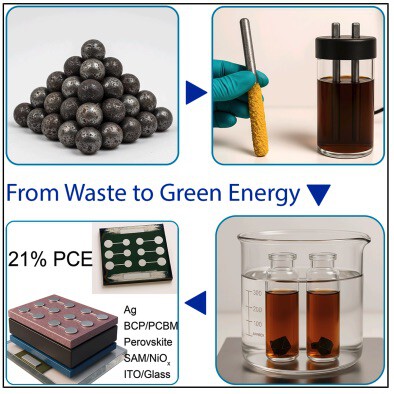
Lead is a toxic element, and its mining and refining pose environmental and health risks. Recycling lead to the purity levels needed for solar cells is technically challenging and often involves harsh chemicals and large amounts of water. The German team's method offers a cleaner alternative.
From Battlefield to Solar Farm: The Upcycling Process
The researchers devised a two-step upcycling process that transforms old musket bullets into solar-grade lead iodide. First, they use a non-aqueous electrochemical route to dissolve the lead from the bullets. Then, they purify the solution through monocrystal crystallization, a technique that yields highly pure lead iodide crystals.
This approach contrasts with conventional methods that rely on strong acids and generate significant aqueous waste. By avoiding water-intensive steps, the process is more environmentally friendly and could be scaled up for industrial production.
Proving the Concept with Real Bullets
To demonstrate the robustness of their method, the team used actual musket bullets from the 17th century. These bullets, recovered from historical sites, provided a real-world test of the upcycling process. The resulting lead iodide was then used to fabricate perovskite solar cells, which showed high performance.
This proof-of-concept highlights the potential of upcycling historical lead sources, turning what might be considered waste into valuable material for clean energy technologies.
Key Takeaways from the Breakthrough
- Efficient upcycling: The two-step process converts lead from bullets into high-purity lead iodide for solar cells.
- Sustainable supply: It reduces reliance on primary lead mining and offers a recycling pathway for lead waste.
- High performance: Perovskite cells made from this lead iodide achieved competitive efficiencies.
- Environmental benefits: The method avoids strong acids and large water volumes, minimizing ecological impact.
- Scalability potential: The process could be adapted for industrial-scale production of lead iodide.
Comparing Lead Iodide Production Methods
| Method | Key Features | Environmental Impact | Purity Level |
|---|---|---|---|
| Traditional acid-based | Uses strong acids, large water volumes | High waste, toxic byproducts | High, but energy-intensive |
| Electrochemical (new) | Non-aqueous, two-step upcycling | Lower waste, no strong acids | Very high (monocrystal) |
| Primary mining | Extraction from ore | Significant land and energy use | Variable, requires refining |
What This Means for the Solar Industry
The solar industry is rapidly expanding, with perovskite cells poised to play a major role. However, concerns about material sourcing and toxicity could hinder adoption. This upcycling approach addresses both by providing a sustainable source of lead iodide and reducing the need for new mining. The background to this story is set out in Perovskite Solar Cells Break Bottleneck with 10-Minute Vacuum Process. A related thread runs through Transparent Perovskite Solar Cells Generate Power Even in Shade.
Moreover, it opens the door to using other lead-containing waste streams, such as old batteries or construction materials, as feedstock for solar cell production. This circular economy approach could make perovskite solar more environmentally sound. Earlier coverage in Turn a Chair into a Stool: Upcycling DIY Guide shows how the argument developed. A closer look at the same subject appears in Energy Utilities: latest articles.
While the process is still in the lab, the researchers are optimistic about scaling it up. The next steps involve optimizing the electrochemical and crystallization steps for larger volumes and exploring continuous-flow systems. Anyone following the wider picture can start with Agrovoltaics in Mexico: Solar Energy and Agriculture Combined. The same theme surfaces in Solar Panels on Farms Double as Cow Shade and Clean Energy, which takes a different angle.
FAQ
What are perovskite solar cells?
Perovskite solar cells are a type of thin-film solar cell that use a perovskite-structured compound as the light-harvesting layer. They offer high efficiency and low manufacturing costs, making them a promising alternative to silicon cells.
Why is lead iodide important for perovskite solar cells?
Lead iodide is a key precursor in the most efficient perovskite solar cells. High purity is essential to achieve high performance and stability, but producing it sustainably is challenging.
How did the researchers upcycle musket bullets?
They used a two-step process: first, a non-aqueous electrochemical method to dissolve lead from the bullets, followed by monocrystal crystallization to purify the lead iodide. This avoids harsh acids and large water volumes.
Can this process be scaled up for industrial production?
The researchers believe the method is scalable, but further work is needed to optimize the process for larger volumes and continuous operation. The team is exploring ways to adapt it for industrial use.
Browse the Shop
 Acacia frida deluxe solid wood bed frame |
Bedroom bench |
Bed chest drawers |
Lingerie dresser |
Frame base |
Mirror with jewelry storage |
30 Bathroom Vanity |
Memory foam queen mattress |
Mattresses for back pain |
Nightstand set of 2 |
Grand Goldman Shop |
Civil Lawyer
Deutschland Trikot WM 2026







