

The COVID-19 pandemic exposed how little we truly understand about the sense of smell. While we have had detailed maps of vision, hearing, and touch for decades, the olfactory system remained a biological black box. Now, a team of researchers at Harvard has drawn the first comprehensive map of how smell is organized in the nose, and the findings are reshaping our understanding of this mysterious sense.
Why Smell Has Been So Hard to Map
Unlike other senses, the olfactory system is staggeringly complex. A mouse's nose contains over a thousand different types of odor receptors and roughly twenty million neurons. This biological chaos has frustrated scientists for years, making it nearly impossible to predict how a given odor molecule would be detected.
Find Original Home Decor sparking conversation at Grand Goldman Shop.

The challenge was not for lack of effort. Researchers have long known that each olfactory neuron expresses just one type of receptor, but how those neurons were arranged in the nasal cavity remained unclear. The Harvard team's breakthrough was to show that this arrangement is not random at all.
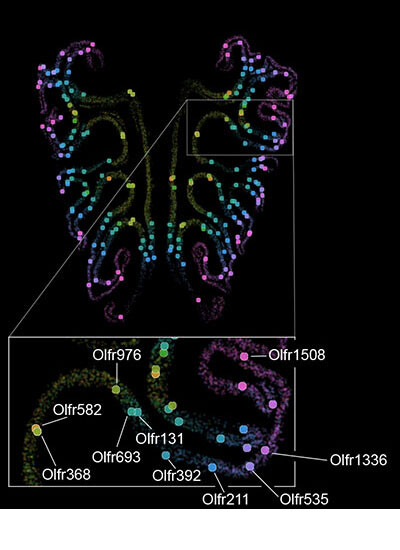
The Discovery: A Spatial Code in the Nose
What the researchers found is that olfactory neurons are organized into overlapping bands that run from the top to the bottom of the nasal cavity. Each band is defined by the type of receptor the neurons express, creating a spatial code that is consistent across all animals studied.
This pattern is virtually identical in every species examined, suggesting an ancient and highly conserved biological architecture. In other words, the nose has its own internal GPS, with each neuron knowing exactly where it belongs.
A Mirror in the Brain
Perhaps most surprising is that this banded arrangement in the nose directly mirrors the map of the olfactory bulb in the brain. The position of a neuron in the nasal cavity determines precisely which zone of the brain it will send its signals to.
This topographic continuity means that the brain receives smell information in a highly organized way, preserving the spatial relationships established in the nose. It is as if the nose and brain share a common coordinate system.
Why This Matters for COVID-19 and Smell Loss
The COVID-19 pandemic brought sudden attention to smell loss, with millions reporting anosmia or parosmia. Yet the underlying mechanisms remained poorly understood. This new map provides a crucial framework for understanding how viruses and other factors can disrupt the olfactory system.
Because the spatial code is so precise, damage to specific regions of the nasal cavity could explain why some people lose the ability to detect certain smells while others remain unaffected. It also opens avenues for targeted treatments and rehabilitation strategies.
- The olfactory system has over 1,000 receptor types, making it far more complex than other senses.
- Olfactory neurons are organized in overlapping bands from top to bottom of the nasal cavity.
- This spatial code is conserved across species, indicating its evolutionary importance.
- The nasal map mirrors the brain's olfactory bulb, creating a continuous topographic system.
- This research could lead to better understanding and treatment of smell disorders, including those caused by COVID-19.
How the Map Was Built
The Harvard team used advanced imaging techniques to visualize the distribution of receptor types across the nasal cavity. By labeling individual neurons and tracking their projections, they were able to reconstruct the three-dimensional organization of the system.
The resulting map reveals that neurons with the same receptor type cluster together in bands, but these bands overlap extensively. This overlapping arrangement ensures that each odorant can activate multiple receptor types, enabling the brain to distinguish a vast array of smells. The background to this story is set out in Why Do Older People Smell Different? The Science of 2-Nonenal. A related thread runs through Download Offline Maps for the 2026 Solar Eclipse on Mobile. Earlier coverage in Energy Utilities: latest articles shows how the argument developed.
| Sense | Mapping Status | Key Complexity |
|---|---|---|
| Vision | Well-mapped (retinotopic map) | ~1 million optic nerve fibers |
| Hearing | Well-mapped (tonotopic map) | ~15,000 hair cells per cochlea |
| Touch | Well-mapped (somatotopic map) | Various mechanoreceptors |
| Smell | Newly mapped (spatial code) | ~1,000 receptor types, 20 million neurons |
What This Means for the Future of Smell Science
This discovery is more than an academic milestone. It provides a foundation for understanding how smells are encoded, how the brain interprets them, and what goes wrong in disorders like anosmia. It also raises intriguing questions about how this spatial code develops and whether it can be rewired after injury. A closer look at the same subject appears in Octopus Arms Have Their Own Brains: The Science of Distributed Intelligence. Anyone following the wider picture can start with New Island Discovered in Antarctica's Danger Zone Near Joinville. The same theme surfaces in Colombia Loses Cerros de la Plaza Glacier After Decade of Satellite Monitoring, which takes a different angle.
For the first time, we have a coherent framework for studying smell that parallels the maps we have for other senses. The nose's own Google Maps is finally here, and it is already changing the way we think about one of our most underappreciated senses. Context on how this played out before sits in Chinese Team's CO2 Power Plan for Mars Colonization. A companion piece, The Nose's Own Google Maps: How We Finally Mapped Smell, approaches the same subject from another angle.
FAQ
What did the Harvard researchers discover about smell?
They discovered that olfactory neurons are organized into overlapping bands in the nasal cavity, creating a spatial code that mirrors the brain's olfactory bulb. This arrangement is consistent across species.
Why is this discovery important for COVID-19 patients?
It provides a framework for understanding how smell loss occurs and why some people are more affected than others. It could lead to targeted treatments for smell disorders.
How does the nose's map compare to other senses?
Unlike vision and hearing, which have well-established maps, the olfactory system was unmapped due to its complexity. This new map brings smell in line with other sensory sciences.
What are the practical applications of this research?
It could improve diagnosis and treatment of smell disorders, enhance our understanding of how smells are processed, and inspire new technologies in odor detection and virtual reality.
Browse the Shop
 Acacia frida deluxe solid wood bed frame |
Bedroom bench |
Bed chest drawers |
Lingerie dresser |
Frame base |
Mirror with jewelry storage |
30 Bathroom Vanity |
Memory foam queen mattress |
Mattresses for back pain |
Nightstand set of 2 |
Grand Goldman Shop |
Civil Lawyer
Deutschland Trikot WM 2026







