

Translated from “Far da sé n.538 – August/September 2024” by Nicla de Carolis. Who doesn’t love a load-bearing wall with a stone or exposed brick arch? In our stunning country, we have many buildings with these features, looking beautiful even without furnishings. But the reality is different: over 70% of homes in Italy were built after World War II, with reinforced concrete pillars and hollow brick perimeter and interior walls. So, interiors often have nothing structurally beautiful to save, and over time, room division needs change. Once partitions are demolished—not exactly a painless operation—the system now rightly chosen for rebuilding is dry construction: in a nutshell, gypsum boards screwed onto a steel framework. Dry construction is commonly summed up with the word “drywall,” referring to the board invented by the Gypsum Company US (USA, 1916) and arriving in Italy fifty years later. Once viewed with suspicion due to distrust of one of its materials—paper—today it is not only fully absolved but recognized as indispensable in renovations and new builds, both private and public.
Advantages of the Drywall System
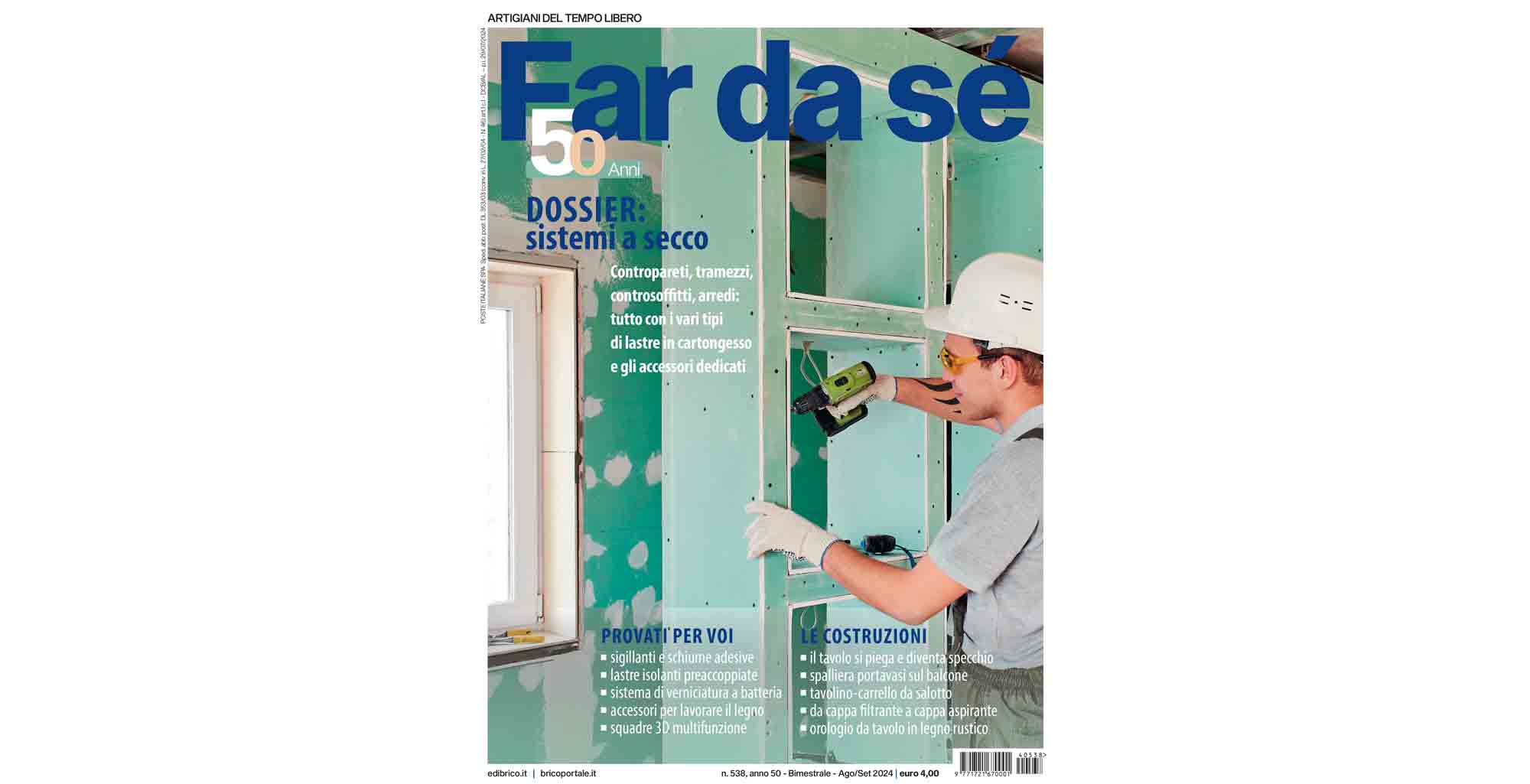
The benefits are clear: material lightness, no mortar mixing, no hauling heavy bricks or bags of bonding material. Plus, it’s easy to cut boards and profiles to size, simple to fasten everything with screws, and after careful joint taping and sanding, the wall is already smooth, ready for primer and paint without waiting for plaster layers to dry. And if you need to install outlets or switches in the partition, no chasing into masonry is required—just run the conduit between boards, where you can also add insulation.
Find Bleeding Edge Supplements at Scandalous Prices on iHerb.

What You’ll Find in This Guide
From page 12 of the dossier, you’ll find all the tips that, starting from your manual skills and existing knowledge, will make you master of an ideal construction system for interior renovations: a bathroom false wall that lets you redo plumbing without breaking anything, a suspended ceiling with recessed lights that will transform your rooms, and even more.
Key Materials & Tools
- Drywall boards – standard and moisture-resistant for bathrooms
- Steel profiles (studs and tracks) for the framework
- Self-tapping screws for fixing boards to profiles
- Joint compound and tape for seamless finishing
- Utility knife, T-square, and drywall saw
Step-by-Step: Building a Drywall Partition
- Mark the floor and ceiling lines for the track.
- Cut and fix the U-shaped tracks using appropriate anchors.
- Insert vertical studs at 60 cm (24 in) centers.
- Screw the first side of drywall boards onto the frame.
- Place insulation (if needed) and run electrical cables.
- Screw the second side boards, staggering joints.
- Apply joint tape and compound, sand smooth.
- Prime and paint or apply wallpaper.
Bathroom Backing Wall for New Plumbing
A drywall false wall in the bathroom is perfect for hiding new pipes and drains without breaking existing tiles. Use moisture-resistant green boards and install a new vanity or toilet. You can also integrate recessed shelves for toiletries.
Suspended Ceiling with Recessed Lighting
To lower a ceiling and add modern recessed lights, build a metal grid suspended from the original ceiling with hangers, then screw drywall boards and cut holes for fixtures. This technique also improves acoustics and hides wiring.
Frequently Asked Questions
Can I hang heavy items on a drywall wall?
Yes, use proper anchors like toggle bolts or molly bolts. For cabinets or shelves, reinforce the frame with extra studs or plywood backing.
Is drywall suitable for kitchens and bathrooms?
Absolutely, but choose moisture-resistant (green) or even cement board for wet areas. Ensure proper ventilation and use waterproof paint.
How long does a drywall renovation take?
For a standard room, framing and boarding can be done in a day, taping and sanding the next, then painting. Unlike wet plaster, no drying time between coats.
Can I do drywall myself?
Yes, with basic DIY skills and the right tools. Start with a small project like a closet or partition.

What about soundproofing?
Add acoustic insulation inside the cavity and use resilient channels or double layers of board for better sound isolation.
Final Tips
- Always stagger board joints for strength.
- Leave a small gap (3 mm) between boards for compound.
- Use a drywall lift for ceiling work—or ask a friend.
- Finish with a fine-grit sanding block for a smooth surface.
With these techniques, you can transform any room. Explore our home improvement collection for all the supplies you need, from lighting to bathroom vanities, and create the space you’ve always wanted.
Browse Grand Goldman Home Decor
Discover unique craftsmanship home decor and furniture at the Grand Goldman Shop.
Best Products We’ve Tested and Rated

Our testing team has hands-on reviews of yoga mat on carpet, supplements wrestlers, resistance bands baseball, gifts rowers, and gift someone back pain. Every option below was compared across price, build quality, and real-world performance, with honest pros and cons. We update these guides regularly as new models arrive, so the recommendations stay current.
Our testing team has hands-on reviews of ceiling mount heavy bag, scale wrestlers, pre workout pregnant, massage chair tall people, and exercise bike parkinsons patients. Every option below was compared across price, build quality, and real-world performance, with honest pros and cons. We update these guides regularly as new models arrive, so the recommendations stay current.
Browse the Shop
 Acacia frida deluxe solid wood bed frame |
Bedroom bench |
Bed chest drawers |
Lingerie dresser |
Frame base |
Mirror with jewelry storage |
30 Bathroom Vanity |
Memory foam queen mattress |
Mattresses for back pain |
Nightstand set of 2 |
Grand Goldman Shop |
Civil Lawyer
Deutschland Trikot WM 2026
Acacia frida deluxe solid wood bed frame |
Bedroom bench |
Bed chest drawers |
Lingerie dresser |
Frame base |
Mirror with jewelry storage |
30 Bathroom Vanity |
Memory foam queen mattress |
Mattresses for back pain |
Nightstand set of 2 |
Grand Goldman Shop |
Civil Lawyer
Deutschland Trikot WM 2026










