

Irrigation timers are the best gadget for going on vacation with peace of mind, ensuring your garden doesn't die while you're away. These devices have been around for decades, but they remain one of the most practical and affordable solutions for keeping your plants watered without relying on friends or family.
July and August are the months when we think most about our plants, garden, or vegetable patch—if you have one. Paradoxically, they're also the months when we dedicate the least time to them. When we go on vacation, plants are left alone.
Find Original Home Decor sparking conversation at Grand Goldman Shop.

The age-old solution has always been to ask a relative or friend to stop by and water, but there's a much more convenient substitute: irrigation timers. These devices have been on the market for decades, and you don't need to spend a fortune to get a decent one. Here's everything you need to know.
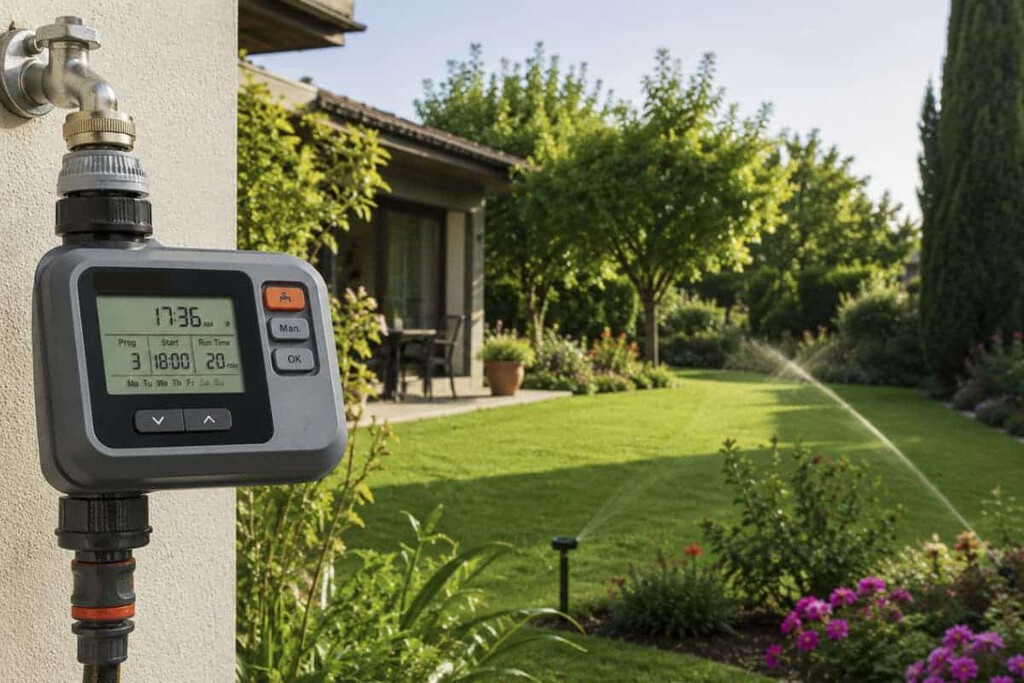
What Is an Irrigation Timer and How Does It Work?
An irrigation timer is a device that connects between your garden tap (or a hose) and your watering system. It opens and closes the water flow according to a schedule you set yourself. In its simplest version, it's a dial or a screen with buttons that lets you say "water for X minutes, on Y day, at Z time." Nothing more.
The device does the rest: it opens the valve, lets water run for the programmed time, and closes it again. This automation ensures your plants receive consistent watering even when you're not there to do it manually.
A Bit of History
This isn't a new invention. The first timers appeared in the United States in the 1960s for large-scale irrigation systems. It wasn't until the 1970s that the first compact, domestic models arrived—much more manageable than those used until then.
Why You Need an Irrigation Timer for Your Vacation
Going on vacation shouldn't mean coming back to a dead garden. An irrigation timer solves that problem by automating watering, so you can relax and enjoy your time away. It's especially useful during hot summer months when plants need regular watering.
Beyond vacations, these devices are handy for busy professionals, frequent travelers, or anyone who simply forgets to water. They also help conserve water by ensuring you only use what's needed and at the right times.
- Peace of mind: No need to bother neighbors or friends with watering duties.
- Consistency: Plants get watered on a regular schedule, promoting healthy growth.
- Water savings: Programmed cycles avoid overwatering and runoff.
- Convenience: Set it and forget it—ideal for busy lifestyles.
- Affordability: Basic models are budget-friendly and easy to install.
How to Choose the Ideal Irrigation Timer
Not all irrigation timers are created equal. The right choice depends on your garden size, watering needs, and budget. Here are the key factors to consider.
Types of Irrigation Timers
There are two main types: electronic and mechanical. Electronic timers offer precise scheduling and often come with digital displays. Mechanical timers are simpler and rely on clockwork mechanisms, but they're less flexible.
You'll also find smart timers that connect to Wi-Fi and can be controlled via smartphone apps. These allow remote monitoring and adjustments, which can be handy if you're away and want to check on your garden.
Key Features to Look For
Consider the number of watering cycles, duration settings, and whether it has a rain delay function. A rain sensor can prevent unnecessary watering after rainfall, saving water. Also, check the battery life and water pressure requirements. The longer history behind the story is traced in Irrigation Timers: The Best Gadget for a Worry-Free Vacation Garden.
For larger gardens, you might need a timer with multiple zones. If you have a small patio, a single-zone model suffices. The background to this story is set out in East London Water Crisis: Residents Face Months Without Running Water. A related thread runs through Technology: latest articles. Earlier coverage in Best Robot Vacuums 2026: My Top Picks Are Not Xiaomi or Roomba shows how the argument developed.
Comparison Table
| Feature | Basic Mechanical | Electronic | Smart (Wi-Fi) |
|---|---|---|---|
| Programming | Dial | Digital screen | App |
| Watering Cycles | 1 | Multiple | Multiple |
| Rain Delay | No | Sometimes | Yes |
| Remote Control | No | No | Yes |
| Price Range | $ | $$ | $$$ |
Installation and Maintenance Tips
Installing an irrigation timer is straightforward. Connect it to your outdoor tap, attach your hose or irrigation system, and set the schedule. Make sure the connections are tight to avoid leaks. A closer look at the same subject appears in Samsung IFA 2026: The Smart Home Battle Is Now About Ecosystems. Anyone following the wider picture can start with Dyson Enters Robot Vacuum Market With Three New Nurovi Models. The same theme surfaces in Xiaomi's Bullet Ice Maker: 6-Minute Ice Cubes for Summer, which takes a different angle.
Regular maintenance includes checking batteries, cleaning filters, and winterizing the unit if you live in a cold climate. Store it indoors during freezing months to prevent damage. Context on how this played out before sits in MOVA Robots at IFA 2026: Touch, Watering, and Fruit Picking. A companion piece, Automatic Battery Charger: Smart Charging for Every Vehicle, approaches the same subject from another angle.
Frequently Asked Questions
Can I use an irrigation timer with any watering system?
Most irrigation timers are compatible with standard garden hoses and drip irrigation systems. However, check the connector size and water pressure requirements to ensure compatibility. Some timers come with adapters for different fittings.
How long can I leave my garden unattended with an irrigation timer?
With a reliable timer and a sufficient water source, you can leave your garden for weeks. Ensure the battery is fresh and the schedule is set correctly. It's also wise to test it for a few days before your trip.
Do irrigation timers work with low water pressure?
Some models require a minimum water pressure to operate correctly. If you have low pressure, look for timers designed for low-pressure systems or consider a pump. Check the product specifications before buying.
Are smart irrigation timers worth the extra cost?
Smart timers offer convenience like remote control and weather-based adjustments, which can save water and ensure optimal watering. If you travel often or have a large garden, the investment may be worthwhile. Otherwise, a basic electronic timer suffices.
In conclusion, an irrigation timer is a small investment that pays off in healthy plants and peace of mind. Whether you choose a simple mechanical model or a smart Wi-Fi device, you'll be able to enjoy your vacation without worrying about your garden.
Browse the Shop
 Acacia frida deluxe solid wood bed frame |
Bedroom bench |
Bed chest drawers |
Lingerie dresser |
Frame base |
Mirror with jewelry storage |
30 Bathroom Vanity |
Memory foam queen mattress |
Mattresses for back pain |
Nightstand set of 2 |
Grand Goldman Shop |
Civil Lawyer
Deutschland Trikot WM 2026







