

Wealth concentration in Galicia has reached a telling milestone: for the first time, the region has more people who own multiple urban properties than people who own just one. According to the Dirección General del Catastro (DGC), in 2025, 977,906 individuals held multiple urban properties, while 968,936 held only one. This shift, though subtle, signals a deeper trend of property accumulation among a smaller group of owners.
The data comes amid broader concerns about wealth inequality in Spain. While Spain's wealth gap is less severe than in some European countries, the top 10% still controlled over 57% of total wealth in 2024, per the World Inequality Lab. Galicia's property records now reflect that same pattern of concentration, but with a local twist.
Find Original, High-end Home Decor that spark conversation at Grand Goldman Shop.
What the Catastro Data Actually Shows
The DGC's registry, which tracks urban real estate ownership, reveals that the number of people with multiple properties has edged past those with a single property. This might seem like a sign of broader wealth distribution, but a closer look shows the growth is not among families with two or three homes. Instead, it's driven by owners with more than ten properties.
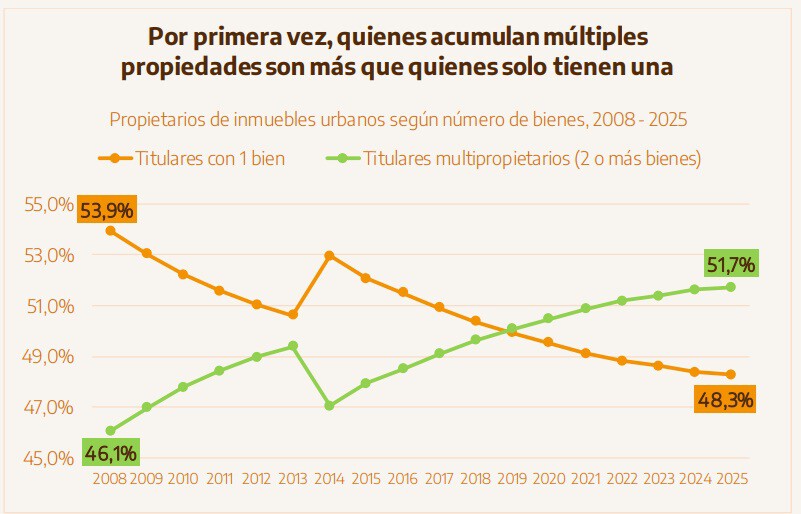
In other words, the increase in multi-property owners is largely due to large portfolios, not small-scale second-home ownership. This suggests that wealth is not being spread more widely; it's being consolidated among those who already hold significant assets.

Why This Matters for Wealth Inequality
Property is a key component of household wealth in Spain, and ownership patterns directly influence how wealth is distributed. When a small group accumulates many properties, it can drive up housing costs and limit access for first-time buyers. In Galicia, where the total number of individual owners has actually declined, the rise in multi-property owners points to a shrinking pool of owners controlling a growing share of real estate.
- More owners with multiple properties than single properties for the first time in Galicia.
- Growth concentrated among owners with 10+ properties, not small-scale owners.
- Total individual owners fell, indicating consolidation of ownership.
- Spain's top 10% hold over 57% of wealth, reflecting broader inequality trends.
The Bigger Picture: Wealth Concentration in Spain
Spain's wealth distribution has been under scrutiny as housing costs rise and wages stagnate. The World Inequality Lab's 2024 report highlighted that the richest 10% of Spaniards hold more than half of the country's wealth. While this is lower than in some European neighbors, it still represents a significant gap.
Galicia's property data offers a granular look at how this concentration happens on the ground. The DGC's figures show that the number of people with multiple urban properties has grown, but not evenly. The growth is skewed toward those with large holdings, while the number of single-property owners has decreased.
How Galicia Compares
| Category | Number of Owners (2025) |
|---|---|
| Owners with one urban property | 968,936 |
| Owners with multiple urban properties | 977,906 |
| Growth driven by | Owners with 10+ properties |
This table illustrates the shift: the number of multi-property owners now exceeds single-property owners. The key takeaway is not that more people are buying second homes, but that a smaller group is amassing larger portfolios.
What's Driving This Concentration?
Several factors could explain the trend. Low interest rates in recent years made it cheaper for wealthy individuals to finance property purchases. Additionally, tourism-driven demand in Galicia, particularly along the coast, may have encouraged investment in multiple properties. At the same time, rising prices have made it harder for average buyers to enter the market, reducing the number of single-property owners.
Another factor is inheritance. As wealth transfers between generations, properties may be consolidated among fewer heirs, especially if they choose to keep and rent out family assets rather than sell. This can lead to a concentration of ownership over time.
The Role of Tax and Policy
Property taxes and regulations also play a role. In Spain, owning multiple properties can be tax-advantaged through deductions or favorable treatment of rental income. Policies that encourage investment in real estate may inadvertently favor those who can afford to buy more, exacerbating concentration. Context on how this played out before sits in Wealth Concentration in Galicia: More Owners Hold Multiple Properties.
Meanwhile, policies aimed at helping first-time buyers have not kept pace with rising prices. This creates a cycle where those who already own property can leverage their assets to acquire more, while others struggle to buy even one home. The background to this story is set out in First Home Buyers Scheme: 1,500 Properties Turned Into. A related thread runs through First Home Buyers Scheme: 1,500 Properties Became Investments.
What to Watch Next
The DGC's data is a snapshot, but it points to a trend that could accelerate. If property ownership continues to concentrate, it may deepen wealth inequality and affect housing affordability in Galicia. Policymakers may need to consider measures that encourage broader ownership, such as progressive property taxes or incentives for small-scale buyers. Earlier coverage in First Home Buyers Scheme Twist: 1,500 Properties Became shows how the argument developed. A closer look at the same subject appears in Trending: latest articles.
For now, the numbers tell a clear story: in Galicia, the silent concentration of wealth is no longer just an abstract concept. It's written in the property registry, where the many are giving way to the few. Anyone following the wider picture can start with Asturias Housing Prices Surge 29.3%: Why the Region Leads Spain. The same theme surfaces in Spanish Island with Castle Near Madrid Lists for €3.25 Million, which takes a different angle.
FAQ
What does the Catastro data show about property ownership in Galicia?
The Catastro data shows that in 2025, there were more people owning multiple urban properties (977,906) than those owning just one (968,936). This is the first time this has happened in Galicia, indicating a concentration of property wealth.
Who is driving the increase in multiple property ownership?
The increase is primarily driven by owners with more than ten properties, not by families with two or three homes. This suggests that large portfolios are growing, while small-scale ownership is not.
How does this relate to wealth inequality in Spain?
Spain's top 10% hold over 57% of total wealth, according to the World Inequality Lab. The concentration of property ownership in Galicia mirrors this broader trend, as real estate is a major component of household wealth.
What are the potential consequences of this trend?
If property ownership continues to concentrate, it could worsen wealth inequality and make housing less affordable for first-time buyers. It may also lead to a rental market dominated by large landlords, affecting tenant rights and housing costs.
Browse the Shop
 Acacia frida deluxe solid wood bed frame |
Bedroom bench |
Bed chest drawers |
Lingerie dresser |
Frame base |
Mirror with jewelry storage |
30 Bathroom Vanity |
Memory foam queen mattress |
Mattresses for back pain |
Nightstand set of 2 |
Grand Goldman Shop |
Civil Lawyer
Deutschland Trikot WM 2026










