

Europe's homeownership map reveals a striking divide between Germany and Romania, exposing two Europes: one of owners and one of renters. According to Eurostat data visualized by The World in Maps, the countries with the highest homeownership rates are often the poorest, while wealthy nations like Germany have some of the lowest rates. This counterintuitive pattern challenges assumptions about prosperity and property.
The data comes from the EU-SILC survey, which asks households whether they own or rent their homes. The latest figures show a continent split along economic lines, with profound implications for wealth inequality, labor mobility, and social policy.
Find Original Home Decor sparking conversation at Grand Goldman Shop.

Why Homeownership Rates In Europe Vary So Widely
Homeownership is the primary form of wealth for most European households, making it central to understanding wealth inequality. Yet the map shows that rich countries tend to have fewer owner-occupiers. Germany, Europe's largest economy, has one of the lowest homeownership rates, while Romania, one of the EU's poorest members, has one of the highest.
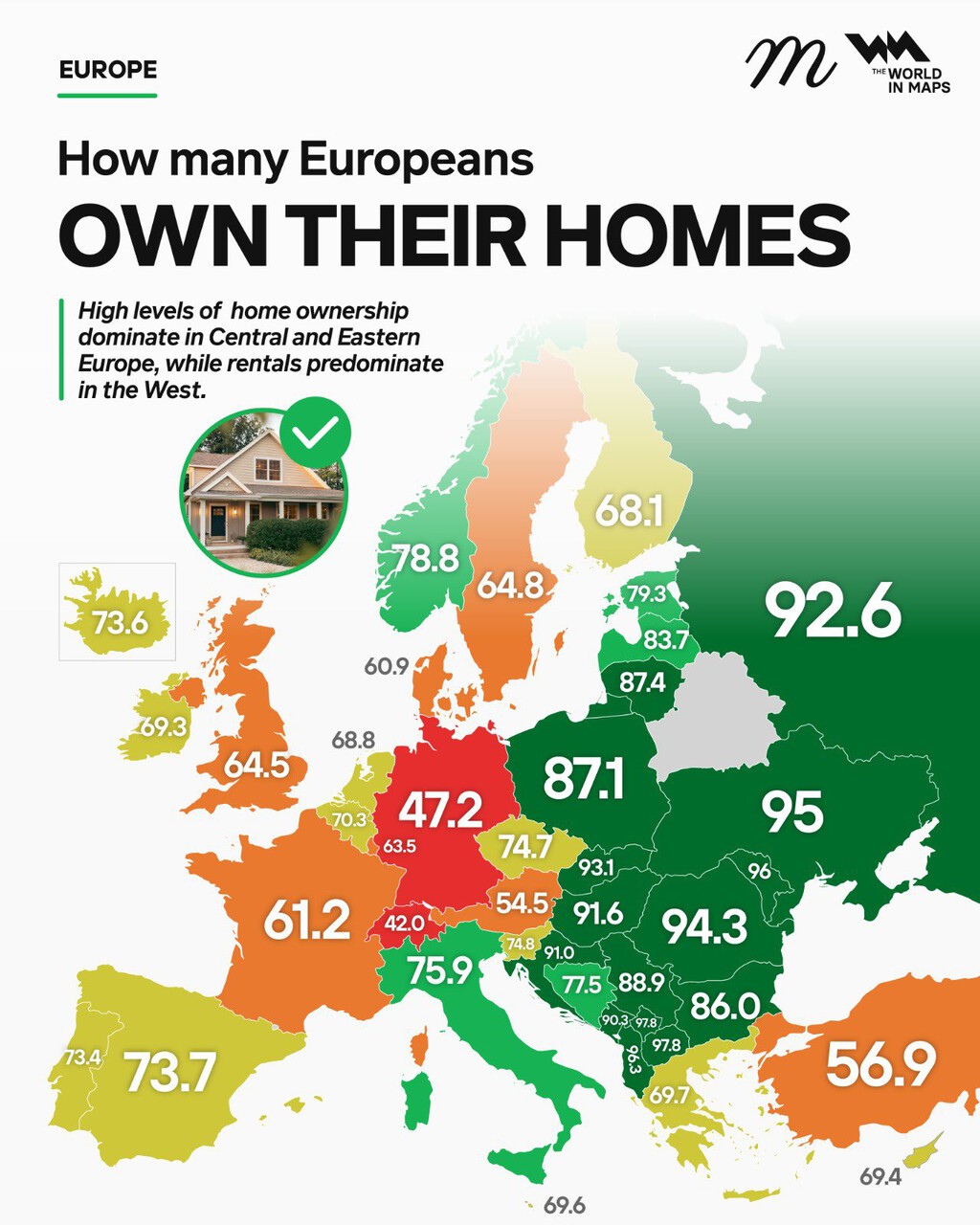
This inverse relationship is not a coincidence. It reflects historical, institutional, and cultural factors that shape housing markets across the continent. In Eastern Europe, mass privatization after the fall of communism turned millions of renters into owners overnight, often in aging, low-quality housing. In Germany, a strong rental culture, tenant protections, and a decentralized housing market have kept ownership rates low.
The Legacy of Privatization in Eastern Europe
After 1989, many post-communist countries sold public housing to sitting tenants at below-market prices. This created a nation of homeowners but also a stock of aging buildings in need of renovation. In Romania, for example, homeownership exceeds 90%, but many dwellings lack basic amenities.
These policies boosted ownership without necessarily creating wealth. In contrast, in countries like Germany, the rental sector is large, regulated, and often provides high-quality housing. The result is that homeownership alone does not tell the full story of housing quality or financial security.
The German Anomaly: Why Renters Dominate
Germany's low homeownership rate—around 50%—is often cited as an outlier in Europe. A combination of factors explains this: a long tradition of renting, strong tenant rights, and a housing market where renting is not stigmatized. In cities like Berlin, Munich, and Hamburg, the majority of residents rent.
This does not mean Germans are worse off. In fact, the rental market offers flexibility and security, with many renters living in well-maintained properties. However, it also means that wealth accumulation through property is less widespread, which can exacerbate wealth inequality when property prices rise.
Spain: A Middle Ground with Broken Prices
Spain sits somewhere in between. Homeownership is high—around 75%—but the market is dysfunctional. Prices have skyrocketed, making it difficult for young people to buy. The author's personal experience of buying a flat in Madrid after years of renting illustrates the tension: renting no longer made financial sense, but buying was only possible after significant sacrifice.
Spain's story shows that high homeownership does not guarantee affordability. In fact, it can coexist with volatile prices and high household debt, as the 2008 crisis demonstrated.
What the Map Means for Wealth and Inequality
Homeownership is a double-edged sword. On one hand, it builds equity and provides stability. On the other, it can lock people into place, reducing labor mobility, and concentrate wealth among those who already own property. In countries with high ownership, inheritance plays a larger role in determining wealth, potentially entrenching inequality.
The map also highlights the importance of housing quality. In Romania, many owners live in dwellings that are structurally unsound or lack modern conveniences. Ownership without quality is not a marker of well-being. Eurostat data often shows that overcrowding and poor housing conditions are more prevalent in high-ownership countries.
Key Takeaways from Europe's Homeownership Map
- Wealthy countries like Germany have lower homeownership rates, while poorer countries like Romania have higher rates.
- Historical privatization in Eastern Europe created mass homeownership but often in low-quality housing.
- Germany's strong rental culture and tenant protections keep ownership rates low but provide secure alternatives.
- High homeownership does not guarantee affordability or quality, as seen in Spain's volatile market.
- Homeownership affects wealth inequality, labor mobility, and inheritance patterns across Europe.
Comparing Homeownership and Housing Quality Across Europe
| Country | Homeownership Rate (approx.) | Housing Quality Issues | Key Characteristics |
|---|---|---|---|
| Germany | 50% | Low | Strong rental market, tenant protections |
| Romania | 90%+ | High | Post-communist privatization, aging stock |
| Spain | 75% | Moderate | High prices, volatile market |
| France | 65% | Low | Mixed tenure, strong social housing |
The table illustrates that homeownership rates alone are misleading. Germany's low rate coexists with high housing quality, while Romania's high rate masks significant deficiencies. Spain's high rate comes with affordability challenges. France strikes a balance with a mixed market. The longer history behind the story is traced in Europe Homeownership Map: Germany vs Romania Housing Divide. More on the surrounding debate is collected in Europe's Industrial Divide: Mapping the Desindustrialization Gap.
What to Watch Next in European Housing Policy
Policymakers face a dilemma: encouraging homeownership can boost wealth for some but may exclude others and reduce mobility. The European Commission has highlighted housing affordability as a growing concern, especially in urban areas. The rise of remote work could also change demand patterns, potentially easing pressure on expensive cities. The background to this story is set out in Australia Housing Downturn: Renters Hope for Homeownership. A related thread runs through Romania to Build Europe's Largest Solar Plant, Overtaking Germany. Earlier coverage in Britain Faces Europe's Highest Energy Costs This Winter shows how the argument developed.
Meanwhile, the rental market is under strain in many countries. In Germany, rent controls are debated; in Spain, new housing laws aim to curb speculation. The map of homeownership will continue to evolve as economies recover from the pandemic and face new challenges like energy costs and demographic shifts. A closer look at the same subject appears in Europe's War Readiness and NATO Defense Challenges. Anyone following the wider picture can start with None of them in Germany! The best nude beaches in Europe. The same theme surfaces in Business: latest articles, which takes a different angle.
Understanding the two Europes of housing is essential for anyone following economic trends. The divide between owners and renters is not just about tenure; it's about wealth, security, and opportunity. As the data shows, the richest countries are not always the ones with the most owners—and that paradox will shape debates for years to come. Context on how this played out before sits in England's North-South Divide: Burnham's Devolution Challenge. A companion piece, Jed York Arrest Exposes America's Inequality Divide, approaches the same subject from another angle.
FAQ
Why do richer European countries have lower homeownership rates?
Richer countries often have well-developed rental markets with strong tenant protections, making renting a viable long-term option. Additionally, high property prices and urbanization can discourage ownership. Historical factors, such as Germany's decentralized housing market, also play a role.
Is homeownership a good indicator of economic well-being?
Not necessarily. Homeownership can build wealth, but it can also burden households with debt and reduce mobility. In countries like Romania, high ownership rates coexist with poor housing quality. A better indicator might combine ownership, housing quality, and affordability.
How does homeownership affect wealth inequality?
Homeownership is a major component of household wealth. When property prices rise, owners benefit, widening the gap with renters. Inheritance of property further entrenches inequality. However, in countries with high ownership, wealth is more evenly distributed among homeowners, though quality varies.
What can other countries learn from Germany's rental model?
Germany's rental market offers security and quality, with strong tenant rights and rent regulation. This model can inspire policies to improve rental conditions elsewhere. However, it relies on specific historical and institutional contexts, so direct transplantation may be challenging.
Browse the Shop
 Acacia frida deluxe solid wood bed frame |
Bedroom bench |
Bed chest drawers |
Lingerie dresser |
Frame base |
Mirror with jewelry storage |
30 Bathroom Vanity |
Memory foam queen mattress |
Mattresses for back pain |
Nightstand set of 2 |
Grand Goldman Shop |
Civil Lawyer
Deutschland Trikot WM 2026







