

In 1912, Spanish inventor Leonardo Torres Quevedo unveiled El Ajedrecista, widely considered the first computer game in history. This remarkable chess automaton, which played the endgame of king and rook against a lone king, stunned audiences in Paris and sparked debates about machine intelligence.
What Was El Ajedrecista?
El Ajedrecista was a mechanical chess player that used electromagnets, electrical sensors, and a mechanical arm to move pieces on a board. It did not play a full game; instead, it specialized in the final moves of king and rook versus king, always forcing a checkmate.
Find Original Home Decor sparking conversation at Grand Goldman Shop.

When it delivered mate, a voice would announce "¡Jaque Mate!" — a dramatic touch that emphasized the automaton's apparent intelligence. The device was entirely autonomous, requiring no human intervention during play.
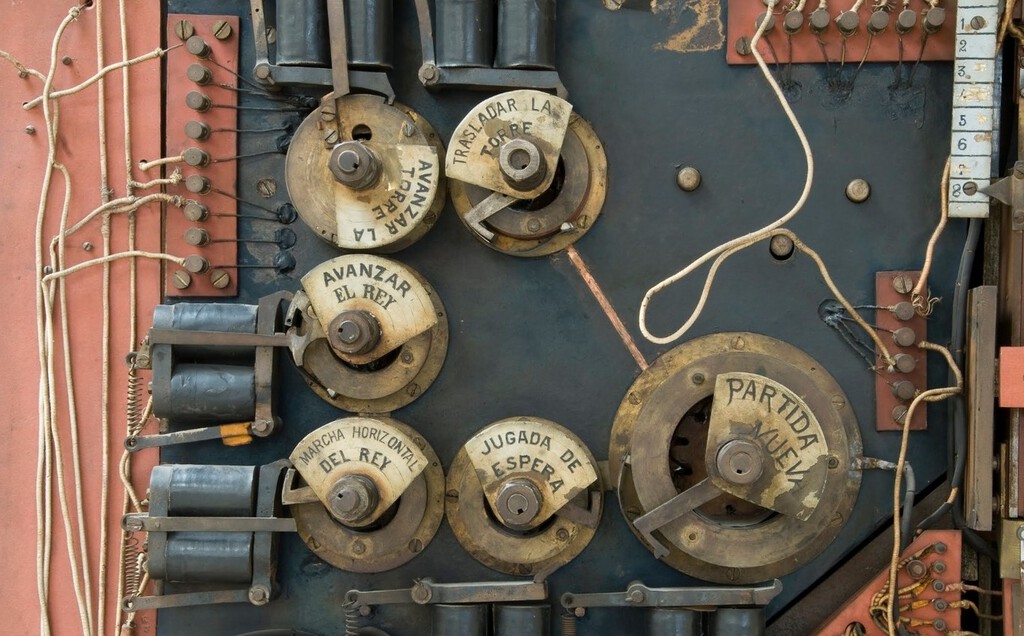
How Did This Early Computer Game Work?
The automaton relied on a simple algorithm that allowed it to respond to the opponent's moves. Sensors under the board detected the position of the pieces, and the machine calculated the correct response using a system of electrical circuits.
This was decades before digital computers, yet El Ajedrecista demonstrated that machines could perform tasks requiring logical reasoning. It is often cited as one of the earliest examples of artificial intelligence.
The Impact of El Ajedrecista
When Torres Quevedo demonstrated the device in Paris, it caused a sensation. Scientific American wondered whether machines could replace the human mind. The automaton was not just a curiosity; it was a proof of concept for automated decision-making.
Interestingly, 1912 was also the birth year of Alan Turing, the father of modern computing. While Torres Quevedo was already building chess-playing machines, Turing was still an infant — a fact that highlights how ahead of his time the Spanish inventor was. The background to this story is set out in Spain Wins World Cup: Ferran Torres Goal Dethrones Argentina. A related thread runs through Spain Win World Cup: Ferran Torres Breaks Argentina's Resistance. Earlier coverage in Spain Wins World Cup: Ferran Torres Seals Dramatic Final shows how the argument developed.
Why El Ajedrecista Matters Today
El Ajedrecista laid the groundwork for the development of computer games and artificial intelligence. It showed that machines could simulate human thought processes, even in a limited domain like chess. A closer look at the same subject appears in Spain Wins World Cup: Ferran Torres Seals Historic Victory. Anyone following the wider picture can start with Spain Wins World Cup: Ferran Torres Dethrones Argentina in Extra. The same theme surfaces in Science: latest articles, which takes a different angle.
Today, chess engines can defeat world champions, but it all started with a mechanical device that could only play one specific endgame. The legacy of Torres Quevedo's invention lives on in every computer game and AI system we use. Context on how this played out before sits in TRON: The Japanese OS That Became the Asian Windows. A companion piece, How Many Times Have We Been to the Moon and Why Only 12 Humans Have Walked, approaches the same subject from another angle.
- El Ajedrecista was invented in 1912 by Leonardo Torres Quevedo.
- It was the first autonomous computer game, playing a chess endgame.
- It used electromagnets, sensors, and a mechanical arm.
- It announced checkmate with a voice saying "¡Jaque Mate!"
- It is considered a precursor to artificial intelligence.
El Ajedrecista vs. Modern Chess Computers
| Feature | El Ajedrecista (1912) | Modern Chess Engines |
|---|---|---|
| Technology | Electromechanical | Digital software |
| Scope | King and rook vs. king endgame | Full game |
| Autonomy | Fully autonomous | Fully autonomous |
| Output | Mechanical moves and voice | Digital moves and analysis |
FAQ
What was El Ajedrecista?
El Ajedrecista was a chess automaton invented by Leonardo Torres Quevedo in 1912. It played the endgame of king and rook against king and is considered the first computer game.
How did El Ajedrecista work?
It used electromagnets, electrical sensors, and a mechanical arm to move pieces. The machine responded to the opponent's moves automatically, following a built-in algorithm.
Why is El Ajedrecista important?
It was one of the first machines to exhibit artificial intelligence, demonstrating that machines could perform logical tasks. It paved the way for modern computer games and AI research.
Did El Ajedrecista ever lose?
No, El Ajedrecista was designed to always win from the starting position. It would force checkmate without fail, showcasing the reliability of its algorithm.
El Ajedrecista remains a milestone in the history of technology, a testament to human ingenuity and the desire to create machines that can think.
Browse the Shop
 Acacia frida deluxe solid wood bed frame |
Bedroom bench |
Bed chest drawers |
Lingerie dresser |
Frame base |
Mirror with jewelry storage |
30 Bathroom Vanity |
Memory foam queen mattress |
Mattresses for back pain |
Nightstand set of 2 |
Grand Goldman Shop |
Civil Lawyer
Deutschland Trikot WM 2026







