

January, the month for signing up to the gym, is already underway, and with it comes the dreaded post-holiday weight gain. With the intention of shedding those extra pounds, Spaniards tend to flood gyms during the first two or three months of the year, only to later start abandoning that goal of being healthier.
To save you the financial expense that paying an annual gym membership can involve, we're going to review the best exercises you can do in your living room without any equipment (or with the bare minimum), so you can train in the comfort of your own home.
Find Bleeding Edge Supplements at Scandalous Prices on iHerb.

Squats
We couldn't start the list of exercises without talking about squats, one of the basic exercises for working the lower body with our own body weight.
For this exercise, we'll point out a couple of key aspects: the first is the posture of our back, which should remain as neutral as possible, avoiding arching in the lumbar (hyperlordosis) and dorsal (hyperkyphosis or "hump") areas. If maintaining the posture is difficult, a good way to start doing squats is to opt for the isometric variation against the wall, for which we'll position ourselves with our back against the wall and bend our knees until they form a 90-degree angle, at which point we'll hold the position for a few seconds and return to the starting position.
The second point to consider is the knees. If for any reason not attributable to a lack of strength we are unable to do squats, we can try doing them with a chair: from a seated position on the edge of the chair and keeping our back straight, we'll stand up and sit back down. This is a good option in case we are unable to do traditional squats. This option can also be a good alternative for lower body work for older people.
Push-ups
And if squats are the classic exercise for working the strength and power of our lower body, push-ups would be their equivalent when we talk about the upper body, as they work the strength of our arms, chest muscles, and core (the latter helps stabilize posture, thus preventing lower back arching and potential injuries).
If we have a strength deficit that prevents us from doing push-ups directly on the floor, we can opt to do them inclined, leaning for example on the edge of a chair or sofa, or if we want to work on the floor, we can choose to support ourselves on our knees instead of our feet, thereby "reducing" the body weight we're working with.

ATIVAFIT Atviafit Fitness Alfombrillas Esfera Confort - Espuma de Alta Densidad NBR- Colchoneta Antideslizante para Gimnasio 183 cm Largo x 61 cm Ancho x 1cm Espesor
Lunges
Lunges are a great complement to squats, as besides being a strength exercise, they allow us to work on and improve our balance through the activation of the gluteus medius. Additionally, we can do lunges both forward and backward.
If we want to add difficulty to this exercise, we can opt to hold some weight in one of our hands, which will force us to compensate for this "imbalance" with greater core work. If, on the other hand, we don't have great balance, we can do them next to a table that we can lean on in case we lose our balance while we improve it.
Plank
One of the best, if not the best, exercise for working our core. Unlike the risk that classic crunches posed, the plank (and all the variations we can do) will allow us to work our core globally and completely and, most importantly, safely. An alternative, if we have the necessary equipment, is to do the ab wheel rollout instead of the plank. This accessory can be purchased at stores like Decathlon at a fairly affordable price (around 20 euros).
Burpees
This now-classic exercise, loved or hated by people in equal measure, will allow us to work our body globally, as it combines strength work with cardiovascular work, making it a magnificent exercise for improving our cardiovascular endurance.
Glute Bridge
To work the lower body from the "posterior" point of view, the glute bridge is an excellent exercise that will focus the work mainly on the hamstring, gluteal muscles, and the lumbar area. Like all exercises, it has variations, with the most basic starting from a lying-on-your-back position on the floor with your legs bent. As we raise the support point of our feet, for example by placing them on the edge of the sofa or a chair, the work done by the hamstrings and glutes will be greater.
Mountain Climbers
A complementary exercise to planks that also works the core. For those who aren't able to start working this exercise directly in the initial push-up position on the floor, we recommend starting by doing it with your hands supported on a chair, so that you're inclined relative to the floor and performing the movement as if you were walking (the main idea of the exercise is to perform the movement as quickly as possible). There are numerous options to add difficulty and intensity to our workout.
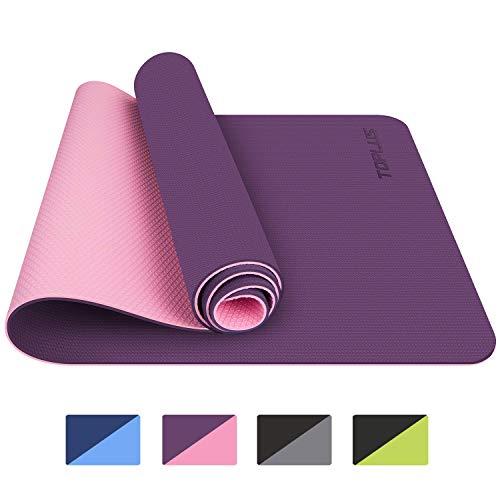
TOPLUS Esterilla Yoga Antideslizante Nivel Profesional Alfombrilla de Yoga Esterilla Pilates Esterilla Deporte- con Correa de Hombro 183cm x 61cm (Violeta)
Two routines to work out at home with your body weight
Now that we've seen the main exercises to get in shape and lose weight after the holidays, we're going to propose two types of routines to work out at home: one will be based on the sets-repetitions system and the other will be in the form of a HIIT circuit.
Sets-repetitions exercise routine
Between each set, we recommend leaving between 45 and 90 seconds of rest depending on each person's physical condition, and between one and two minutes between exercises.
- Burpees - 2 x 10
- Squats - 3 x 10
- Glute Bridge - 3 x 15 (we suggest doing a few more repetitions of this exercise in the first few weeks as the hamstrings are often a muscle group that tends to be "behind" compared to the quadriceps)
- Lunges - 2 x 10 (with each leg)
- Push-ups - 3 x 10
- Mountain Climbers - 3 x 20
- Plank - 3 x 10 x 3-5" (three sets of ten repetitions of between three and five seconds each)
HIIT circuit mode exercise routine
For those who want to work these exercises in high-intensity circuit mode, we'll structure it using the Tabata method, consisting of 20-second work periods alternated with ten-second rests. For beginners, doing three rounds of this circuit can be a good way to start getting in shape. For intermediate levels, we could do between three and six rounds, and for advanced, a good workout could be completing ten rounds. Between rounds, depending on each user's fitness level, rest periods can range from three minutes for the newest to 45-60 seconds for the most advanced.
The order of the exercises will be the same as for the previous workout: burpees, squats, glute bridge, lunges (here we'd do two consecutively, one with each leg), push-ups, mountain climbers, and plank.
Home Decor Shop
 Acacia frida deluxe solid wood bed frame |
Bedroom bench |
Bed chest drawers |
Lingerie dresser |
Frame base |
Mirror with jewelry storage |
30 Bathroom Vanity |
Memory foam queen mattress |
Mattresses for back pain |
Nightstand set of 2 |
Grand Goldman Shop |
Civil Lawyer
Deutschland Trikot WM 2026
Acacia frida deluxe solid wood bed frame |
Bedroom bench |
Bed chest drawers |
Lingerie dresser |
Frame base |
Mirror with jewelry storage |
30 Bathroom Vanity |
Memory foam queen mattress |
Mattresses for back pain |
Nightstand set of 2 |
Grand Goldman Shop |
Civil Lawyer
Deutschland Trikot WM 2026










