

A cosmic laser beam that has traveled for 8 billion years has finally reached Earth, and it is the most distant and powerful of its kind ever detected. Using the MeerKAT telescope in South Africa, astronomers discovered this extraordinary microwave laser, opening a new window into the early universe.
What Is a Cosmic Laser?
The phenomenon is known as a megamaser—a natural cosmic laser that emits microwaves instead of visible light. The prefix "mega" indicates that its luminosity is millions of times greater than that of an ordinary hydroxyl maser.
Find Original Home Decor sparking conversation at Grand Goldman Shop.

These megamasers form when two galaxies collide. The violent collision compresses gas clouds, exciting hydroxyl molecules that then release amplified, coherent microwaves—essentially the cosmic equivalent of a laser.
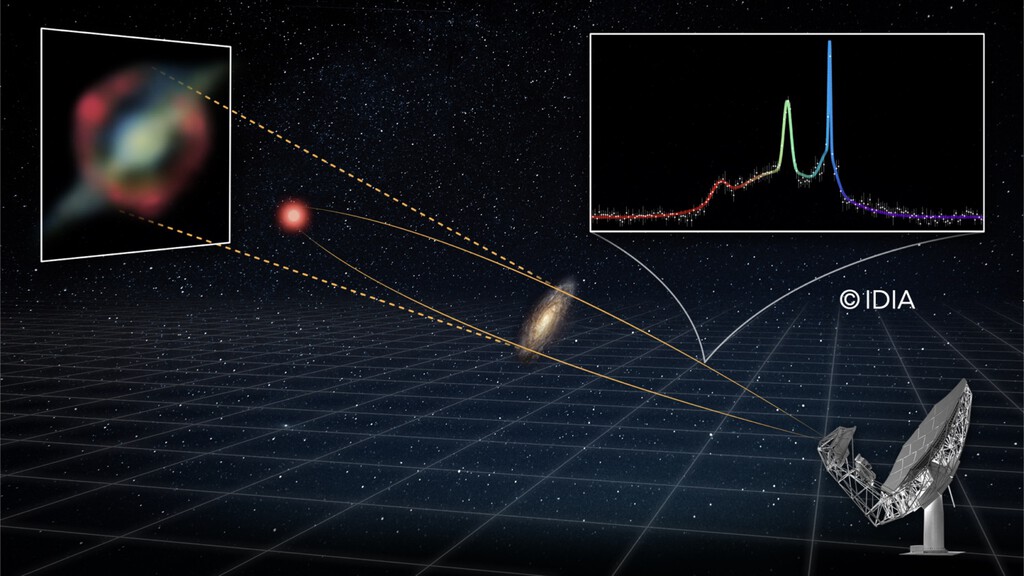
The Record-Breaking Discovery
The MeerKAT telescope spotted this megamaser after it traveled 8 billion years to reach us. To locate it, the team needed a cosmic magnifying glass—a gravitational lens predicted by Einstein over a century ago.
Gravitational lensing occurs when a massive object, like a galaxy cluster, bends and magnifies the light from a more distant object behind it. This natural telescope allowed astronomers to see the megamaser in unprecedented detail.
Why This Megamaser Matters
Megamasers serve as cosmic beacons that help astronomers study how galaxies formed in the early universe. This particular megamaser is the most distant ever found, providing a glimpse into galaxy interactions when the universe was just a fraction of its current age. Context on how this played out before sits in Cosmic Laser Blast from 8 Billion Years Ago Hits Earth.
By analyzing the microwaves from this megamaser, scientists can learn about the conditions inside colliding galaxies billions of years ago. This helps piece together the history of galaxy formation and evolution. The background to this story is set out in Black Hole Merger That Broke All the Rules Had a Trick: Gravitational Lensing. A related thread runs through Science: latest articles.
Key Takeaways
- The most distant and powerful cosmic laser ever detected has reached Earth after 8 billion years.
- Megamasers are natural microwave lasers formed when galaxies collide.
- The discovery relied on gravitational lensing, a phenomenon predicted by Einstein.
- Megamasers act as cosmic beacons for studying early galaxy formation.
- The MeerKAT telescope in South Africa made the record-breaking detection.
How It Compares to Other Cosmic Lasers
| Property | This Megamaser | Typical Megamaser |
|---|---|---|
| Distance | 8 billion light-years | Hundreds of millions of light-years |
| Luminosity | Millions of times brighter than ordinary masers | Millions of times brighter than ordinary masers |
| Detection Method | MeerKAT with gravitational lensing | Radio telescopes |
| Significance | Most distant and powerful ever | Studying galaxy collisions |
What to Watch Next
Astronomers will continue to study this megamaser to understand the dynamics of galaxy collisions in the early universe. Future telescopes, like the Square Kilometre Array, may detect even more distant megamasers, further illuminating the cosmic dark ages. Earlier coverage in James Webb Finds a Young Galaxy That Stopped Spinning Too Early shows how the argument developed. A closer look at the same subject appears in James Webb Lifts Galactic Gas Veil: How Baby Stars Shape Their Neighbors.
This discovery also highlights the power of gravitational lensing as a tool for astronomy. As more powerful telescopes come online, we can expect to find even more extreme cosmic phenomena. Anyone following the wider picture can start with James Webb Space Telescope Maps 164,000 Galaxies in Epic Cosmic Survey. The same theme surfaces in Samsung Galaxy S26 Review: The Compact High-End Phone Still Thrives, which takes a different angle.
FAQ
What is a megamaser?
What is a megamaser?
A megamaser is a natural cosmic laser that emits microwaves. It forms when two galaxies collide, compressing gas clouds and exciting hydroxyl molecules to release amplified, coherent microwaves. Megamasers are millions of times more luminous than ordinary masers.
How was this megamaser detected?
How was this megamaser detected?
The MeerKAT telescope in South Africa detected the megamaser using gravitational lensing, which magnified the signal. This natural magnifying glass was predicted by Einstein's theory of general relativity.
Why is this discovery important?
Why is this discovery important?
This is the most distant and powerful megamaser ever found, offering insights into galaxy formation and collisions in the early universe. It serves as a cosmic beacon for studying the universe's history.
What is gravitational lensing?
What is gravitational lensing?
Gravitational lensing is a phenomenon where a massive object, like a galaxy cluster, bends and magnifies light from a more distant object behind it. This effect was predicted by Einstein and acts as a natural telescope.
Browse the Shop
 Acacia frida deluxe solid wood bed frame |
Bedroom bench |
Bed chest drawers |
Lingerie dresser |
Frame base |
Mirror with jewelry storage |
30 Bathroom Vanity |
Memory foam queen mattress |
Mattresses for back pain |
Nightstand set of 2 |
Grand Goldman Shop |
Civil Lawyer
Deutschland Trikot WM 2026







