

Earth's Van Allen radiation belts temporarily split into four distinct rings after a massive solar storm in May 2024, a phenomenon never before observed. The discovery, made by scientists at the Royal Belgian Institute for Space Aeronomy, raises urgent questions about how solar activity reshapes the space environment around our planet.
Without a magnetic field, Earth would face a constant bombardment of energetic particles from the Sun and cosmic rays. Fortunately, this shield deflects most particles while trapping some in two donut-shaped rings known as the Van Allen belts. These belts protect us on the ground, but they pose serious risks to satellites and spacecraft that pass through them unprepared.
Find Original Home Decor sparking conversation at Grand Goldman Shop.

What Happened During the May 2024 Solar Storm
The solar storm, nicknamed the "Mother's Day event," was one of the strongest in decades. It triggered spectacular auroras worldwide and disrupted some satellite communications. But it also produced something entirely unexpected: a temporary restructuring of the Van Allen belts from two to four.
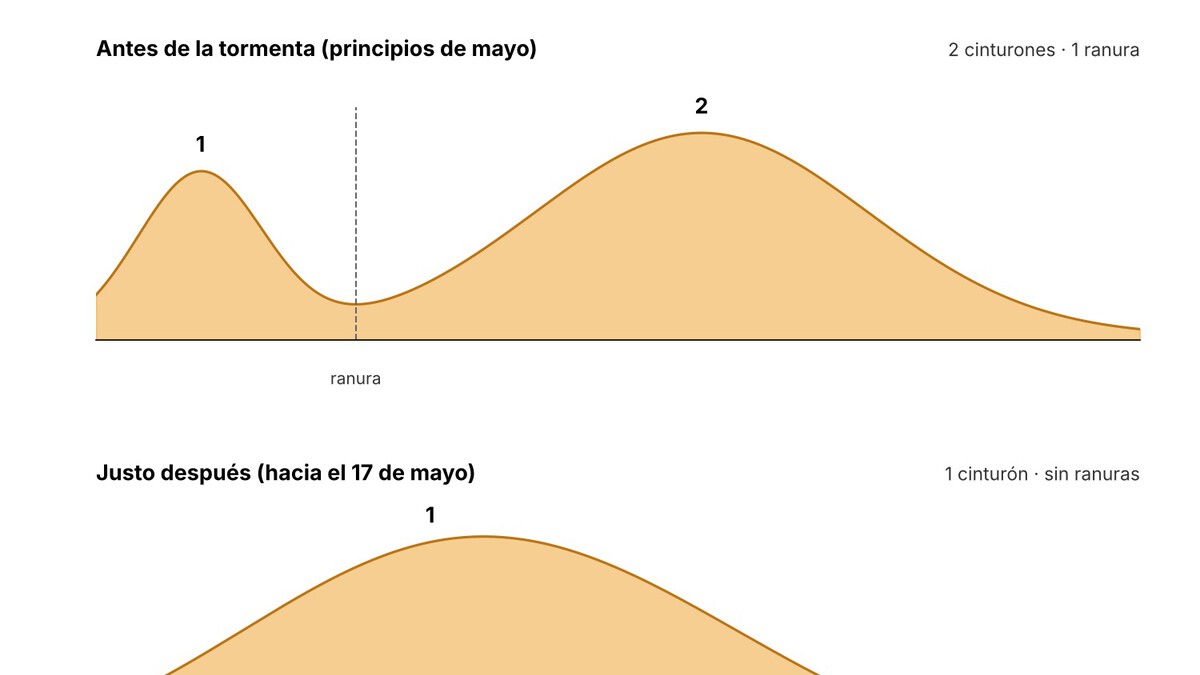
Researchers analyzed data from multiple spacecraft and found that the storm had injected new populations of high-energy particles into the region between the inner and outer belts. This created two additional, short-lived belts that persisted for several weeks before fading away.
According to the team, this is the first time such a four-belt configuration has ever been detected. More concerning, the jump from two to three belts appears to be becoming more frequent, suggesting that extreme space weather events are on the rise.
Why the Belts Matter for Satellites and Astronauts
The Van Allen belts are not just a scientific curiosity. They are a critical hazard for anything operating in near-Earth space. Satellites that cross the belts can suffer electronics damage, solar panel degradation, and even total failure. Crewed missions beyond low Earth orbit must also limit their exposure to avoid dangerous radiation doses.
When the belts temporarily multiply, the risk zone expands. A satellite that normally avoids the worst radiation might suddenly find itself inside a new belt. This is why understanding these changes is essential for mission planning and satellite operations.
- Radiation hazard: The belts trap high-energy particles that can damage spacecraft electronics and harm astronauts.
- Dynamic structure: The belts are not static; solar storms can reshape them within hours.
- New belts: The May 2024 event created two extra belts that lasted for weeks.
- Increasing frequency: Three-belt events are becoming more common, possibly due to stronger solar cycles.
- Operational impact: Satellite operators may need to adjust orbits or power down systems during extreme storms.
How the Belts Form and Why They Split
Earth's magnetic field traps charged particles in two main regions. The inner belt, dominated by protons, sits about 1,000 to 6,000 kilometers above the surface. The outer belt, mostly electrons, extends from roughly 13,000 to 60,000 kilometers. Between them lies a "slot region" where electromagnetic waves scatter particles into the atmosphere, keeping it relatively empty.
During a powerful solar storm, the slot region can become filled with new particles. If the storm is strong enough, it can create a temporary third belt. The May 2024 event went further, producing a fourth belt. Scientists are still working to understand the exact conditions that lead to these extra rings and why they eventually disappear.
The research team used data from the Van Allen Probes and other spacecraft to track the evolution of the belts over time. Their findings highlight how little we still know about the dynamic space environment close to home.
What This Means for Future Space Weather Forecasting
As we become more dependent on satellite technology for communication, navigation, and weather monitoring, the need for accurate space weather forecasts grows. The discovery of four belts suggests that current models may underestimate the complexity of solar storm effects.
Improved forecasting could help satellite operators take protective measures, such as temporarily switching off sensitive instruments or adjusting orbits. It could also inform the design of future spacecraft that must operate in or near the belts.
The Belgian team's work is part of a broader effort to understand the Van Allen belts. Similar research is underway using data from missions like the Van Allen Probes and the forthcoming European Space Agency's Space Weather mission. Each new finding adds to a picture of a system that is far more variable than once thought. The background to this story is set out in Space Airbag: 400-Ton Plasma Shield Against Solar Storms. A related thread runs through Space Shield Against Solar Storms Uses Lithium and Barium. Earlier coverage in Solar Storms Explained: Why Modern Society Is So Vulnerable shows how the argument developed.
What to Watch Next
Scientists will continue to monitor the belts for signs of further splitting. The Sun is currently in a period of heightened activity, so more extreme storms are likely in the coming years. Each event provides a natural experiment that can help refine our understanding. A closer look at the same subject appears in GPS Disruption From Solar Storm Exposes Fragility of Navigation. Anyone following the wider picture can start with Science: latest articles. The same theme surfaces in Half-Ton Metal Ring Falls from Sky in Kenya: Mystery Remains, which takes a different angle.
For satellite operators, the key takeaway is that the radiation environment can change rapidly. Having contingency plans in place is no longer optional. For the rest of us, the discovery is a reminder that even the space around our planet is not as stable as it seems. Context on how this played out before sits in Reflect Orbital's Plan to Sell Sunlight at Night Sparks Scientific Backlash.
FAQ
What are the Van Allen radiation belts?
What are the Van Allen radiation belts?
The Van Allen belts are two regions of charged particles trapped by Earth's magnetic field. The inner belt contains mostly protons, while the outer belt is dominated by electrons. They protect Earth from solar and cosmic radiation but pose a hazard to satellites and astronauts.
How did the belts temporarily become four?
How did the belts temporarily become four?
A powerful solar storm in May 2024 injected high-energy particles into the slot region between the two permanent belts. This created two additional, short-lived belts that persisted for several weeks. It is the first observed case of a four-belt configuration.
Why is this discovery important?
Why is this discovery important?
It shows that solar storms can reshape the radiation environment around Earth more dramatically than previously thought. This has implications for satellite safety, astronaut health, and space weather forecasting. It also suggests that extreme events may be becoming more common.
Could this happen again?
Could this happen again?
Yes, especially as the Sun remains active. The increase in three-belt events suggests that similar or even more extreme configurations could occur in the future. Scientists are monitoring the belts closely to understand the conditions that lead to these changes.
Browse the Shop
 Acacia frida deluxe solid wood bed frame |
Bedroom bench |
Bed chest drawers |
Lingerie dresser |
Frame base |
Mirror with jewelry storage |
30 Bathroom Vanity |
Memory foam queen mattress |
Mattresses for back pain |
Nightstand set of 2 |
Grand Goldman Shop |
Civil Lawyer
Deutschland Trikot WM 2026







