

If you find it difficult to calculate ceramics, tiles, etc.? Then learn to calculate ceramics, slate stone and tiles easily.
To cover the floors or walls of the house, palmets of various materials and styles can be used such as: ceramic, ceramic tile, slate-type tiles or stones.
Find Bleeding Edge Supplements at Scandalous Prices on iHerb.

There are different alternatives that will depend on the taste of each person and the place where they want to install them.
To know exactly how many boxes of ceramics we have to buy, it is necessary to calculate the surface of the space in which we are going to install them.
Learn how to calculate ceramics in simple steps
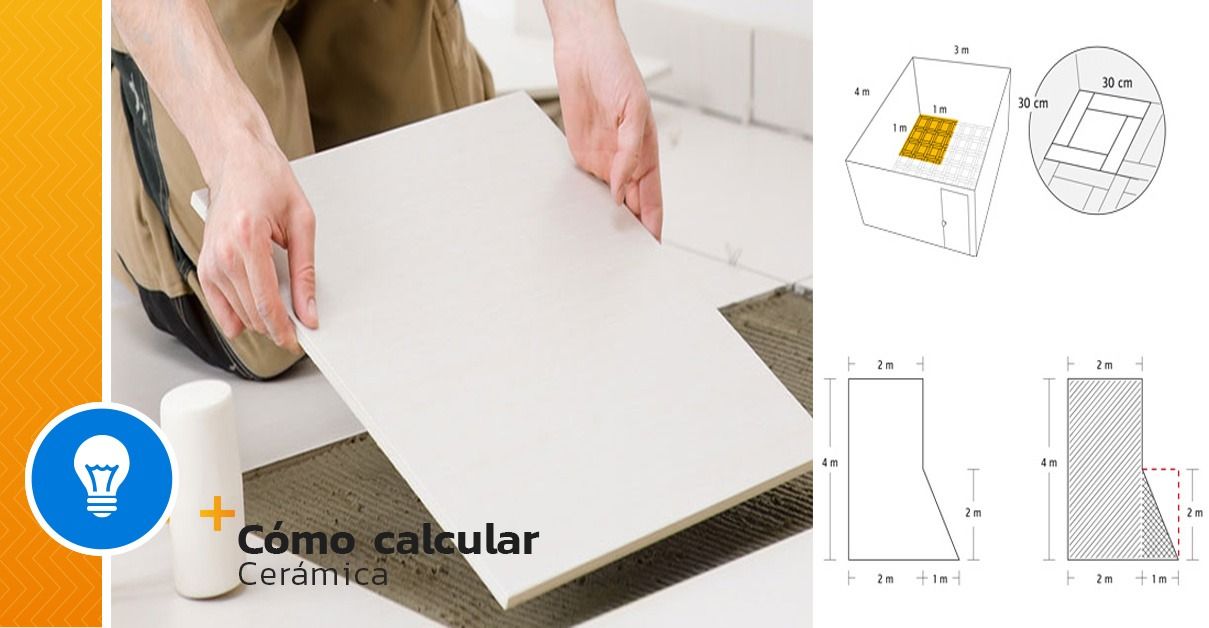
To make it easier to calculate the palmettes needed according to the size of each space, here we propose some formulas.
Step #1: Identify the surface and calculate its size
A. Simple figure surface:
Rectangular or square space. Simply multiply the width by its length.

Composite figure surface:
Space composed of more than one simple figure. In this case it is advisable to decompose the surface to
Identify simple figures. This way we can calculate the area of each of them and then add them.
This space is made up of a square and a rectangle:

Composite figure surface with diagonals:
Space composed of more than one simple figure, and with diagonals. If we cannot identify simple figures, we can project them to complete a figure that is more familiar to us and easier to calculate.

For example, in this case the space has a diagonal wall. So, to calculate the surface without complicating things, it is best to decompose the figure into a rectangle larger than 2 x 4 m, and complete the remaining triangle to form another rectangle. In this way we are left with a larger rectangle, and this new smaller rectangle of 1 x 2 m.

The small rectangle is formed by two equal triangles, so by dividing its surface in two, we will obtain the square meters of the triangular space that we have to cover.


Walls with doors, windows or furniture:
Many times the walls on which we want to install ceramics have doors, windows or kitchen furniture. In these cases, it is advisable to calculate the total surface area, and then subtract these elements, since they will not have palmettes.


Recommendation
Consider possible surplus material
- In most cases, the measurements of the palmettes do not exactly coincide with the dimensions of the walls and floors.
- Then the ceramics must be cut to fit exactly the surfaces we are going to cover.
- When ceramics are cut to a specific size, there is generally a surplus that is not used, unless we are lucky enough to have it match somewhere else.
- For all these cuts that generate some type of loss in the palmettes, it is necessary to account for an additional 5%.
If our surface to cover measures 20 m2, we must calculate 5% of this surface.


Step #2: How many ceramic boxes to buy
Identify the performance of the box:
Manufacturers indicate on the label the performance of each box, which varies according to the size of the palmette:

Examples of performance indication on different ceramic cases.
A. Palmettes of equal size:
If we want to install ceramic tiles with all the panels of the same size, we must divide the total number of meters of the surface we want to cover by the performance indicated on the label to know how many boxes we need. Thus, if the ceramic to be installed is sold in boxes that have a yield of 2.5 m2, we calculate it as follows:

As the palmettes are sold per box, then we must buy 5 boxes. We can save the remaining palmettes, since in the future we may need them in case one breaks, is damaged, or we have to make a small repair.
B. With palmettes of different sizes:
To form a special design we can install palmettes of different sizes. For example: batuco-type ceramic tiles with two types of palmette:
One measuring 20 x 20 cm, surrounded by four measuring 5 x 25 cm.

In these cases, we can calculate how many palmettes of each type fit in an area of 1 m2. By making a diagram of the figure that the tiles will form, we can determine that we have a square of 30 x 30 cm left, that is, 0.30 m x 0.30 m.
This means that each design of four rectangles and a central square covers an area of 0.30m x 0.30m = 0.09 m2. To know how many times this design fits in a square meter, we simply have to divide a square meter by this value:


So 11 combination games fit in one square meter.
Since each combination game has one large tile and 4 small ones, we multiply:

That is, 1 m2 contains 11 20 x 20 cm tiles and 44 5 x 25 cm tiles. To determine the total number of palmettes needed, simply multiply the calculation for 1 m2 by the total number of square meters of the surface we wish to cover.
In this case, we have an area of 12 m2. To calculate how many tiles we need, we must multiply the amount that fits in one square meter by the total number of meters of the surface, that is, 12 m2.

Knowing the number of units needed, we can calculate how many boxes of each type of ceramic we need. Thus, if 10 palmettes come in a box, we must divide the number of units needed in total by the number of palmettes that come in a box:

We then need to buy 14 boxes of the large tile and 53 boxes of the small tile.

Learn how to calculate ceramics with us in simple steps.
🙂 join our great community on Instagram: bit.ly/2FothPC

See this post on InstagramA post shared by Ingenio Extra (@ingenio.extra) on
Thank you for visiting perfect ideas, check out more interesting content here below:
Popular Content
How to make a rocket stove for outdoors
Cardboard Drawers Lined with Jeans
Ideas and Advantages of Window Grilles for the Home!
Latest Articles
How to make a refrigerator out of insulating material: Practical step-by-step guide
How to make a Kilim for the Home: Complete Step by Step Guide
How to protect ourselves from accidents in our workplace: Complete prevention and safety guide
Related Content
Chairs with a butterfly design: the vintage touch that transforms any space
Excellent tip to remove stains from your toilet
How to obtain a precise octagonal structure for the exterior of your home
Build your own pallet closet with exact measurements
Creative Home Decor Ideas to Transform Every Space
Refreshing your home starts with smart design choices that combine comfort, personality, and functionality. Whether you want to modernize a small apartment, upgrade outdoor areas, or create cozy rustic interiors, these trending ideas can completely change the atmosphere of your space.
Outdoor Spaces That Increase Style and Functionality
Outdoor living continues to dominate modern home trends. Homeowners are increasingly investing in practical entertainment zones inspired by these BBQ shed ideas, which create the perfect setup for gatherings and weekend cooking sessions.
First impressions also matter when designing exteriors. Elegant farm entrance gates design ideas help properties stand out while improving privacy and curb appeal.
Compact living solutions are also gaining popularity. These inspiring 16x40 shed house interior design ideas show how smaller spaces can still feel luxurious and functional.
To enhance patios and entryways, homeowners are adding stylish protection with these creative porch awning exterior DIY ideas that blend aesthetics with practicality.
Rustic and Cozy Interior Design Trends
Warm and natural interiors remain timeless. These charming rustic decor ideas combine wood textures, vintage accents, and earthy tones to create welcoming spaces.
Bedrooms are becoming more personalized with curated wall arrangements. Many homeowners use these stylish picture wall ideas for bedroom spaces to display memories and artwork creatively.
Textured wall treatments are another major trend. Installing a board and batten wall adds architectural character while keeping interiors elegant and modern.
Similarly, bold accent wall ideas can instantly transform plain rooms into eye-catching focal points without requiring a full renovation.
Smart Kitchen and Organization Inspiration
Functional kitchens are essential for modern homes. These practical kitchen wall cabinet ideas maximize storage while maintaining a clean and stylish appearance.
Organization also starts at the entrance. Well-designed mud room ideas help families keep shoes, coats, and daily essentials neatly arranged.
Colorful and Personalized Home Styling
Vibrant interiors are becoming increasingly popular thanks to playful dopamine decor ideas that use bright colors and joyful accessories to improve mood and energy.
Gallery walls also continue to evolve as a major decorative feature. These trendy gallery wall inspiration ideas offer creative ways to combine prints, photos, and statement art.
Young renters and new homeowners are especially embracing these stylish first apartment aesthetic ideas to create sophisticated interiors on a budget.
Finally, selecting the right shades can dramatically influence any room’s atmosphere. These modern trendy color ideas help homeowners choose palettes that feel fresh, elegant, and timeless.
Final Thoughts
From rustic charm and colorful interiors to outdoor entertaining areas and functional storage solutions, today’s home decor trends focus on creating spaces that feel both beautiful and livable. By combining smart layouts, modern textures, and personalized decorative elements, any home can become more stylish, comfortable, and inspiring.
Browse the Shop
 Acacia frida deluxe solid wood bed frame |
Bedroom bench |
Bed chest drawers |
Lingerie dresser |
Frame base |
Mirror with jewelry storage |
30 Bathroom Vanity |
Memory foam queen mattress |
Mattresses for back pain |
Nightstand set of 2 |
Grand Goldman Shop |
Civil Lawyer
Deutschland Trikot WM 2026
Acacia frida deluxe solid wood bed frame |
Bedroom bench |
Bed chest drawers |
Lingerie dresser |
Frame base |
Mirror with jewelry storage |
30 Bathroom Vanity |
Memory foam queen mattress |
Mattresses for back pain |
Nightstand set of 2 |
Grand Goldman Shop |
Civil Lawyer
Deutschland Trikot WM 2026










