

The Microsoft AI Diffusion Report reveals a stark global divide in artificial intelligence adoption, with only 17.8% of the world's working-age population using AI tools. The report, which monitors the AI economy across 100 countries for the first quarter of 2026, highlights ten leading nations and many others falling behind.
This data comes from anonymized telemetry of Microsoft products, meaning users who only interact with ChatGPT, Gemini, or Claude are not counted. Microsoft applies statistical adjustments to correct this bias, but it doesn't eliminate it entirely.
Find Original Home Decor sparking conversation at Grand Goldman Shop.

What the Microsoft AI Diffusion Report Measures
The report tracks AI usage through telemetry from Microsoft's suite of products, including Windows, Office, and Azure. It focuses on the working-age population (15-64) and defines AI usage as any interaction with AI-powered features or services.
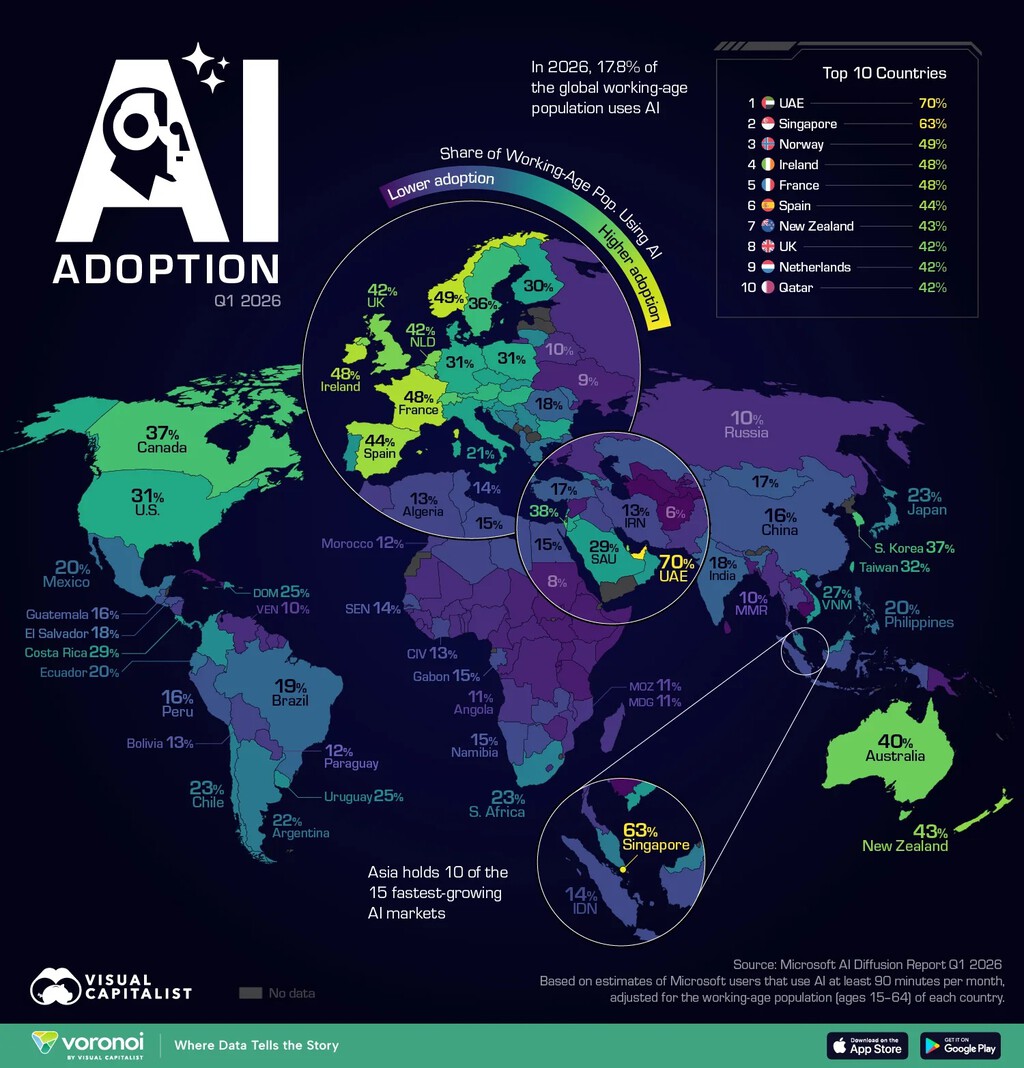
Visual Capitalist adapted the data into an infographic that color-codes countries by adoption rate: yellow for high adoption and darker tones for lower usage. This visual makes the global disparity immediately clear.
Global Leaders in AI Adoption
The ten countries with the highest AI adoption rates are primarily developed economies with strong digital infrastructure. While the report doesn't list them explicitly, the infographic shows concentrated yellow areas in North America, Western Europe, and parts of Asia-Pacific.
These leaders share common traits: high internet penetration, robust tech sectors, and supportive regulatory environments. Their workforces are also more likely to be in knowledge-intensive roles where AI tools are easily integrated.
Why Some Countries Lag Behind
Many countries show minimal AI adoption, often due to limited digital infrastructure, lower internet access, or economies dominated by sectors less amenable to AI integration. Regulatory hurdles also play a role, particularly in regions like Europe where legislation often trails behind technological advances.
Cultural and linguistic factors matter too: AI tools are predominantly developed in English, which can create barriers in non-English-speaking markets. Additionally, smaller economies may lack the investment capital to deploy AI at scale.
The Role of Profession and Skills
Even within countries, adoption varies widely by profession. Knowing how to use AI has become a skill in itself, essential for some roles but less so for others. A waitress, a secretary, a plumber, and a journalist will have different exposures and needs.
The report underscores that AI is not a one-size-fits-all revolution. Its impact is uneven, shaped by the nature of work and the availability of training. Workers in repetitive cognitive tasks may find AI more immediately useful than those in manual or highly creative roles.
Key Takeaways from the Report
- Only 17.8% of the global working-age population uses AI, indicating vast untapped potential.
- Ten countries lead in adoption, while many others remain far behind.
- Microsoft's telemetry-based method may undercount users of competing AI services.
- Profession and digital infrastructure are strong predictors of adoption.
- Europe's regulatory environment may slow adoption compared to other regions.
Comparison of Adoption Drivers
| Factor | High Adoption Countries | Low Adoption Countries |
|---|---|---|
| Internet Penetration | High (>80%) | Low (<50%) |
| Tech Sector Strength | Strong | Emerging or weak |
| Regulatory Environment | Supportive | Restrictive or unclear |
| Language of AI Tools | Primarily English | Non-English dominant |
| Workforce Composition | Knowledge-intensive | Manual or agricultural |
What This Means for the Future of Work
The report's findings challenge the narrative that AI is universally disrupting jobs. Instead, it shows a world where adoption is patchy, and the benefits are concentrated in certain regions and sectors. The background to this story is set out in UN Adopts Equal Earth Map to Correct Western Bias. A related thread runs through China's AI Adoption Hits 700 Million Users: Why the West Lags. Earlier coverage in Technology: latest articles shows how the argument developed.
For workers, the message is clear: AI skills are becoming a differentiator. Those who can leverage AI in their roles may find themselves more productive and valuable, while others risk being left behind. A closer look at the same subject appears in Windows 11 Weather App Uses Over 1GB RAM: Bloatware Exposed. Anyone following the wider picture can start with Distraction-Free Keyboards: The Booming Business of Focus. The same theme surfaces in ChatGPT's Meteoric Rise: 1 Billion Users and Surpassing TikTok, which takes a different angle.
For policymakers, the data highlights the need to invest in digital infrastructure and education to ensure broader participation in the AI economy. Without such efforts, the gap between AI haves and have-nots will only widen. Context on how this played out before sits in How Many Millionaires Live in Spain in 2026? New Data Reveals. A companion piece, Microsoft AI Diffusion Report: Global AI Adoption Map Revealed, approaches the same subject from another angle.
FAQ
What is the Microsoft AI Diffusion Report?
It is a report that monitors AI usage across 100 countries using anonymized telemetry from Microsoft products, providing insights into global adoption trends.
How does Microsoft measure AI adoption?
Microsoft uses telemetry from its products to track interactions with AI features, then applies statistical adjustments to account for users of other AI services.
Which countries lead in AI adoption?
The report identifies ten leading countries, primarily developed economies with strong digital infrastructure and tech sectors, though the specific list is not detailed in the source article.
Why is AI adoption uneven globally?
Factors include internet penetration, regulatory environments, language barriers, and the nature of local economies, which affect how easily AI tools can be integrated into work processes.
Browse the Shop
 Acacia frida deluxe solid wood bed frame |
Bedroom bench |
Bed chest drawers |
Lingerie dresser |
Frame base |
Mirror with jewelry storage |
30 Bathroom Vanity |
Memory foam queen mattress |
Mattresses for back pain |
Nightstand set of 2 |
Grand Goldman Shop |
Civil Lawyer
Deutschland Trikot WM 2026







