


South Africa is a vibrant and diverse destination that attracts travelers from around the globe. With its stunning landscapes, rich history, and unique wildlife, it's no wonder that it ranks among the top travel spots on the African continent.
However, before you pack your bags, there are some essential South Africa travel tips to ensure a smooth and safe trip. As someone who’s explored both the bustling cities and tranquil natural reserves, I’ve gathered the most up-to-date, reliable advice to help you get the most out of your adventure.
One of the first things to consider is safety—it’s a crucial aspect of any trip to South Africa. While it offers an unparalleled experience, like safaris, visiting Cape Town, and exploring the Winelands, understanding how to navigate the country’s diverse regions is key to a safe journey.
You’ll also need to plan for travel logistics, like local transport and accommodation options. When it comes to the best time to visit, South Africa offers year-round travel opportunities, but understanding the climate can help you plan the perfect trip. Whether you’re a first-time visitor or returning to explore more, these tips will prepare you for a safe, memorable journey to one of the most captivating countries in the world.
Tips for travelling to South Africa on your own
Do you know what load shedding is? Do you need to rent a car to travel around South Africa? How many days are recommended in the Kruger? What is the best time to go? Can you see the Big Five? Don't worry, below you will find all the information you need to organize a trip to South Africa on your own and enjoy a memorable African adventure.
1. Best time to travel to South Africa
The good news is that you can visit South Africa all year round , as no season is considered bad. Keep in mind that being in the southern hemisphere , the seasons are reversed: when it is winter in Spain, it is summer there, and vice versa.
The climate in South Africa varies from area to area, but generally enjoys warm summers (December to February) and mild winters (June to August) with cooler temperatures in the interior of the country.
As for the rains , the wet season in the Cape Province (southwest of the country) starts in April and lasts until September, while in the eastern regions (Kruger area) it lasts from October to February. This is the theory, you know that in the times of climate change we live in it is difficult to predict. We went the first time in October and the second time in August and we noticed that in the east of the country the colors were much greener with the first rains in October.
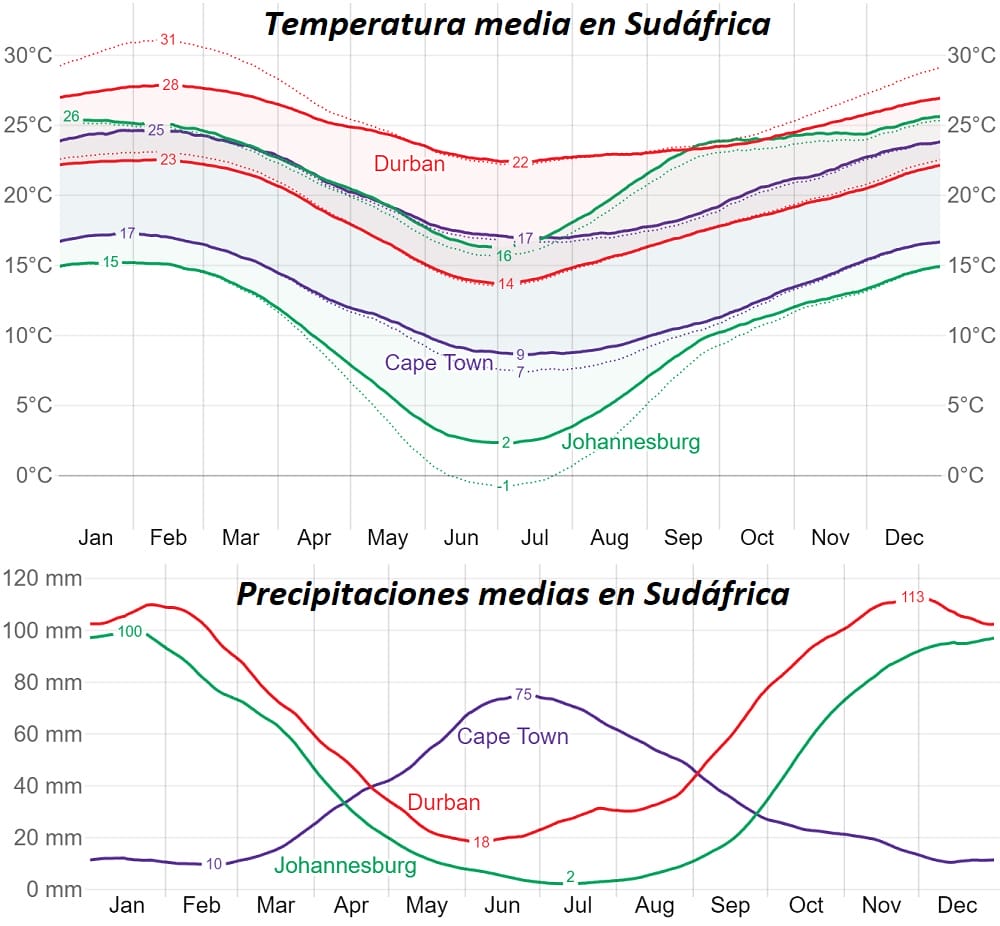
Generally speaking, we would say that the best months to travel to South Africa are from August to November , which is the end of the dry season in the Kruger and therefore ideal for animal watching (the vegetation is not so dense and they come close to the few waterholes to drink).
March and April , the southern autumn, are also good times to visit . However, many people prefer to go between December and March (South African summer) as temperatures are higher and you can enjoy the beaches.
Other dates to consider are school holidays , when South African families take advantage of the opportunity to travel around their own country (and especially to the national parks, such as Kruger, which are often full). These take place between June and July and for a week at the end of September . During these periods of high occupancy, prices increase and availability is reduced.
As we mentioned, our first trip was in October and we found it to be a pretty good time. It is true that we had some torrential rain in the centre of the country, but in general we enjoyed a great climate, neither intensely hot nor cold. The second trip was at the end of August and beginning of September and we found some rather arid and dry landscapes.
What is clear is that, regardless of the season, you must come prepared for all types of climates , because in one day you can experience all 4 seasons!
2. Visa to enter South Africa
Fortunately, the vast majority of nationalities do not need to apply for a visa in advance to enter South Africa and stay between 30 and 90 days . Spain, other European countries and most Latin American nationalities enjoy this right, although there are some exceptions such as Colombia, Nicaragua, Honduras or the Dominican Republic.
If you have any questions, it is best to contact the South African embassy or consulate in your country directly.
Important : the passport must have at least 2 blank pages (I narrowly escaped) and be valid for at least 30 days from the date of departure from the country.
3. South Africa must-sees
South Africa is a very diverse country that offers very different landscapes and activities for all types of travelers. From its wild coast where you can surf, national parks where you can improvise safaris, incredible cities like Cape Town where you can try exquisite cuisine or very interesting museums where you can learn more about the dark chapter of Apartheid ... There are a thousand things to do in South Africa, but these are our must-sees :
- Cape Town : one of the most beautiful cities we have ever seen, thanks especially to its brutal natural scenery.
- Cape Peninsula : spectacular beaches, penguins, cliffs, panoramic roads and many more surprises.
- Hermanus : A charming seaside town world famous for whale watching.
- Winelands Tour : This wine region is a delight for wine lovers, with historic wineries, idyllic landscapes and colonial architecture.
- De Hoop Reserve : we fell in love with its dune landscapes, whale watching and a unique variety of flora and fauna (those cute bonteboks).
- Garden Route : A scenic, panoramic road that winds through stunning natural surroundings and national parks.
- Addo National Park – Home to elephants and other animals, this is a perfect place for a self-guided safari and wildlife viewing.
- Santa Lucia + iSimangaliso : synonymous with hippos and wetlands. Are you going to miss it?
- Kruger National Park : without a doubt one of the best places in the world for safaris, and here you can do them at your leisure… a real luxury!
- Panorama Route : Waterfalls, lookouts, rock formations and one of South Africa's most stunning scenic drives.
- Johannesburg : Vibrant and multicultural, Johannesburg is the economic and cultural epicentre of South Africa. Must-sees include the Apartheid Museum and the Soweto neighbourhood .
- Extra : It is worth including a short stop in Eswatini to visit the Hlane National Park . We went both times by car from St Lucia and spent a night there before continuing to Kruger.
⭐ Here we tell you in more detail the best things to see and do in South Africa .
4. 3-week itinerary for South Africa
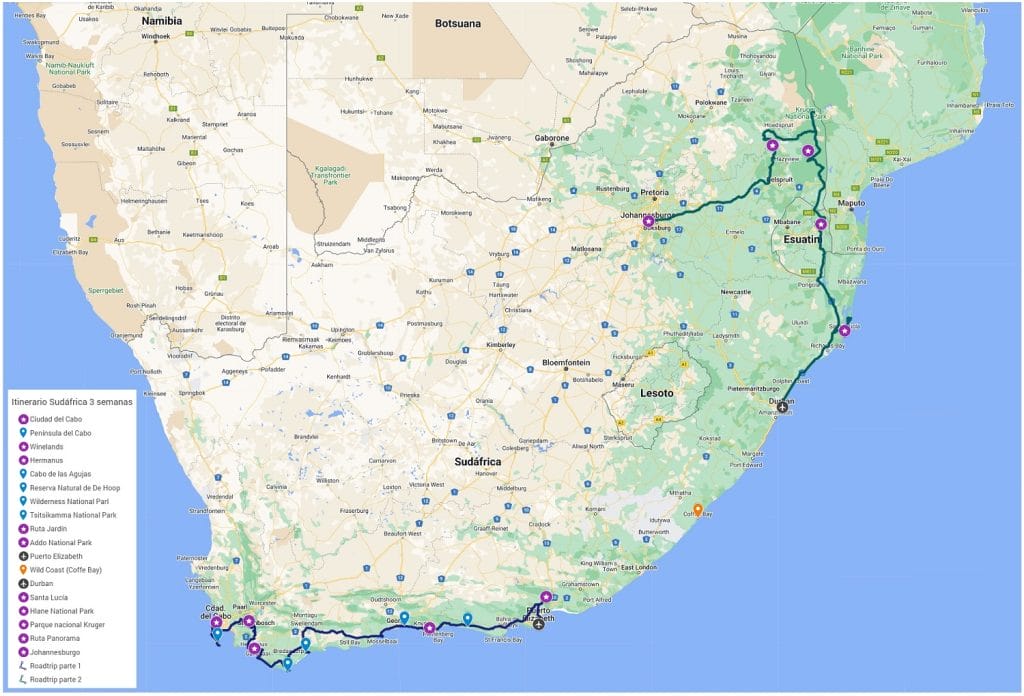
For our first trip to South Africa, we spent a total of 27 days exploring the country. For our second trip, we spent 16 days, focusing on Cape Town and the eastern area (Saint Lucia, Eswatini and Kruger). We believe that 2 or 3 weeks can be a great and complete itinerary. This 3-week route seems to us to be the most suitable:
- Days 1, 2 and 3 : Cape Town (+ Cape Peninsula)
- Day 4 : Winelands
- Day 5 : Hermanus
- Days 6, 7 and 8 : Garden Route
- Day 9 : Addo National Park
- Days 10 and 11 : St Lucia and iSimangaliso Park. We drove for several days to get there, but logistically it is better to take a flight from Port Elizabeth to Durban and rent another car there, to save some time.
- Day 12 : Hlane National Park (Eswatini)
- Days 13-19 : Kruger National Park
- Day 20 : Panorama Route
- Day 21 : Johannesburg
Do you have a little less time? This was the route we took on this second 2-week trip through South Africa :
- Days 1, 2 and 3 : Cape Town (+ Cape Peninsula)
- Day 4 : Flight to Durban and rent a car to go to Saint Lucia
- Day 5 : Santa Lucia and iSimangaliso Park
- Day 6 : Hlane National Park (Eswatini)
- Days 7 to 13 : Kruger National Park
- Day 14 : Johannesburg
⭐ We leave you the best route through South Africa for 2 and 3 weeks
5. Rent a car in South Africa
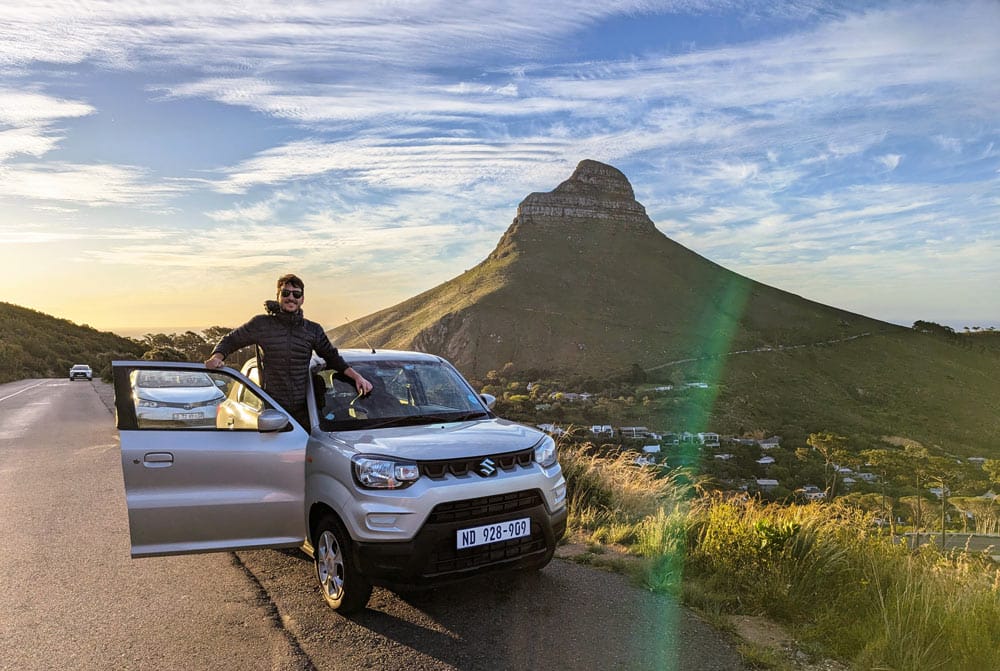
Based on our own experience, we believe that renting a car in South Africa is the key to organizing a great self-drive trip . There are almost no tourist-friendly bus lines throughout the country, only local transport, which is slow and uncomfortable, and does not go everywhere.
On the first trip we picked up our car (named Piccolo e Tondo ) directly at Cape Town airport on arrival and returned it to Johannesburg airport on departure. The second time, we rented a car just for the 3 days in Cape Town (just to tour the Cape Peninsula) and another one from Durban to Johannesburg.
As we mentioned, the other interesting alternative is to divide the trip into two parts and reserve two rental cars:
- The first between Cape Town and Port Elizabeth
- Flight from Port Elizabeth to Durban
- The second between Durban and Johannesburg
⭐ We give you more information on how to drive and rent a car in South Africa so you can get started in the wonderful world of potholes hehe.
6. Currency, budget and reference prices
If you are used to European prices, South Africa will probably seem like a relatively cheap country to you . You can enjoy small treats by paying much less than in the Old Continent. For example, getting around the cities in an Uber, having an Aperol spritz in an idyllic place, staying in a gorgeous hotel or B&B, going to a cenote with a tasting menu or drinking a beer on a terrace facing the sea.
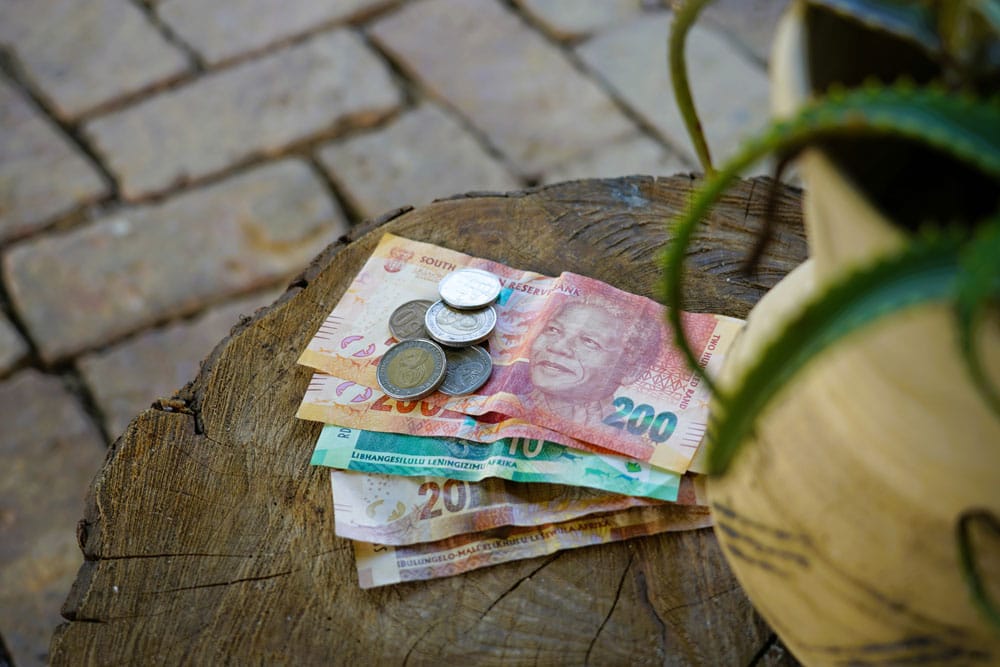
But let's start with the most important thing: the currency in South Africa is the Rand (ZAR) , and the best way to have cash on hand is to have previously taken out one of the special cards for travelling, with which you can avoid bank fees. The one we always recommend is the Revolut card (with a €10 promo if you sign up now), and as an alternative, the N26 card is also interesting . Both have a free version.
What you cannot avoid is the commission that South African ATMs charge (estimate a fixed 75 Rand per withdrawal, approximately €3.50). Remember that when you withdraw money you must select the option that does not convert it to € because you will be hit with a big rip-off.
Important : If you have a choice, choose to use ATMs located inside bank offices, in shopping centers and closed places.
You won't need to take out a lot of money, as card payment is widely used throughout the country, even at craft stalls. It's also a good idea to carry several of these cards, as you never know when one might fail.
Some reference prices in South Africa are:
- Specialty coffee at a cute coffee shop (for example at Truth Coffee, considered the best coffee shop in the world): €2
- Bottle of beer in a restaurant: €1.50-€2
- Coca-Cola in a restaurant: €1
- Pint of beer or cocktail: €3-5
- Burger or fish dish: €7-12
- Fish&Chips at local place: 4-5€
- Night in a medium-sized hotel or B&B: €40-60
- Night in a bungalow in Kruger: 80-90€
- Guided safari in Kruger: 20-25€
- Wild Card: €300 (for 2 people)
- Car rental for 2 weeks with insurance and one-way: €400-500
✓ Tips
They are not included in the ticket, but it is customary to leave a tip of 10-15% in restaurants . It is also customary to give a few coins to people who “watch” the cars in the parking lots and to gas station employees when they clean your window.
7. Wild Card
One of the best tips for travelling to South Africa that we can give you is to get a Wild Card. This is a card that allows you to access several protected areas and national parks in the country (from Kruger to the Cape Peninsula, for example), and avoid paying daily conservation fees for each park you visit. It is valid for one year and is available in different categories (individuals/couples/families).
Is it worth it? In our case we opted for the Wild Card for couples, the price is about €300 and it was worth it. Just by visiting Kruger for 6 days it is already worth it, but if we also add other parks and reserves such as the Cape Peninsula, De Hoop, Addo, the discount on Table Mountain, etc. it is even better.
→ You can buy it on the SANParks website or at the park ticket offices.
✓ Kruger National Park
The Kruger is one of those places in the world where you put your whole life into perspective and feel a brutal connection with nature . There you get into a fantastic routine , driving around the park in your car, improvising safaris and moving from one camp to another waiting for the surprise of seeing a lion or a leopard appear at any moment. In addition, the possibility of joining cheap guided game drives (20€) is an extra plus.
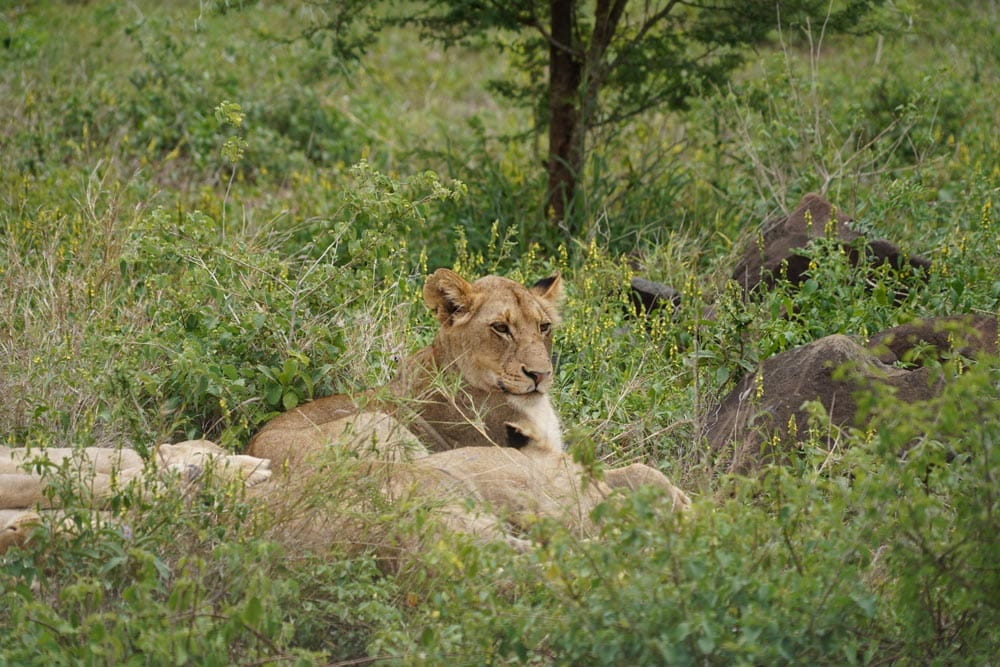
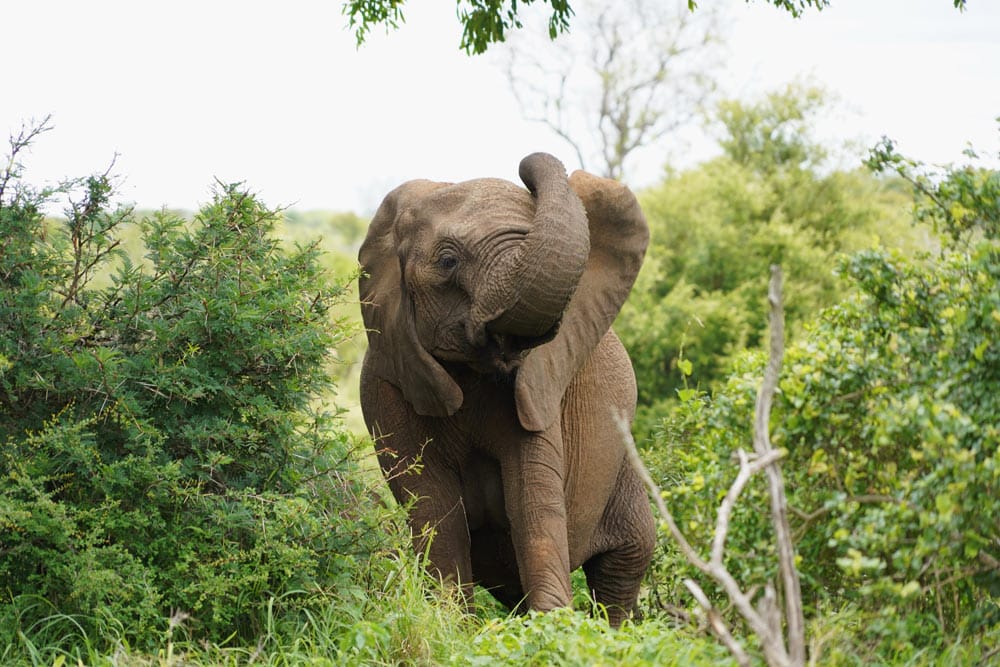
Kruger National Park is famous for being one of the best parks in Africa to see the “Big Five” (lion, leopard, elephant, buffalo and rhino). But there are many other animals, some of which you will tire of seeing (zebras, giraffes, wildebeest, crocodiles, impalas and more antelopes… and others more elusive like hyenas, cheetahs or African wild dogs.
On both trips we spent a good number of days in Kruger (8 and 7 respectively) and were only able to visit the southern half (although they say that the northern area has less wildlife). It may seem like a lot, but we assure you that every day you spend in this park on your itinerary through South Africa will be worth it.
⭐ We have prepared a post with the best tips for travelling to Kruger , as there is a lot to know and organise. And another one telling you all about accommodation and campsites in Kruger , because it will be the first thing you will do to plan your expeditions (the process is a bit complicated but once you get the hang of it, you won't have any problems). An important tip: book in advance: places in the camps fly!
8. Security in South Africa
Is it safe to travel to South Africa? This was, without a doubt, the question we received most times on social media while we were talking about our trip. And it is not an easy question to answer, to be honest.
Let's start with our experience: during both trips we didn't have any security problems . It's true that we arrived a bit scared because of the country's reputation, but we quickly felt comfortable and throughout the almost month and a half that we were there in total, we didn't have any bad experiences.
Obviously there are areas that require more respect and others that should be avoided , but if you are travelling as a tourist, you will not need to go into shady neighbourhoods. To find them, always ask at the hotel reception for information on dangerous streets and areas, or look online for safety tips for the cities you visit.
Something that is impressive is seeing entire neighborhoods with houses protected by electrified fences , slums crowded in townships on the outskirts of large cities, or the deep segregation that still exists in South African society. A consequence of the damned Apartheid , the system that governed the country between 1948 and the early 1990s and that caused a huge gap in the distribution of wealth and opportunities among the population, which obviously contributes to street crime.
As for the road trip itself , we found the roads to be safe (although some are in questionable condition), we crossed city centers without any problems and people just ignored us. Forget about jumping red lights to avoid having to stop or weird things. What you should avoid is driving at night, not only because of the insecurity on certain streets but also to avoid running over any wild animals crossing the road.
That said, it is undeniable that it is a country where certain security recommendations must be followed :
- Do not drive at night.
- Learn about neighborhoods to avoid in big cities.
- Always lock your car and don't leave anything in sight (when it's nothing, it's absolutely NOTHING).
- Don't show off expensive belongings or take out wads of cash on the streets.
- Do not carry large amounts of cash.
- Leave the documentation at the accommodation and take only one copy with you.
- Uber is a safe and cheap way to get around cities, better than a taxi.
- Do not wander around the cities at night.
- Always use common sense and do not trust or let your guard down when faced with suspicious behavior.
✓ Vaccinations required for travel to South Africa
There are no mandatory vaccinations, but it is a good idea to be vaccinated against hepatitis A+B (three doses, free), typhoid fever (one dose or 3 pills taken on alternate days, free), cholera or traveler's diarrhea (two sachets, free) and tetanus (one dose, free).
In addition, if you come from countries with a risk of yellow fever transmission (or have transited for more than 12 hours in one of them), a yellow fever vaccination certificate is required.
As for malaria , it is present in certain areas of the country (especially in the eastern provinces, including Kruger), so it is essential to take maximum precautions against mosquito bites. As you know, there is no vaccine against malaria, but there is a prophylaxis ( Malarone ): it is taken one day before entering the risk area, for the entire duration of your stay and 7 days afterwards. And very important: contact your insurance if symptoms appear.
→ More health advice and appointments with the international vaccination centre
9. Best travel insurance for South Africa
Luckily, we didn't have to use our travel insurance, but we obviously always have our backs covered. And here's another top tip for traveling to South Africa: don't travel without insurance . Investing in good travel insurance can save you a fortune in the event of illness or emergency, and this applies to every trip.
In the case of South Africa, we recommend the Iati Standard insurance as it includes a broad limit on medical expenses (up to €500,000) as well as other interesting coverages, 24-hour assistance in your language and no deductibles (which means you don't have to pay any money in advance).
For family trips, especially if there are small children, we recommend Iati Familia insurance , which covers up to €300,000 of medical expenses (per insured) and other special coverage for this type of trip.
You already know that if you purchase insurance from these links you will benefit from a 5% discount .
10. Accommodation in South Africa
Apart from the accommodation in Kruger, which we found expensive and poor value for money, the rest of the country surprised us with beautiful hotels and guest houses at reasonable rates . These were our accommodations:
- Cape Town: Stone Cottage
- Franschhoek: a divine B&B
- Hermanus: B&B 13 on 2nd
- Cape Agulhas: Agulhas Ocean House
- Garden Route: Walter's Place / Fairy Knowe Hotel / Misty Mountain Lodge
- Addo: Ndlovu Addo River Lodge
- Wild Coast: Driftwood Treehouse / Wildview Cottages Coffee Bay (we couldn't go due to rain) / Sugar Beach Resort
- Santa Lucia: Sunset Lodge
- Hlane (Eswatini): Ndlovu Camp
- Kruger: Crocodile Bridge / Lower Sabie / Skukuza / Satara / Olifants / Tamboti
- Panorama Route: Paradise View Guesthouse
- Johannesburg: The Catalyst
We booked all accommodation (except the Kruger camps) through Booking about a month in advance (important to get good prices and availability) and always with free cancellation, in case the plan changed. We also looked at Airbnb in certain places, such as Cape Town, but we were not completely convinced.
11. Beware of power outages (Load Shedding)
Since 2007, due to the energy crisis in the country (partly due to the obsolete way in which energy is generated and partly due to the increase in demand), the South African government has implemented a system of scheduled blackouts , known as “National Loadshedding”. In other words: in South Africa, sometimes there is no electricity and this will surely end up affecting your trip. Its objective is to balance the amount of electricity available with the demand, thus avoiding massive blackouts.
Blackouts usually last a couple of hours (this depends on the degree of the blackout, or “stage”) and occur in areas, entire neighbourhoods or towns, according to a schedule that the national energy company Eskom schedules in advance. You can check if and when you will be affected through their website https://loadshedding.eskom.co.za (only if you connect from a South African IP) or in their APP “Eskom Se Push”. We recommend that you download the APP before your trip and add the areas where you will be staying.
During power outages you will not be able to use the accommodation's electrical grid (no WiFi or charging your mobile phone), unless they have generators. However, all accommodations are well prepared with autonomous lights, flashlights in the rooms, etc.
Update : In Cape Town, the blackouts have been temporarily suspended and we hope this will be for good, unlike in other areas of South Africa. It is best to check the schedules, both on websites/apps and by asking at the accommodation.
✓ Plugs in South Africa
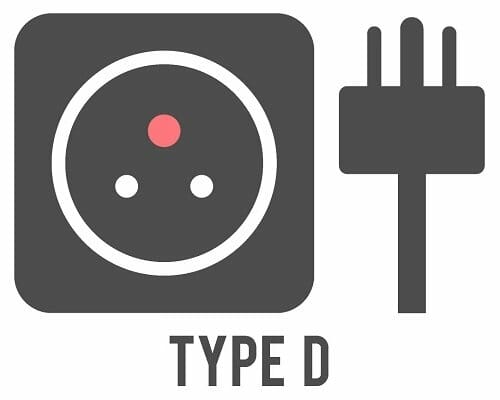
The plugs in South Africa are of type D and M, with 3 holes , different from those in Spain, so it will be necessary to buy an adapter. It is true that in many hotels there are universal plugs installed that you can use without any problem, but in the Kruger camps, for example, there are only the national type.
If you're going to buy an adapter from Amazon, keep in mind that universal adapters don't usually have this type of plug and you'll have to find one specific to South Africa . We bought one from a supermarket there and had to cut off the plastic ring around the part with the two holes to use the large round plugs, like the one on the laptop. They also sell them in the Kruger shops for around €3.
12. How to get internet in South Africa
Although all accommodations and restaurants have Wi-Fi (although sometimes it is limited), we highly recommend getting a SIM or eSim so you can have internet on your phone at any time. Especially since you will be spending many hours on the road and sightseeing, so having access to the internet is essential.
We took a Holafly eSim with us before we left on our trip and bought an MTN SIM card from a shop in a shopping mall in Cape Town (spoiler alert: not the best company).
⭐ In this post we tell you about our experience and we talk about the different options of how to have internet in South Africa
13. Apartheid
Last but not least, a fundamental piece of advice for travelling to South Africa: read, get informed, watch films about Apartheid , one of the darkest chapters in the country's history. Talking about Apartheid is complicated, and it is even more difficult to try to summarise in a few words what it was and what it meant, but we tried...
It was a system of segregation that was implemented in South Africa from 1948 until the early 1990s, which discriminated against the population based on the colour of their skin, giving privileges to the white minority and limiting the rights and opportunities of the black majority. It was a period of great injustice and violation of human rights, which was finally abolished after the emergence of an anti-apartheid movement and the release of Nelson Mandela in 1990.
→ To expand your knowledge in an entertaining way, we recommend listening to Diana Uribe 's "South African history" series, which you can find on various podcast platforms .
What we didn't know before arriving was that although apartheid no longer exists, there is still a clear segregation in South African society today . Black communities often face major economic and social challenges, including limited access to basic services and educational and employment opportunities.
⭐ If you want to learn more, we have a post where we talk more in depth about the topic: Apartheid in South Africa .
More tips for traveling to South Africa
Before finishing the post we leave you with a few more recommendations and useful information:
- There is a before and after going on a safari with binoculars . And although they are expensive, we recommend you bring good ones. We bought the Olympus 10×50 S and they also recommended the Nikon Aculon A211 to us .
- For the next trip we have a new gadget in mind: a very powerful flashlight . It is not essential, but it will keep you entertained on night safaris and at dinner in some of the restaurants at the camps.
- Other things that you should definitely pack include a light raincoat, power bank, sunscreen, mosquito repellent, and a cap or hat (you don't need to dress like a 19th century explorer). If you forget something, keep in mind that almost everything can be found there without any problem.
- One of the best experiences to have in South Africa is to have a braai (South African barbecue). It is not just a meal, it is a whole social and cultural event! There are barbecue facilities in every accommodation and wood is sold in bags in almost every supermarket.
- Of course, foodie travelers will enjoy the rest of the local cuisine . Here we tell you the dishes that you must try in South Africa .
- Regular supermarkets don't sell alcohol (only some have a wine section) so if you want to buy beer and other spirits, you'll have to go to a "liquor store", which is often right next to a large supermarket.
- If you are not sure about including Johannesburg in your itinerary due to security issues, we did the combo of a tourist bus + tour of Soweto and found it very interesting.
- More travel advice from the Ministry of Foreign Affairs .
We hope this post with travel recommendations for South Africa will help you, calm you down and encourage you even more to enjoy one of the adventures of a lifetime 😉 We already told you: the rainbow nation is an endless number of truly brutal landscapes, from beaches to waterfalls, not to mention its natural parks and reserves full of wild animals. We can only tell you that we are going back two years in a row, and we still have many more to go.
Popular Beach Hotels
Best beach hotel in South Miami for a bachelorette party | Best beach hotel in Lamai Koh Samui | Best beach hotel in Waikiki for families | Best beach hotel in Cabo with swimmable beaches | Best beach hotel in La Jolla California
France Travel Guides
Best Paris neighborhoods | Best free museums Paris | Paris dining tipping etiquette | Best places Latin Quarter Paris | Best public transport Paris | Best places to visit Paris | Best free place to see Paris | Best things to do Paris Winter | Best Restaurant Paris | Paris travel guide | Best hotels Leman Lake Geneva Switzerland | Best spa hotel wellness center Ile de France Paris | Best Michelin star restaurant Avignon France | Best castle hotel France | Best restaurants La Rochelle France | Best luxury honeymoon destinations France







