

No one likes having to deal with a situation where they have to put out a fire. However, like everything in security, along with housing comes the need for prevention. That's where the fire extinguishers and his role fire protection .
Therefore, we provide you with the following guide on the types there are, as well as their use. Keep in mind that you will not need the same type of extinguisher if you live in a house, a neighborhood community, a small building, etc. Besides, Not all of them work the same.
Find Bleeding Edge Supplements at Scandalous Prices on iHerb.

Is it mandatory to have a fire extinguisher?
In Spain, there is legislation that regulates the presence of fire extinguishers in homes. According to this, citizens are not obliged to have one in their private homes, so on an individual level the answer would be no.You are not required to have a fire extinguisher inside your home.
On the other hand, the situation of theneighborhood communitiesIt's something different. The Basic Building Standard establishes the obligation for buildings built or rehabilitated after 1996 to have fire extinguishers.
That is, any community built after that year, or in which any major rehabilitation has been carried out, You must have these devices .
Regarding the placement, this comes regulated in Royal Decree 513/2017 , which indicates the following:“The location of the extinguishers will allow them to be easily visible and accessible; they will be located close to the points where it is estimated that the fire is most likely to start.
If possible, close to the evacuation exits and, preferably, on supports fixed to vertical walls, so that the upper part of the extinguisher is located between 80 cm and 120 cm above the ground.
If possible, close to the evacuation exits and, preferably, on supports fixed to vertical walls, so that the upper part of the extinguisher is located between 80 cm and 120 cm above the ground.
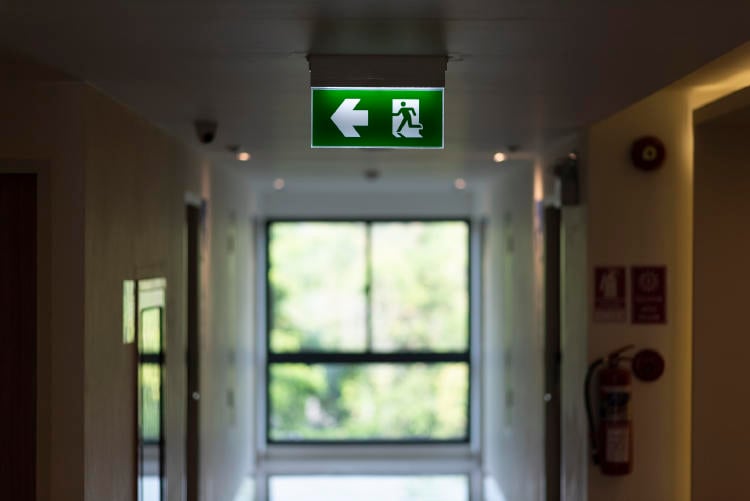
Its distribution will be such that the maximum horizontal path, from any point in the fire sector, which must be considered the origin of evacuation, to the extinguisher, does not exceed 15 m.
Thus, although the buildings prior to 1996 that are not rehabilitated do not have this obligation Yes, it is a fire protection measure that is important to have. Among its greatest advantages are effectiveness and price.
Types of fire extinguishers
To familiarize yourself with the types of fire extinguishers on the market, you need to know how the different types of fires that can start in a home are classified.
This classification is established taking into account the materials involved in the origin of the fire :
The type AThey are fires caused by solid materials, such as firewood, garbage, etc. In the case of the i type B fires, fuels are flammable liquids or gases. Another possibility is that they originate from electrical equipment and are classified as type C.
It may be that even metals are the fuel for a fire. In this case, they are classified as type D fires. A classification that not all include is that of type K. It is a very specific name that refers to arson. by burning oil or fat.
Many times, they are included in type B fires, considering the fuel as a flammable liquid.
Knowing these types of fires is necessary to correctly choose the best fire extinguisher for our private home or for the building in which we reside. That said, let's see what types of fire extinguishers are on the market:
- The e water extinguishersthat spray water under pressure. They are very useful for fires. type A. Water works well when trying to put out a fire on a solid surface. However, it is not recommended use them if the fire originated in a electrical appliance , since, being a conductor of electricity, water has a danger of electrocution.
- Another option is the e ABC powder extinguishers.As their name indicates, they are recommended for fires of type A, B and C . They also work well to put out class K fires.
- Similar to the previous ones, we haveCO2 extinguishers. They are suitable for extinguishing fires type A, B and C (in addition to type K) . The only difference with respect to the previous ones is that these have a greater risk of poisoning, since they expel a chemical element.
- Lastly, there are thefire extinguishers for special fires.They act by suffocation and cooling. They are the only ones suitable for class D fires, although these are the least common in homes.
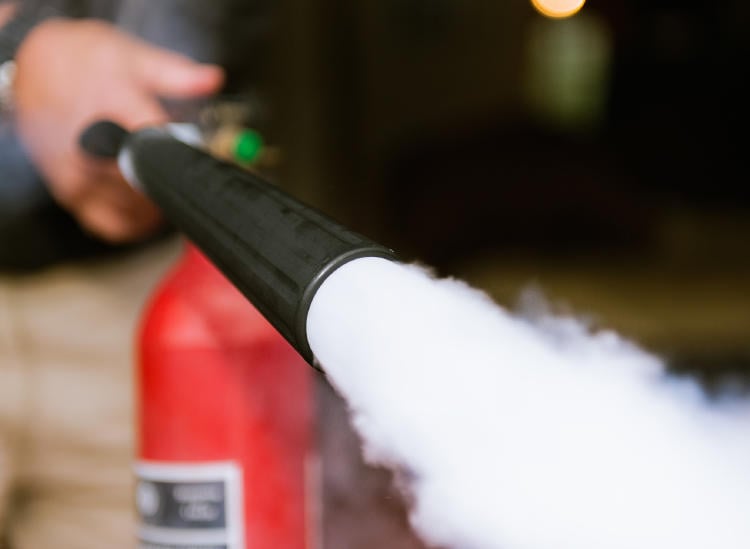
When choosing the right device for your home, you should take into account a series of criteria. To begin with, the weight, since the handling of a fire extinguisher depends in part on whether it is not too heavy. Intended for domestic use,There are 1, 6 and 9 kilos.
La homologation is also very important . Check that the labels on the fire extinguisher ensure that it has the corresponding guarantees. And, in addition, you will also have to consider the price.
ThisIt usually ranges between 20 and 100 euros, so you can find some very affordable ones.
From this publication, we recommend an ABC powder extinguisher, which are usually the most effective for home use according to experts.
Tips for using the fire extinguisher at home
When you have the right one, whether for your own home or for the building you live in, remember that it should be in a visible place and as close as possible to danger areas.
The fire extinguisher usually come with what you need to hang it on the wall , so remember to place it at a height accessible to you, but out of the reach of children.
Regarding the procedure for using the fire extinguisher, domestic ones are relatively simple to use, although you must be careful. First of all, remove the safety ring.
Once done, Aim straight at the fire and squeeze the way to let out the water, powder or substance contained in the extinguisher. If you have the windows open and it's windy, use itin the direction of the wind.
Remember to move it in a zigzag pattern and, once the fire is out, place it on the ground horizontally and wait for the emergency team to arrive. When the firefighters arrive, seeing it in this position will know that it has been used and that they must recharge it.
Finally, keep in mind thatThe useful life of a fire extinguisher is around 20 years, from the date of the first stamp. The stamping is the first test that is carried out with it, and the date is written on its label.
It doesn't matter if you want to protect your apartment, if you live in a single-family home or if you are looking for safe investments with your business. In Yoigo Alarms We have the devices you need.
Read next: Best bedroom hidden cameras | Best Spy Camera Watch | Best low level CO detector | Best Wifi Router EMF Protection | Best Camera for MEVO Plus | Best Security Camera Without Subscription | Best Budget Camera for Blue Iris | Best Barking Dog Alarms | Best Free VPN for Rainbet | Best Solar Powered Security Camera | Alarmes Maison
Browse the Shop
 Acacia frida deluxe solid wood bed frame |
Bedroom bench |
Bed chest drawers |
Lingerie dresser |
Frame base |
Mirror with jewelry storage |
30 Bathroom Vanity |
Memory foam queen mattress |
Mattresses for back pain |
Nightstand set of 2 |
Grand Goldman Shop |
Civil Lawyer
Deutschland Trikot WM 2026
Acacia frida deluxe solid wood bed frame |
Bedroom bench |
Bed chest drawers |
Lingerie dresser |
Frame base |
Mirror with jewelry storage |
30 Bathroom Vanity |
Memory foam queen mattress |
Mattresses for back pain |
Nightstand set of 2 |
Grand Goldman Shop |
Civil Lawyer
Deutschland Trikot WM 2026










