

The losses due to theft in commercial premises , they are very numerous in Spain , making the country one of the main countries in Europe to suffer this type of petty theft. Furthermore, inflationary cycles like the current one tend to aggravate these types of situations.
Anyone who has an establishment must take anti-theft measures to prevent the theft of your items. However, this becomes more difficult especially when dealing with small objects, which are easy to manipulate and can be hidden.
Find Bleeding Edge Supplements at Scandalous Prices on iHerb.

Of all the possible measures, one of the most used is anti-theft labels . We explain what they are and what security differences exist among the adhesive and rigid .
What are anti-theft labels?
The anti-theft labels They are one of the most effective security systems available for commercial premises so, if you have a business, it is undoubtedly an option to consider.
More specifically, they are elements that are placed in the store items , and issue a alarm signal if someone tries to steal them.
These devices do not work on their own, but are complemented by a receiving element , which is the one receive the signal . Anti-theft labels work with different types of technology, generally electromagnetic, for radio frequency (RFID) or acustommagnetic.
At the moment that the article with the label on it crosses the security arch or receiving element, whatever it may be,sets off the alarmso you know that someone is trying to steal something from your business.
The main reason for using these labels is that they are small items, easy to handle and that, depending on how they are placed in the article, they may go unnoticed. As you may have guessed, for bypass the security system Thieves will try to remove the labels from the object, so ideally they will not detect it.
Once the definition of anti-theft labels is clear, let's see What types are there and which one best suits your needs? . This will depend fundamentally on the type of items you sell.
Types of anti-theft labels
Anti-theft labels can be of many shapes, but fundamentally they are divided into two types depending on the system used to adhere them to store items:
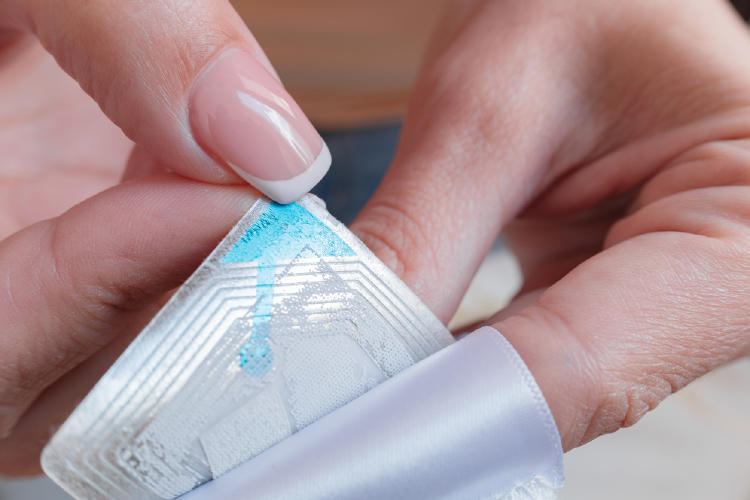
adhesive labels
As its name indicates, these labels are attached to the item . To avoid failures in the security system, these devices have a special glue that helps them adhere to the object and there is no possibility of them falling.
Rigid labels
Rigid labels are those that are commonly we refer to them as “alarms” . As we have already indicated, they can be in many different forms.
Once placed on the object, a special magnet to remove them , since if you try to tear them off the item would break.

Given these two possibilities, it is common for people to wonder which of the two options is safer than the other for a business. In reality, it will depend a lot on what the needs individuals, as well as budget that can be allocated to security in each case.
However, and to resolve possible doubts, we are going to explain below what are the advantages and disadvantages of the labels adhesive and rigid , to help you discern which one is best for your business.
Advantages and disadvantages of adhesive labels
Adhesive labels are essentially more practical than rigid labels. They have aglue specialwhich serves to adhere strongly to the items in your store, making it easier to alarm all the objects.
When selling a product, these labels are not removed to deliver it to the customer, but rather they are deactivated, normally by the billing system itself. This allowsstreamline cashier work, since the clerk will not have to spend time removing the alarms.
However, the glue on adhesive labelscan be harmful to certain materials, which is why it is not recommended, for example, for clothing stores. Likewise, it is preferable not to use them with other objects whose material may be sensitive.
Compared with rigid labels,They are much cheaper, among other things due to its deactivation system, which, as we have said, does not depend on an external element to remove them from the product.
Advantages and disadvantages of rigid labels
Rigid labels, on the other hand,they are more expensivesince they must be removed when collecting the product. It is not possible to disable them, so the client You cannot leave the store carrying them , or it would set off alarms in any case. To do this, a special device is used to release them.
To attach them to the products, a nail is usually used for all those that can be pierced, such as clothing, bags, cloth shoes, belts, etc. When it comes to rigid items that cannot be drilled, a strap is used to attach them.
Removing them is much more complicated than in the case of adhesive labels, soIt is a safer element. For alarm purposes, their operation is similar, since they also emit a signal that detects the security arc if the person tries to leave the premises with any object.
Which of the two options is better?
The first thing you should attend to is your type of business and what you sell . In some cases, there is no possibility of choosing between one or the other since, if you have a clothing store, adhesive labels are not an option, or at least not a recommended one.
However, if you have the possibility to choose, it is always preferable to consider safety criteria. In that sense, rigid labels they are safer , at the cost of making a slightly larger investment and sacrificing the speed of payments at the cashier. Remember that, by having to withdraw them manually, it will probably take you a little longer to collect.
En Yoigo Alarms We help you reinforce the security of your business with our alarm system. If you have any questions, visit our website or call us at 900 622 550 and we will be at your disposal.
Best bedroom hidden cameras | Best Spy Camera Watch | Best low level CO detector | Best Wifi Router EMF Protection | Best Camera for MEVO Plus | Best Security Camera Without Subscription | Best Budget Camera for Blue Iris | Best Barking Dog Alarms | Best Free VPN for Rainbet | Best Solar Powered Security Camera | Alarmes Maison
Browse the Shop
 Acacia frida deluxe solid wood bed frame |
Bedroom bench |
Bed chest drawers |
Lingerie dresser |
Frame base |
Mirror with jewelry storage |
30 Bathroom Vanity |
Memory foam queen mattress |
Mattresses for back pain |
Nightstand set of 2 |
Grand Goldman Shop |
Civil Lawyer
Deutschland Trikot WM 2026
Acacia frida deluxe solid wood bed frame |
Bedroom bench |
Bed chest drawers |
Lingerie dresser |
Frame base |
Mirror with jewelry storage |
30 Bathroom Vanity |
Memory foam queen mattress |
Mattresses for back pain |
Nightstand set of 2 |
Grand Goldman Shop |
Civil Lawyer
Deutschland Trikot WM 2026










