

Although no one is exempt from being robbed, there are many security devices to protect your home and not make it easy for thieves. The motion sensor and the presence detector will help you make your home safer, but what are the differences between the two and which option is better?
- The best security systems on the market by 2025
That will be the question we will answer throughout this article. This way you will not have any doubts regarding the installation of this type of devices. We hope it will be useful to you to improve and increase the security of your home or business.
Find Bleeding Edge Supplements at Scandalous Prices on iHerb.

How a Motion Sensor works: Complete guide
Sensor and detector are used interchangeably, since they both mean the same thing. Now, there are various types of sensors or detectors : for doors and windows, for smoke, motion and presence detection, etc.
In this article, we are going to focus on the main differences between the motion sensor and the presence detector . Although they do not have exactly the same use, they are often confused.
What is a motion sensor or detector?
To start, this is the general definition detector or sensor, whatever its function: it is a device capable of identify any changes on the spot where it is placed.
That is why it is so useful for prevent theft or send an alert immediately to the owner if there are intruders in the house. Even from notify the Police directly. Another very important function, in addition to security , is that they help you save energy in your home.
A clear example are the lights that turn on and off only when there are people in the room. Likewise, they offer a great comfort , since you will not have to locate the switch in the middle of the darkness.
How do a motion sensor work?
Un motion sensor It is a device that detects changes in an environment and triggers a response, such as triggering alarms. Its operation is based on the detection of variations in heat, electromagnetic waves, or interruptions in a light beam , depending on the technology used.
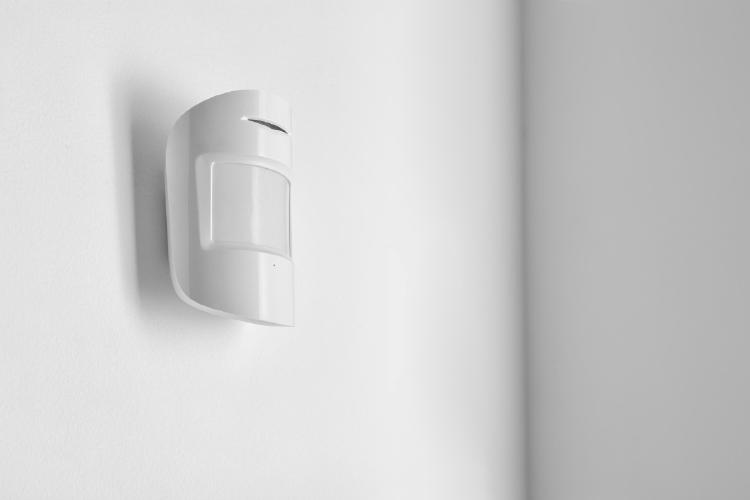
These sensors are commonly used in security systems, automatic lighting and home automation , improving energy efficiency and comfort. When detecting movement, they can turn devices on or off automatically , making them ideal for homes, offices and public spaces.
For optimal performance, it is essential install sensors in strategic locations , avoiding obstructions and sources of interference such as direct sun or drafts.
Additionally, some models include sensitivity and range settings , allowing it to adapt to different needs and environments.
Types of motion sensors
There are several types of alarms with motion sensors , although the main distinction that we must make is between the passive and active motion detectors. This categorization refers to its emission or reception of energy .
https://x.com/julegonzaleeez/status/1359485936371982338
There are different types of these detectors . There are those that use microwaves, vibrations, ultrasonic, or reflective. Also those with dual technology, which combine different types of waves ultrasonic.
However, They are not alarms widely used in homes or businesses because they can be annoying for the owners. They provide a highest number of false alarms in more closed spaces.
Passive motion detectors
Alarms with passive motion detector They are the most common for home protection . Those known as PIR They do not use the emitted energy, but instead receive infrared radiation to detect the presence of a body.
They are activated when noticing a sudden change in movement or heat , that is, to a human or animal nearby. It is the option cheaper and easier to install, in addition to having a very wide field of vision.
Besides, the most common is to come across a passive infrared motion detector (PIR) dual technology . The name also comes from using microwave technology . Queer? Yes, but it is what allows reduce the risk of false alarms, by jumping only when radiation from a body is detected.
At the most expensive—and effective—end are the dual technology PIRCAM . They are possibly the best alarms with motion sensor . This is because in addition to the functions that the previous ones have, They also send live images to the CRA.
Active motion detectors
Alarms with active motion sensor , as its name indicates, emit energy . They work by sending light, microwaves or sound into the environment, and measuring them. So, a reference standard is constituted.
In this way, the alarm will be activated when receiving a different sign to the one set as a reference.
Where and how is the motion sensor installed?
Detecting intruders depends, above all, on the area in which the device is placed. In the case of the alarms mentioned, PIRs are more effective in transit areas , such as hallways or parking lots.
In the case of the Dual technology PIR, It is advisable to place them in larger surfaces such as living rooms, kitchens, meeting rooms, offices, etc. to detect small movements.
The PIRCAMs , instead, They can be used both indoors and outdoors. Let us remember that they have built-in cameras capable of Completely eliminate false alarms.
No There are alarms specifically designed for outdoors. ?The reality is that yes, although they are not as reliable. We thus have:
- Outdoor Dual Technology PIR
- Active infrared barriers for perimeter protection
- Microwave barriers for perimeter protection.
- The former are merely of a anticipatory nature, while the latter, despite being similar , are equipped with intelligent settings that allow them to interpret the data. They are not infallible, but they are more effective than the others.
- However, the best ones for outdoors are microwave barriers for perimeter protection. They are made up of two key components; one emits the waves and the other deciphers the interruptions that occur. If there are any, proceed to determine the dimensions and speed of the body that caused them.
Differences between motion sensor and presence detector
The motion sensors and the presence detectors They are devices used to automate lighting, security and air conditioning systems.
Although they are often confused, They present key differences in their operation and applications. Next, we will see the aspects that distinguish them:
- Detection technology : The motion sensors They detect changes in the environment, such as thermal variations or interruptions in electromagnetic waves. The presence detectors , on the other hand, identify the permanence of a person in a space without the need for movement.
- Sensitivity : A motion sensor only responds to movements, while a presence detector It can register someone's presence even if they are stationary, thanks to its greater precision.
- Applications : The motion sensors They are used in alarms and security lights, where it is required to activate a system when moving. The presence detectors They are ideal for offices and bathrooms, ensuring that lighting or air conditioning remains active while people are in the area.
- Energy efficiency : The presence detectors optimize electrical consumption by keeping systems on only when necessary, while motion sensors They can turn off devices if they do not detect movement, even if people are still present.
Are motion sensor alarms pet friendly?
Sensors are detectors with the ability to measure the amount of the stimulus they receive to determine whether it is a danger or not. However, Not all of them are programmed to determine if radiation or movements are emitted by a pet. or a thief.
PIRs, for example, They do not detect animals on the street, and consider those in the home as intruders . Models are sold specifically to avoid detecting pets, but they tend to be less reliable, since they sacrifice margin for error.
For pet owners we recommend using PIRCAMs or alarms with specific movement detectors. The alternative is ask the technicians alarm installers to configure it in such a way that do not detect the movements of beings of certain dimensions.
La home security is a priority in any home. The more you know about devices that guarantee peace of mind, the better the choice you will make when it comes to hire one.
Frequently asked questions
How do you know if a motion sensor is damaged?
A motion sensor can stop working properly for a variety of reasons. To find out if it is damaged, you can check the following:
- Lack of response: If passing in front of the sensor does not activate any action (light, alarm, etc.), it could be faulty.
- Signs of physical damage: Inspect the device for cracks, burns, or broken parts.
- False shots: If the sensor activates the function (light, alarm, etc.) without anyone passing through its detection field, it is a sign that something is not right.
- Feeding problems: Make sure the batteries or electrical connection are in good condition.
If any of these points are present, you may need to repair or replace the sensor.
What are the disadvantages of motion sensors?
Although motion sensors are very useful tools, they have some disadvantages that you should consider:
- False positives: Sometimes the sensor can be activated by animals, temperature changes, or object movements.
- Limited scope: Some sensors have a reduced detection range, which may not be sufficient for large areas.
- Interference from external factors: Bad weather, such as rain or snow, can affect its performance.
- Energy dependence: If the sensor runs on batteries, you will need to keep them charged or replace them frequently.
How many meters of range does a motion sensor have?
The range of a motion sensor depends on the model and technology it uses, but in general:
PIR sensors: They have a range of 5 to 12 meters , depending on the quality of the sensor.
Ultrasonic sensors: They can reach up to 20 meters or more, since they use sound waves to detect movement.
Microwave sensors: Its reach can exceed 20 meters , but they are more sensitive to interference.
What is the best place to place a motion sensor?
The best place to place a motion sensor is near main entrances , such as doors and windows, to detect intruders. It is also ideal place it in hallways or transit areas inside the house , making sure it is in a raised corner for greater coverage. Avoid installing it near heat sources or where constant movement could cause false alarms.
Browse the Shop
 Acacia frida deluxe solid wood bed frame |
Bedroom bench |
Bed chest drawers |
Lingerie dresser |
Frame base |
Mirror with jewelry storage |
30 Bathroom Vanity |
Memory foam queen mattress |
Mattresses for back pain |
Nightstand set of 2 |
Grand Goldman Shop |
Civil Lawyer
Deutschland Trikot WM 2026
Acacia frida deluxe solid wood bed frame |
Bedroom bench |
Bed chest drawers |
Lingerie dresser |
Frame base |
Mirror with jewelry storage |
30 Bathroom Vanity |
Memory foam queen mattress |
Mattresses for back pain |
Nightstand set of 2 |
Grand Goldman Shop |
Civil Lawyer
Deutschland Trikot WM 2026










