

In 2023, astronomers detected one of the rarest cosmic explosions ever observed: a pair-instability supernova that completely destroyed a massive star without leaving any remnant. The signal, spotted by the Zwicky Transient Facility (ZTF), came from a dwarf galaxy 1.3 billion light-years away and initially looked like an ordinary Type II supernova.
But as researchers tried to classify it, they found puzzling features that didn't fit the standard picture. Their investigation revealed that the event was not a typical supernova at all, but a far more exotic phenomenon that had only been theorized and rarely seen.
Find Original Home Decor sparking conversation at Grand Goldman Shop.

What Is a Pair-Instability Supernova?
A pair-instability supernova occurs when a very massive star with low metallicity reaches the end of its life. In such stars, high-energy gamma rays inside the core convert into electron-positron pairs, which reduces outward pressure and causes the core to collapse.
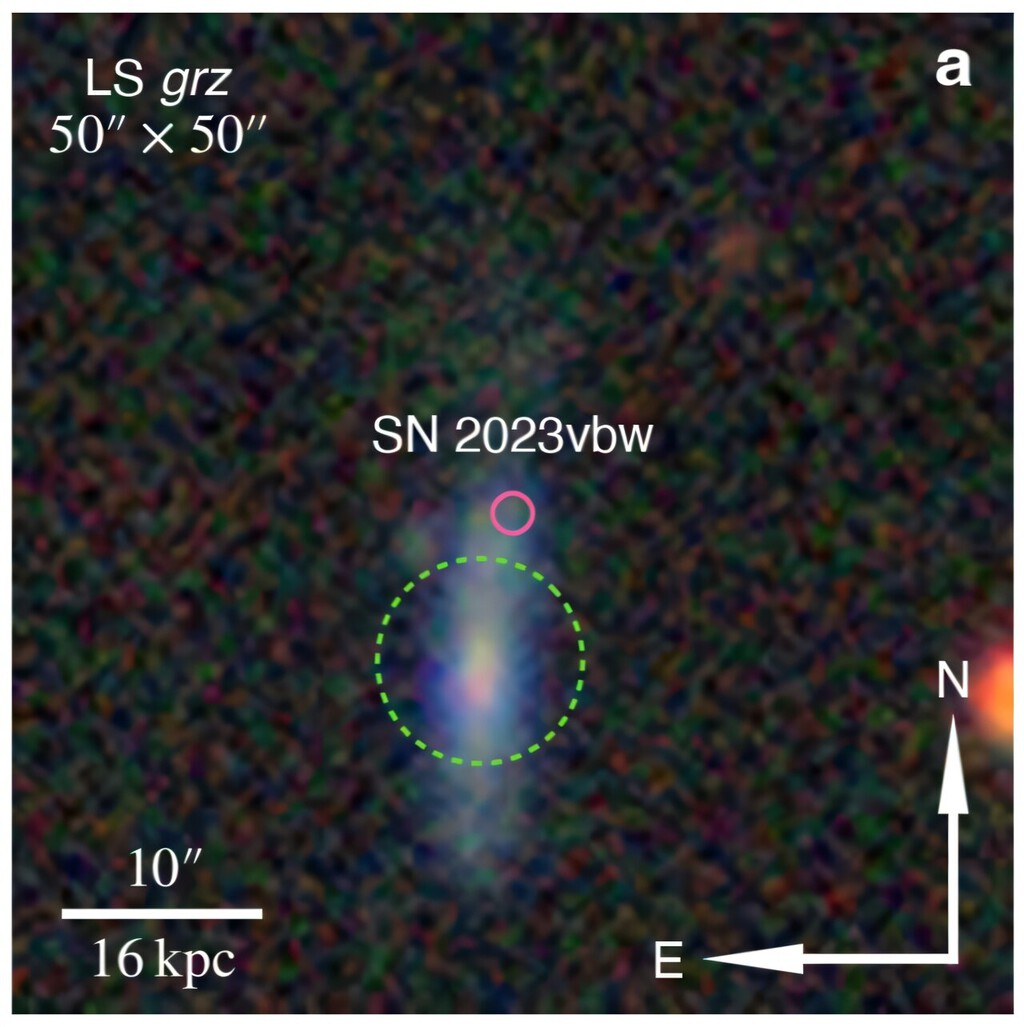
This collapse triggers a runaway thermonuclear explosion that blows the entire star apart. Unlike normal supernovae, which leave behind a neutron star or black hole, this explosion leaves no remnant—the star is completely destroyed.
Why It's So Rare
These events require specific conditions: the star must be massive (typically 130 to 250 solar masses) and have low metallicity (few elements heavier than helium). Such stars were more common in the early universe, making these explosions extremely rare today.
Detecting one is a challenge because they can be faint and easily confused with other types of supernovae. The 2023 event was initially misclassified as a Type II supernova before further analysis revealed its true nature.
How the 2023 Explosion Was Identified
The Zwicky Transient Facility, a robotic camera mounted on the Palomar Observatory's Samuel Oschin Telescope, scans the sky nightly for transient events. In 2023, it flagged a signal from a dwarf galaxy that appeared to be a supernova.
Follow-up spectroscopy showed unusual features: the spectrum lacked hydrogen lines typical of Type II supernovae and instead showed strong emission from heavy elements. The light curve also faded more slowly than expected. These clues pointed to a pair-instability supernova.
The team published their findings, marking one of the few confirmed cases of this phenomenon. The discovery offers a rare opportunity to study the death throes of massive stars in the modern universe.
Key Takeaways from This Discovery
- Pair-instability supernovae completely destroy their progenitor stars, leaving no neutron star or black hole.
- They occur only in massive, low-metallicity stars, making them extremely rare in the local universe.
- The 2023 event was initially misclassified as a Type II supernova, highlighting the difficulty of identifying these explosions.
- Studying such events helps astronomers understand stellar evolution and the chemical enrichment of galaxies.
- Future surveys like the Rubin Observatory's LSST could find more of these elusive explosions.
Comparison with Other Supernova Types
To appreciate the uniqueness of pair-instability supernovae, it helps to compare them with more common types. The table below summarizes key differences.
| Property | Type II Supernova | Pair-Instability Supernova |
|---|---|---|
| Progenitor mass | 8–25 solar masses | 130–250 solar masses |
| Metallicity | Any | Low (primordial) |
| Remnant | Neutron star or black hole | None |
| Light curve | Plateau or linear decline | Slow decline, broad peak |
| Frequency | Common | Extremely rare |
This comparison underscores why the 2023 event stands out. It represents a fundamentally different stellar death mechanism. The longer history behind the story is traced in Rarest Cosmic Explosion: Star Destroyed Itself Without a Trace.
What This Means for Astronomy
The discovery confirms that pair-instability supernovae can occur in the local universe, not just in the distant past. It also provides a benchmark for identifying similar events in archival data. The background to this story is set out in Trace Meek's Best Phone Picture: A Dog, Hat, and Tattoo in Perfect. A related thread runs through How to make a light table to trace. Earlier coverage in Science: latest articles shows how the argument developed.
Astronomers hope to use the lessons from this explosion to search for more examples. The upcoming Vera C. Rubin Observatory's Legacy Survey of Space and Time (LSST) will scan the sky with unprecedented depth and frequency, potentially uncovering many more of these rare explosions. A closer look at the same subject appears in Milky Way's Black Hole Winds Found After 50-Year Search. Anyone following the wider picture can start with James Webb Finds First Black Hole Star, a Theoretical Object. The same theme surfaces in Supernova Explosions: The Physics Behind the Universe's Most Violent Events, which takes a different angle.
Each detection adds to our understanding of how massive stars live and die, and how they shape the chemical makeup of galaxies. Context on how this played out before sits in Starwatch: Count Stars in Pegasus to Measure Your Sky Darkness. A companion piece, Octopus Invasion: Why UK Waters Are Seeing a Population Boom, approaches the same subject from another angle.
FAQ
What is a pair-instability supernova?
A pair-instability supernova is a type of stellar explosion that occurs in very massive, low-metallicity stars. It completely destroys the star, leaving no remnant like a neutron star or black hole.
Why is this explosion considered rare?
It requires a star with a mass between about 130 and 250 solar masses and low metallicity. Such conditions are uncommon in the modern universe, making these events extremely rare.
How was the 2023 event detected?
The Zwicky Transient Facility spotted the signal, and follow-up spectroscopy revealed unusual features that led astronomers to classify it as a pair-instability supernova.
What can we learn from this discovery?
It helps astronomers understand the diversity of stellar explosions and the conditions that lead to complete stellar destruction. It also guides future searches for similar events.
Browse the Shop
 Acacia frida deluxe solid wood bed frame |
Bedroom bench |
Bed chest drawers |
Lingerie dresser |
Frame base |
Mirror with jewelry storage |
30 Bathroom Vanity |
Memory foam queen mattress |
Mattresses for back pain |
Nightstand set of 2 |
Grand Goldman Shop |
Civil Lawyer
Deutschland Trikot WM 2026







