

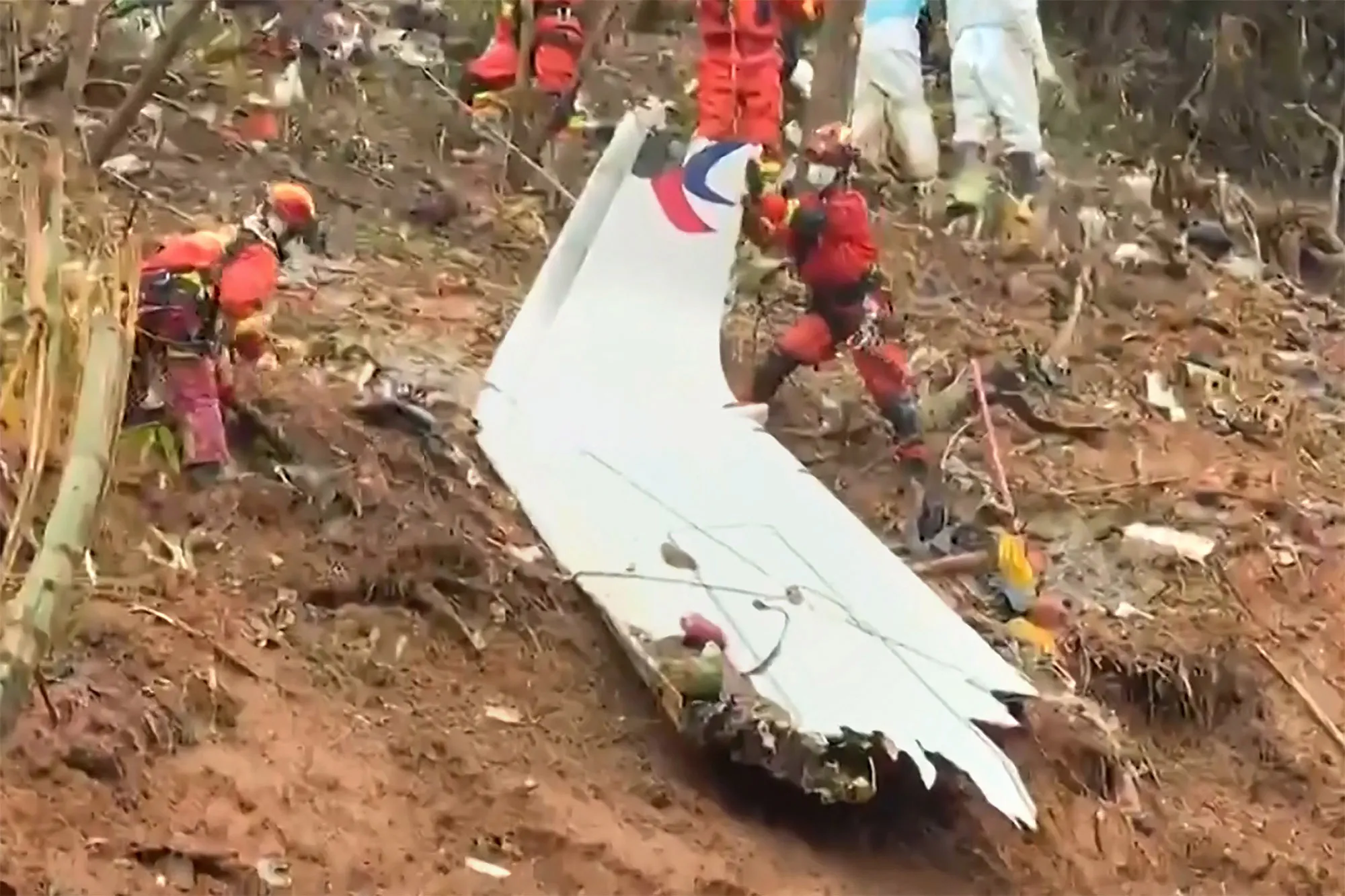
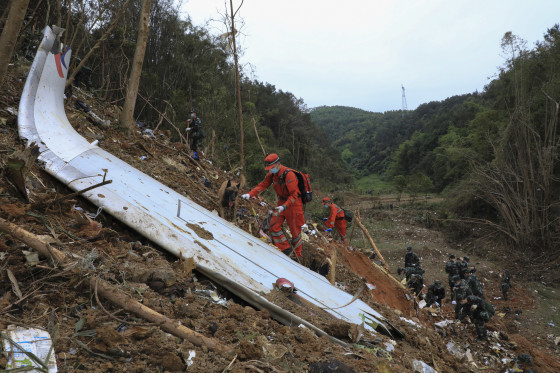
Four years after one of China’s deadliest aviation disasters in decades, investigators still have no definitive explanation for why a China Eastern Airlines Flight 5735 crash plunged from cruising altitude and killed all 132 people onboard.
The silence is now raising global concerns about transparency, aviation safety, and whether critical lessons are being withheld from the international industry.
Find Bleeding Edge Supplements at Scandalous Prices on iHerb.

A disaster with no clear cause
On March 21, 2022, a Boeing 737-800 operated by China Eastern Airlines was flying from Kunming to Guangzhou when it suddenly entered a near-vertical dive.
Within minutes, the aircraft slammed into a mountainside in Guangxi, leaving no survivors.
Key facts of the crash:
| Detail | Information |
|---|---|
| Flight | MU5735 |
| Aircraft | Boeing 737-800 |
| Fatalities | 132 (123 passengers, 9 crew) |
| Crash type | Sudden high-speed descent |
| Location | Teng County, Guangxi |
Flight data later showed the jet dropped from around 29,000 feet at an extreme rate exceeding 30,000 feet per minute.
There was no distress call.

Investigation still offers no answers
According to a 2026 report by Reuters, China’s aviation regulator has not issued any meaningful update since March 2024, allowing the fourth anniversary to pass without new findings.
This lack of progress is highly unusual. Global aviation standards recommend:
- Preliminary reports within 30 days
- Final reports within one year
- Annual updates if delays occur
China has missed all three expectations.
Earlier official statements ruled out the most common causes of aviation disasters:
- No mechanical or engine failure
- No adverse weather
- No communication breakdown
- Fully qualified and rested crew
With these factors eliminated, investigators turned their attention to cockpit activity.

The controversial “intentional crash” theory
One of the most debated aspects of the case is whether the crash was deliberate.
Shortly after the disaster, U.S. officials analyzing black box data suggested the aircraft’s controls may have been intentionally manipulated.
Reports indicated:
- The plane responded to manual inputs
- The descent profile resembled controlled action
- Pilots stopped responding to repeated calls from air traffic control
Chinese authorities strongly rejected this narrative, calling it misleading speculation that interfered with the investigation.
To date, no official confirmation of sabotage, pilot action, or any alternative cause has been released.
Black boxes yielded limited clarity
Both flight recorders were recovered but heavily damaged in the crash.
Early analysis provided only partial insights, and officials have never released full transcripts or detailed data findings.
This has fueled ongoing uncertainty, especially because black box data typically provides decisive answers in modern crash investigations.

Growing frustration among families and experts
Families of victims have now waited four years without closure.
The absence of a final report has triggered:
- Public frustration in China
- Concern among international aviation bodies
- Calls for greater transparency
The International Air Transport Association recently warned that delayed or incomplete crash reports undermine global safety improvements.
Aviation experts emphasize that every major crash investigation contributes to preventing future disasters. Without clear findings, those lessons are lost.
Questions about transparency and national security
Reports have also suggested the investigation may be constrained by political sensitivities.
Some sources indicate authorities have restricted information release citing:
- National security concerns
- Social stability risks
If true, this would mark a rare case where safety findings are withheld from the global aviation community.
China’s regulator has neither confirmed nor denied these claims publicly.

Why this case is so unusual
Most modern aviation disasters are resolved within a few years, even complex ones.
The prolonged uncertainty surrounding Flight MU5735 stands out for several reasons:
1. No mechanical explanation
Investigators found no evidence of technical failure, which typically accounts for many crashes.
2. Lack of communication
The flight crew stopped responding entirely during the descent.
3. Extreme flight profile
The near-vertical dive is highly atypical and difficult to explain without deliberate input.
4. Limited official disclosure
Only brief, high-level updates have been released, with no detailed findings.
Broader implications for aviation safety
The unresolved nature of the crash is not just a national issue—it has global consequences.
Air safety depends on shared knowledge. When investigations stall or remain opaque:
- Airlines cannot update safety procedures
- Manufacturers cannot address potential design issues
- Regulators cannot refine oversight
This case is increasingly cited as an example of how delayed reporting can hinder worldwide aviation improvements.
What happens next?
There is no clear timeline for a final report.
China’s aviation authority has stated only that the investigation is “complex and rare,” without providing further detail.
Key unanswered questions remain:
- What triggered the sudden descent?
- Why did the crew stop responding?
- Did cockpit actions play a role?
- Are critical findings being withheld?
Until those questions are resolved, the crash of Flight MU5735 will remain one of the most puzzling aviation disasters of the modern era.

A mystery that endures
Four years on, the tragedy is no longer just about what happened in the sky over Guangxi.
It has become a test case for transparency, accountability, and the global aviation system’s ability to learn from catastrophe.
For the families of the 132 victims, the lack of answers is more than a technical failure—it is an ongoing human one.
And for the aviation world, it leaves a troubling gap where certainty should be.
Read next - World News
Trump-Iran Tensions | France Runoff Vote | China Crash Mystery | Mueller Passes Away | Trump Airport Threats Tencent AI Tie-Up
Home Decor Shop
 Acacia frida deluxe solid wood bed frame |
Bedroom bench |
Bed chest drawers |
Lingerie dresser |
Frame base |
Mirror with jewelry storage |
30 Bathroom Vanity |
Memory foam queen mattress |
Mattresses for back pain |
Nightstand set of 2 |
Grand Goldman Shop |
Civil Lawyer
Deutschland Trikot WM 2026
Acacia frida deluxe solid wood bed frame |
Bedroom bench |
Bed chest drawers |
Lingerie dresser |
Frame base |
Mirror with jewelry storage |
30 Bathroom Vanity |
Memory foam queen mattress |
Mattresses for back pain |
Nightstand set of 2 |
Grand Goldman Shop |
Civil Lawyer
Deutschland Trikot WM 2026










