

The thermal imaging cameras They are an indispensable complement to numerous industries thanks to their multiple uses and their countless advantages. Today we tell you everything in detail.
- Security camera with video analytics: is it worth it?
Choosing thermal imaging cameras for your business can be a complicated task, especially if you don't have enough technical knowledge, but the evidence shows that it is worth it: Its advantages are innumerable in various industries.
Find Bleeding Edge Supplements at Scandalous Prices on iHerb.

Thermal imaging camera: uses and advantages for the industry
Depending on your needs, the type of camera you will have to install is different. In the case of thermal imaging cameras, you must keep in mind that can prevent failures of significance in the equipment of your business and allow save on maintenance costs y energy expenditure.
Thermal imaging camera: What is it?
The first thing to choose a thermal imaging camera suitable for your business is to understand well what it is and what they are its possibilities. Imagine that you have “special vision” that allows you to see heat instead of colors.
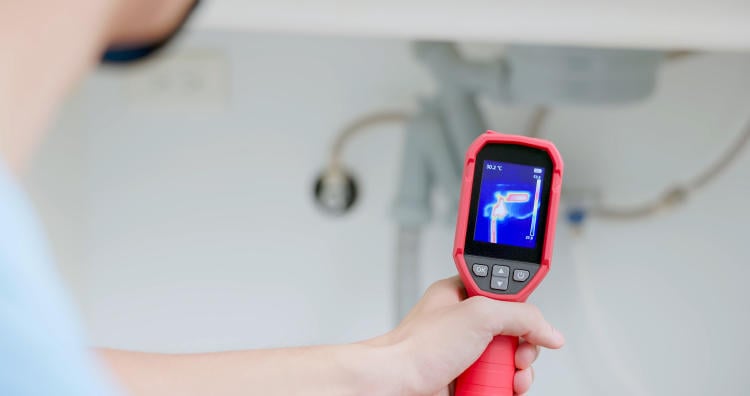
That's exactly what a thermal imaging camera does. This device detects infrared radiation emitted by objects and turns it into a visible image, where the colors represent different temperatures:
The warmest ones appear in red, orange or yellow tones, while the cold ones appear in blue or purple. It is used in many areas, such as electrical fault detection, security, medicine and even in exploration of animals in nature.
It does not need light to operate, which makes it useful in dark environments or with poor visibility. However, the thermal imaging camera has different features and applications than a night security camera.
Thermal imaging camera: How does it work?
Thermal imaging cameras work detecting infrared radiation emitted by objects depending on its temperature. This radiation is invisible to the human eye, but the camera converts it into a thermal image where each color represents a different temperature.
- Infrared radiation capture: The camera sensor detects heat waves emitted by objects.
- Data conversion: Thermal information is translated into electrical signals and processed digitally.
- Thermal image generation: a color-coded image is displayed on the screen; The hottest areas usually appear in red, yellow or white, and the coldest areas in blue or purple.
However, you should keep in mind that the thermal imaging camera is more advanced that one thermal camera. Unlike a thermal camera, a thermal imaging camera can measure temperature with complete accuracy and avoid mistakes.
A practical example of its application and operation: If a thermal imaging camera is used in a electrical installation, the components with overheating (possible failure) will appear in warmer colors, allowing early intervention.
Types of thermal imaging cameras and applications
Thermal imaging cameras have become key tools in multiple industrial sectors due to its ability to detect invisible faults before they cause serious problems.
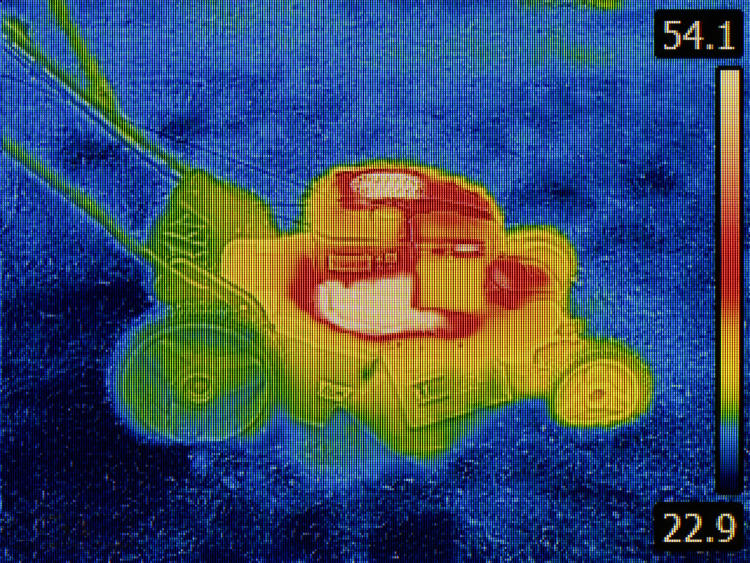
From temperature controls in the covid-19 pandemic to overheat detection in electrical or computer systems. In all cases we are talking about thermal imaging cameras, and not thermal cameras. We can meet:
- Uncooled infrared cameras: They are the most common and use microbolometric sensors that detect heat without the need for cooling. They are compact and more affordable.
- Cooled infrared cameras: They have cryogenically cooled sensors, which allows them to detect more precise temperatures at greater distances. They are used in advanced industrial, military and scientific applications.
Furthermore, depending on its use, They can be portable or fixed (continuous monitoring), as well as thermal imaging cameras for smartphones or drones with cameras of this type. We detail some of their main applications in the industry:
Industrial applications
Industrial and electrical maintenance
- Inspection of motors, transformers and electrical panels.
- Detection of overheating in electrical equipment before serious failures.
- Prevention of electrical fires in factories.
For example: A manufacturing company can use thermography to detect an overloaded motor before it burns.
Construction and building
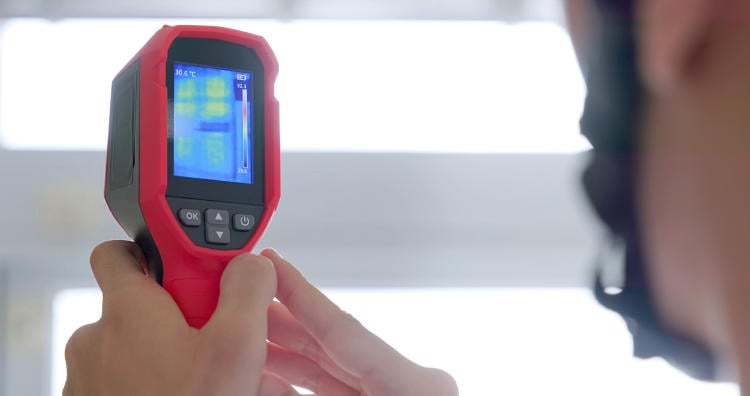
- ID of thermal leaks in walls, ceilings and windows.
- Detection humidity and invisible water leaks.
- Verification thermal insulation in buildings.
For example: an architect uses a thermal imaging camera to find out if a house has insulation problems that increase energy consumption.
Energy and renewables
- Inspection of solar panels to detect defective cells.
- Supervision of power lines and transformers in high voltage networks.
For example: A solar energy company checks hundreds of panels to detect faults sin necesidad de inspección manual.
Medicine and health
- Measurement contactless body temperature measurement (useful in pandemics).
- Detection inflammation or circulatory problems.
For example: A hospital uses thermal imaging cameras at the entrance to identify people with fever.
Automotive and transportation
- Diagnosis of engines and brake systems in vehicles.
- Detection of overheating in cargo truck tires.
For example: A mechanic can identify a defective bearing which generates excessive heat before it causes an accident.
Advantages of thermal imaging cameras for industry
Thermal imaging cameras have its origin in the 19th century with the discovery of infrared radiation by William Herschel in 1800. In the 20th century, technology was developed to military and scientific uses, especially during World War II and the Cold War.
Over time, these cameras They became more accessible and expanded to industrial, medical applications y security and today they are an indispensable element in many industries due to their countless advantages.
Preventing costly failures
The failures mechanical or electrical can cause stops in production, serious damage to equipment or even fire. With a thermal imaging camera, it is possible detect overheating points in motors, transformers or machinery before a breakdown occurs.
Thus, a factory can make regular inspections in electric motors and replace components with high temperatures before they fail, avoiding costly downtime and urgent repairs.
Greater safety at work
Thermal imaging cameras provide greater safety at work, since they allow inspection high voltage electrical equipment, boilers or steam pipes without the need for physical contact, avoiding exposing workers to risks of electrocution, burns or explosions.
We could think of a refinery, in which operators can analyze gas pipes remotely for detect heat leaks, reducing the risk of accidents and improving security of the staff.
Maintenance cost savings
Preventive maintenance with thermography reduces the need for repairs emergency, which are usually more expensive and require stopping operations. Besides, avoid collateral damage in other components of the machinery.
For example, a transport company can detect problems in brakes of your trucks before they fail completely, avoiding costly repairs and accidents on road.
Optimization of energy consumption
Thermal imaging cameras help identify heat leaks in buildings, factories and electrical networks, allowing improve thermal insulation, reduce energy waste and reduce electricity costs.
In short, they can be used in very diverse sectors such as manufacturing, construction, energy, medicine and security. Besides, its technology continues to evolve, with models every time more accessible and accurate.
In the agriculture, Drones equipped with thermal imaging cameras can detect crops with water stress, optimizing irrigation and reducing water waste.
Without a doubt, thermal imaging cameras represent a smart investment for the industry, improving safety, efficiency and profitability of operational processes.
Best bedroom hidden cameras | Best Spy Camera Watch | Best low level CO detector | Best Wifi Router EMF Protection | Best Camera for MEVO Plus | Best Security Camera Without Subscription | Best Budget Camera for Blue Iris | Best Barking Dog Alarms | Best Free VPN for Rainbet | Best Solar Powered Security Camera | Alarmes Maison
Browse the Shop
 Acacia frida deluxe solid wood bed frame |
Bedroom bench |
Bed chest drawers |
Lingerie dresser |
Frame base |
Mirror with jewelry storage |
30 Bathroom Vanity |
Memory foam queen mattress |
Mattresses for back pain |
Nightstand set of 2 |
Grand Goldman Shop |
Civil Lawyer
Deutschland Trikot WM 2026
Acacia frida deluxe solid wood bed frame |
Bedroom bench |
Bed chest drawers |
Lingerie dresser |
Frame base |
Mirror with jewelry storage |
30 Bathroom Vanity |
Memory foam queen mattress |
Mattresses for back pain |
Nightstand set of 2 |
Grand Goldman Shop |
Civil Lawyer
Deutschland Trikot WM 2026










