

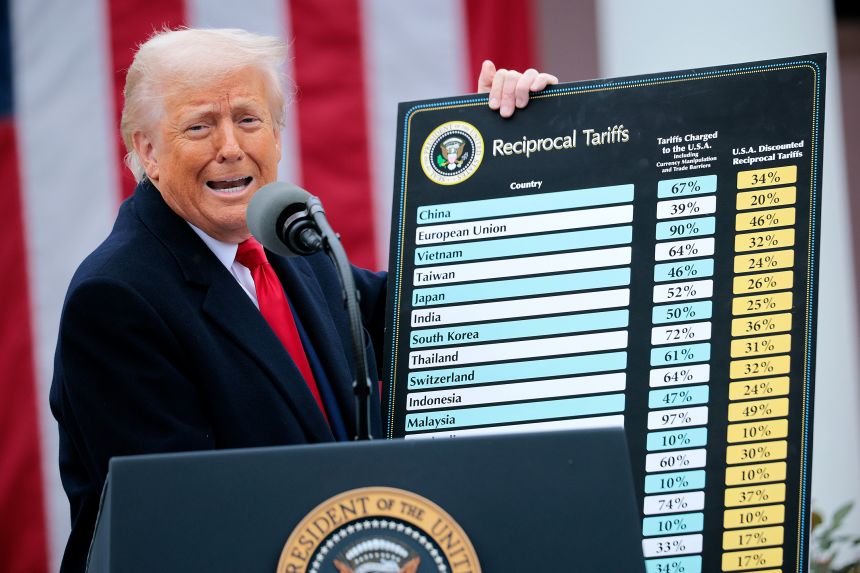
In a landmark February 2026 ruling, the US Supreme Court held in Learning Resources v. Trump that the president does not have the authority to impose broad tariffs under the International Emergency Economic Powers Act (IEEPA) of 1977.
The 6-3 majority opinion, written by Chief Justice John Roberts, held that such sweeping economic powers require explicit Congressional delegation—limiting one of the most aggressive assertions of executive trade authority in modern history.
Find Original, High-end Home Decor that spark conversation at Grand Goldman Shop.
The Case
The case was brought by a coalition of small businesses and 12 state attorneys general challenging Trump-era tariffs imposed under the IEEPA as an emergency trade measure. Plaintiffs argued that tariff-setting authority is constitutionally a Congressional prerogative that has never been explicitly delegated to the president under the IEEPA—a statute historically used for asset freezes and sanctions, not broad import taxes.
The Court's Reasoning
Chief Justice Roberts invoked the major questions doctrine—a principle requiring clear congressional authorization for agency or executive actions of vast economic and political significance. The Court found that because no prior president had ever used IEEPA to impose tariffs, and Congress had not explicitly granted such power, the administration's actions exceeded lawful authority. The ruling applies significant constraints to future executive branch trade actions.
Economic and Political Fallout
The ruling invalidated billions of dollars in tariffs and sent shockwaves through global trade policy. Industries that had benefited from tariff protection—including steel, aluminum, and domestic manufacturing—face renewed competition from imports. The administration responded by pursuing new tariff authorities through alternative legal vehicles and pressing Congress to expand executive trade powers through legislation.
Broader Separation of Powers Significance
Legal scholars describe the ruling as a significant reaffirmation of Congressional power over international commerce and a check on the broad use of emergency statutes to circumvent ordinary legislative processes. It is expected to influence future challenges to executive actions in areas ranging from immigration to environmental regulation, wherever the major questions doctrine may be applicable.
Read next - Health
2026 measles outbreak | drug import tariffs | CDC testing pause | healthcare top concern | hearing gene therapy | cholesterol drug breakthrough | Title X funding | Iowa Medicaid tax | deep sleep hormone | BMI accuracy study
Science
Artemis II launch | forbidden black holes | Starship to Uranus | fusion plasma mystery | China R&D lead | dynamic DNA movement | quantum computer plan | magnetic field mystery | DNA robots medicine | ocean nanoplastics discovery
Birthright citizenship case | Section 230 lawsuits | Roundup cancer lawsuits | conversion therapy ruling | ISP copyright ruling | tariffs authority ruling | social media trials | Monsanto Supreme Court | talc asbestos verdicts | death penalty bias
Browse the Shop
 Acacia frida deluxe solid wood bed frame |
Bedroom bench |
Bed chest drawers |
Lingerie dresser |
Frame base |
Mirror with jewelry storage |
30 Bathroom Vanity |
Memory foam queen mattress |
Mattresses for back pain |
Nightstand set of 2 |
Grand Goldman Shop |
Civil Lawyer
Deutschland Trikot WM 2026
Acacia frida deluxe solid wood bed frame |
Bedroom bench |
Bed chest drawers |
Lingerie dresser |
Frame base |
Mirror with jewelry storage |
30 Bathroom Vanity |
Memory foam queen mattress |
Mattresses for back pain |
Nightstand set of 2 |
Grand Goldman Shop |
Civil Lawyer
Deutschland Trikot WM 2026







