

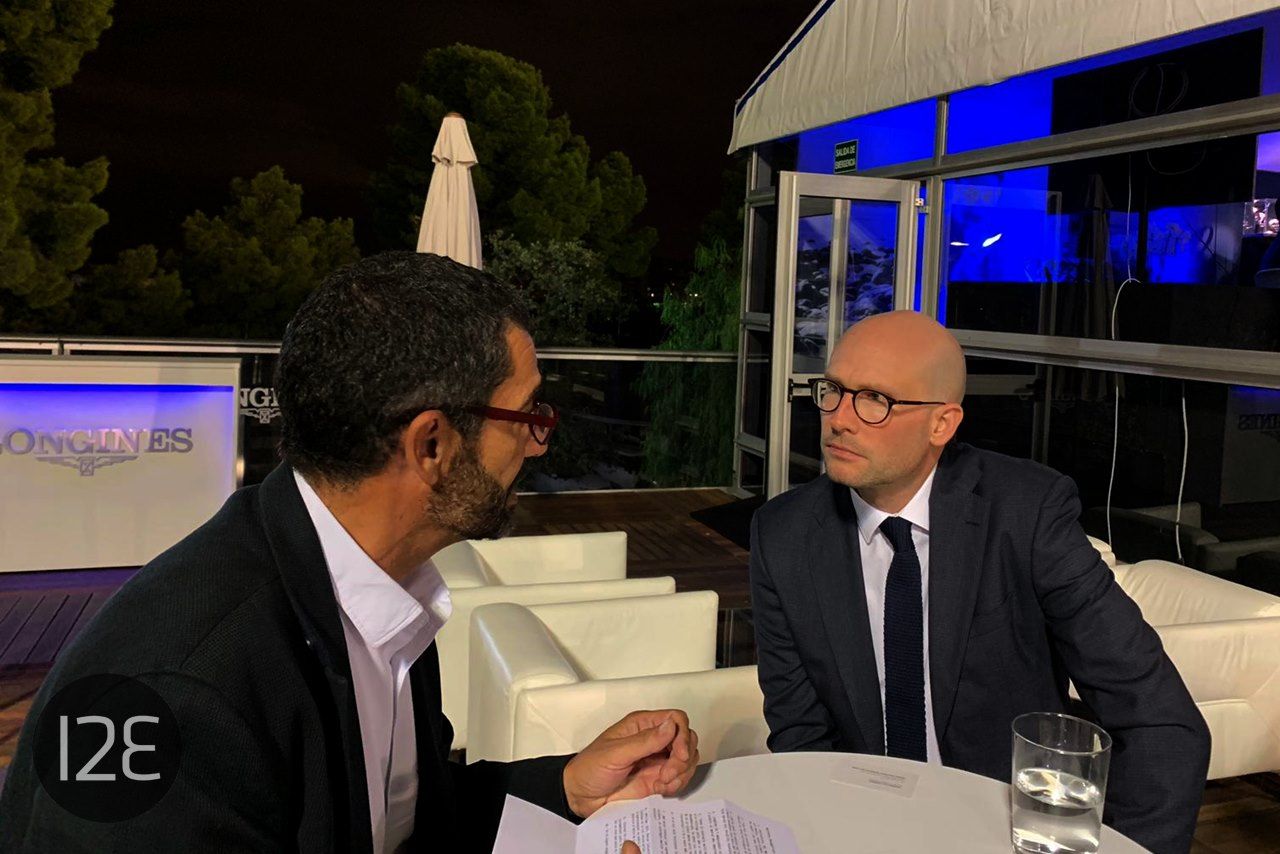
Matthieu Baumgartner, born in the Swiss Jura 41 years ago and educated at the University of Freiburg, has returned “home”: he started in the communications department of Longines in 2006, in 2013 he was appointed Head of Media Strategy at The Swatch Group and since August 2019 he has been vice president of marketing at Longines, replacing the veteran Juan Carlos Capelli. We interviewed him on the occasion of his presence at the grand final of the Longines FEI Jumping Nations Cup™ held in Barcelona in October 2019 (whose Challenge Cup, by the way, was won by Spain)
Special Watches (RE): Journalist, media buyer, media relations… a field he dominates. What do you think of digital media? Do you think that in the long run they will replace traditional media?

Matthieu Baungartner (MB): I find the world of media fascinating, especially from the point of view of the journalist whose work is essential. Regarding this possible substitution, it is something that was on the table two years ago and it is undeniable that traditional media are suffering a drop in readers, advertisers and therefore income. But newspapers, radio and television continue to play an important role. Today there are more readers consuming the same content, just through electronic or digital devices, in different ways, and you have to continue being creative to reach them all.
RE: And Longines? What do you think is the most appropriate medium to communicate your own content?
MB: With the variety of media categories available, the most important thing is actually knowing how to choose to connect with new audiences since the possibility of segmentation is great. The role continues to be important and, given the times we live in, video is very important to communicate our message. On the other hand, digital media give us the opportunity to reach specific and very niche groups, so that there is no preference for some over others but rather we choose each one - or the mix - of them depending on the message we want to transmit or the audience we want to address.
RE: Swatch Group has decided to leave Baselworld and everything indicates that it will not return. The top brands of the group organized their own joint show, but not Longines and others. Does it affect your communication strategy? How do they compensate it?
MB: We have had to explore alternative paths to stay in touch with our clients and partners. Since we no longer have the opportunity to have them all in the same place at the same time, we have had to create opportunities to see them in their own markets. We have gone to see them on their own land and the results have been good. It has allowed us to dedicate more time to them individually, and we have seen more partners than other years because not all of them traveled to Basel for the fair. Another interesting issue is that we have not been forced to present all the news in one week but rather we do it throughout the year. Of course it has forced us to dedicate a budget to it, but we are satisfied with the result considering that we are in a learning process.
RE: So, with these results, has the first year outside of Baselworld been better than the last year at Baselworld?
MB: I don't think they can be compared because there are so many factors that differentiate them. As I said, we are satisfied with what we have done this year. When it comes to building a relationship with our partners, it has proven to be successful to go to the markets and have more time than we used to have in Basel. In Spain, for example, our colleagues did a great job creating these types of events to bring together our distributors and communicate news in a more conducive environment than the frenzy of Baselworld.
RE: Changing the subject. Two years ago, the VHP (Very High Precision) was presented, a three-hand quartz whose technology Longines had shown for the first time in the mid-80s, in the midst of the quartz crisis. Isn't it a bit risky to present a watch like this in the other crisis, this time of smartwatches? Has the VHP worked as expected?
MB: To start, quartz has been a mainstay in Longines collections since the mid-1950s. With the Conquest VHP we take it to a new level of technology, with features that make it extremely comfortable to wear. For example, if exposed to magnetic fields that could harm it, it has the ability to enter a state of rest, recovering the correct time when the danger has passed. At the same time, its design makes it versatile and can be used with sporty or formal attire, and at an attractive price. I don't really think it competes with smartwatches, they are different products
RE: Maybe the question should have been: Is it selling well, or at least as expected?
MB: I think it was well received in the market, and yes, it is a successful product.
RE: Of the 17 ambassadors that Longines has, 6 are Asian with little or no impact/knowledge outside their respective countries. Can we deduce from that that Asia is your main market?
MB: Although we have Ambassadors of Elegance from different backgrounds for different markets, they are not necessarily representative of what those markets mean to Longines. It is true that in addition to ambassadors recognized around the world, we have some who are particularly well-known in their areas. Specifically answering the question, yes, mainland China as a whole is an important market for Longines, but so are Europe and the United States. All in all, we believe that we still have growth potential, and not only in Asia, thanks to our location in the range between 1,000 and 3,000 Swiss francs.
RE: Horses. Longines has a ten-year, multimillion-dollar (nine-figure) contract with the FEI (International Equestrian Federation), which will last until 2023. You were appointed PR for Swatch Group at that time and appear in the contract. Is it giving the results you expected from it in terms of returns? Because it is an enormous amount of money... The answer would perhaps be in the second question: Are they going to renew that contract?
MB: I am not going to comment on those figures, but more important than the figures is that for historical and strategic reasons these disciplines and environment have proven ideal for Longines. We have great affinity with the values of this sport: tradition, elegance and performance, with men and women competing in the same competitions, something that is not common in sport. Likewise, if you look at the stands here at the Polo Club, you will see that there is a balance of men and women as fans. And that, in terms of reach, is very important for Longines.
RE: Having aviation or immersion watches, which could be better exploited at a communication level, why choose a sport as minority and niche as horse riding when Longines is such a transversal brand?
MB: I do not believe – and the figures do not indicate it – that it is such a minority sport. Jumping disciplines or horse racing attract a large number of people around the world. And beyond the amount of audience reached, it is a question of message, of values. Longines has historically been linked to horses, but also to aviation, with the Hour Angle or the Weems, not to mention the air navigation instruments that it has also produced. And that is something we are going to continue working on. Let's not forget that the Longines logo has wings...
RE: Speaking of airplanes or divers, there are watches in the Longines collections for those purposes. Is there a watch for horse riding? How is the Equestrian collection selling?
MB: In the past, if you were an aviator you needed an instrument you could rely on, whether it was on a dashboard or on your wrist. That is, there is a “functional function” there. In the equestrian world it is evident that one does not need a watch (and that if you wear one you will hardly be able to look at it during exercise), so the issue revolves around aesthetic codes and elegance. Equestrian is there for elegance, not functionality.
RE: Finally, is there a question that you have never been asked and that you would like answered?
MB: It's a trick question, huh? (laughs). I see that you have prepared the interview thoroughly and have a good knowledge of the brand, so everything has already been asked.
Thanks to Matthieu Baumgartner for his time and to MRA Agencia de Comunicación for making this interview possible.
www.longines.es










