

Morgan Stanley, with the collaboration of the consulting firm LuxeConsult, has published - only for subscribers - its annual report on the state of the Swiss watch industry.
It has been carried out on the top 50 brands and has been based on 2019 figures, so it does not take into account the effect (devastating, for sure) that the global pandemic that the coronavirus has unleashed will have. The head of LuxeConsult, Oliver R. Müller, has outlined his observations in his blog from the Swiss newspaper Le Temps, and I will comment on mine here.

"The Billionaires Club"
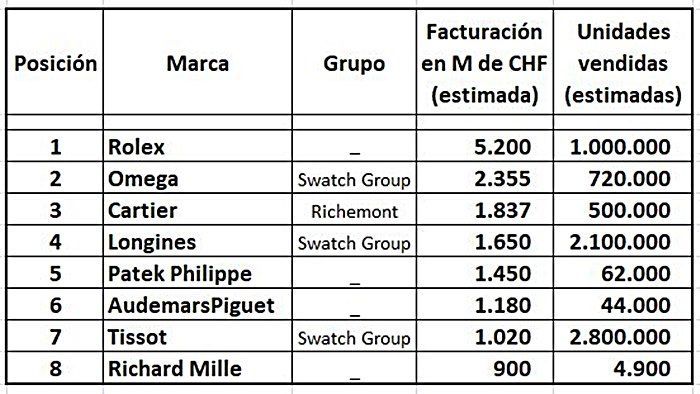
The first of them is that there were not five but seven brands that make up the exclusive "billion club", that is, they invoice above that amount of Swiss francs. To those I already knew (Rolex, Omega, Longines, Patek Philippe and Tissot) are added Cartier and Audemars Piguet.
Right at the gates is a Richard Mille that reaches 900 million having consolidated figures between production (380 million) and sales in its own boutiques (42 worldwide). The impressive thing is that it achieves this with less than 5,000 watches, which puts the ratio per unit above CHF 180,000.

Before continuing, it must be clarified that all the amounts are estimates, because the unlisted ones (the aforementioned Richard Mille, Rolex, Patek and AP) do not communicate figures, and those belonging to groups that are listed on the stock market (Cartier to Richemont and Longines and Tissot to the Swatch Group) do not detail them but provide them consolidated. Even so, it seems that it is the most precise that can be achieved, especially considering that the majority of industry executives are waiting for this report like a May day… and sometimes they complain publicly because it has not got their brand right. But they don't correct it.
So, this would be the appearance of that select billionaire club:
Rolex, as always, in the foreground
This table, combined with other data from the report, confirms the absolute supremacy of Rolex in this complicated environment: it alone accounts for 23.4% of the total turnover by the 50 brands covered by the study (around 22,225 million), but if we add the 310 million that the "sister brand" Tudor would contribute (20th place on the list, 1.4%) we have that they account for practically a quarter of the turnover. If we add that it is a private foundation that does not distribute profits and being known that Rolex is the main real estate owner in the canton of Geneva, one could say that there is no reason to fear for its future no matter how many viruses come (They have just announced a ten-day break for that reason).

The independent ones, the most profitable
On the other hand, it is worth noting that the four private brands of that club add up to an impressive figure of 8.7 billion francs (almost 40% of the total), and that according to the report they have achieved not only the best results in terms of sales but also profit margin. And this leads me to emphasize once again how important communication and marketing are in a world of intangibles such as that of luxury watchmaking: Rolex is the largest advertiser in the world in this sector, while Patek Philippe exploits the story of inheritance between generations extremely well or Richard Mille combines innovation, design and exclusivity with an audacity that is difficult to match. And the extremes come together: Rolex is the one that has been applying marketing to its products for the longest time (practically since its founding in 1905) and Richard Mille is a rare bird that in just 20 years has achieved a similar perception among its target audience. Both obtain a gross profit margin (EBIT) close to 35%, with Richard Mille close to 40%. Do the math.
Is less more?
All the brands that appear in the "photo" above except one have grown in turnover compared to 2018. Tissot has been the exception, which has dropped 30 million. And therein lies another paradox: to reach a figure of “a little” more than 1 billion, it has been necessary to sell almost three million watches, which puts the average price at just over 360 CHF. If we take into account the necessary structures (and the mega-parties, or sponsorships...) to sell three million (Tissot) or 4,900 (Richard Mille) with a similar turnover, it would seem almost natural that the latter obtains more profit. And the most important thing: many may not like it and many more may find its price level an aberration, but here the famous saying "let me be hot and let people laugh" would apply here...
The one that is coming
The fact that the coronavirus pandemic has forced the cancellation of each and every one of the planned watch fairs (including the latest improvised attempt called "Geneva Watch Days" promoted by Bulgari) is subjecting the sector to an offline stress test. The only thing that is certain is that things will not be the same as before, although we still don't know if for the better or not. I invite you to read Mr Müller's article (Chrome has an automatic translation option that works wonders), because it not only gives a perspective but also a prospective vision. I extract a prediction that does not seem crazy to me at all:
«This year will be extremely complicated for luxury brands and the economy in general. The second half will not compensate for the enormous falls of this first in all markets and especially in China. There are many brands with a delicate financial situation even before the Coronavirus appeared, and by the end of 2020 between 30 and 60 Swiss watch brands will have definitively “pulled the plug.”
You can comment on this articlein the forum










