

Christophe Claret's passion for history has inspired him when creating the Aventicum, a tribute to what was the capital of ancient Roman Helvetia for 300 years and with which to highlight the extraordinary work of the Roman Museum of Avenches. In the center of its dial, the Aventicum watch reveals a miniature gold bust of the Roman Emperor Marcus Aurelius. The micro-engraved effigy is especially three-dimensional thanks to an ingenious optical effect.
Excavations in the ruins of Aventicum, near the Swiss city of Avenches, yielded an extraordinary surprise in 1939: a solid gold bust of Emperor Marcus Aurelius was discovered, found while cleaning an ancient pipe. This valuable discovery is one of only three known Roman busts of this style in the world. What makes this discovery exceptional is precisely its existence, since it is assumed that other similar statues were melted down and recycled like other objects over the centuries.
Find Bleeding Edge Supplements at Scandalous Prices on iHerb.

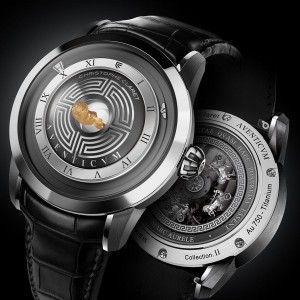 This, and a 3D film also produced by him about the city's ruins and its findings, are the sources of inspiration for Christophe Claret's latest creation, the Aventicum clock. In the center of the sphere you can see a replica of the bust of Marcus Aurelius made of microengraved gold. Using a technique that has never been used before in the history of watchmaking, the faithful small-scale representation of the emperor, less than three millimeters, appears magnified thanks to an ingenious invention calledmirascope. The mirascope is made up of two identical parabolic mirrors arranged one above the other, creating an elliptical shape. The top convex mirror has a hole in the center. When an object is placed in the center of the lower concave mirror, the reflection from the upper mirror creates a hologram of the object displayed almost twice its actual size. By implementing this optical effect on the Aventicum, the bust of Marcus Aurelius appears as if it were projecting from the center of the clock.
This circumstance has conditioned the creation and construction of the hands since the center of the clock was now occupied precisely by the Mirascope. It was decided to implement indicators that rotate in an invisible ring on the perimeter of the dial, each equipped with a counterweight to optimize stability. The challenge in creating the Aventicum's needles was finding a material light enough to compensate for the relatively large, though largely hidden, size of the display mechanism. The solution was to use carbon microfiber, which has an excellent weight/stiffness ratio.
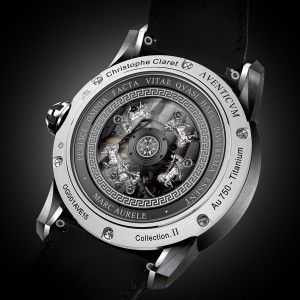
Turning the Aventicum over, the transparent sapphire oscillating weight of the automatic movement can be admired through the caseback. Said rotor has been decorated with fivebigas(light chariots pulled by two horses) that seem to be in full competition. Once again, the playful spirit that we find in a large number of Claret's watches is highlighted: by placing the Aventicum horizontally and making one or two movements with the hand, the carriages are set in motion.
The player whose car stops on top of the “A” for Aurèle (Aurelio) engraved on the outline will be the winner. The Aventicum also displays other classic motifs such as the Roman numerals for the hours or the labyrinthine pattern found both on the dial and on the back of the watch around the oscillating sapphire weight.
As Marcus Aurelius was also a philosopher, the background of the Aventicum also shows one of his famous maxims: "Perfice Omnia facta vitae quasi haec postrema essent" ("carry out each action of your life as if it were your last").
Aventicum will be available in two limited editions: 68 pieces of 5N rose gold and grade 5 titanium with anthracite PVD treatment, and 38 pieces of palladium-rich white gold and grade 5 titanium with anthracite PVD treatment.
Read next: Best watch strap | Best annual calendar watch | Best watch winder | Best black luxury watch | Best Luxury Watches Men
Browse the Shop
 Acacia frida deluxe solid wood bed frame |
Bedroom bench |
Bed chest drawers |
Lingerie dresser |
Frame base |
Mirror with jewelry storage |
30 Bathroom Vanity |
Memory foam queen mattress |
Mattresses for back pain |
Nightstand set of 2 |
Grand Goldman Shop |
Civil Lawyer
Deutschland Trikot WM 2026
Acacia frida deluxe solid wood bed frame |
Bedroom bench |
Bed chest drawers |
Lingerie dresser |
Frame base |
Mirror with jewelry storage |
30 Bathroom Vanity |
Memory foam queen mattress |
Mattresses for back pain |
Nightstand set of 2 |
Grand Goldman Shop |
Civil Lawyer
Deutschland Trikot WM 2026










