

The last Baselworld fair was different from the previous ones. In the style of fashion, where no one seems to have talked to their neighbor but similar trends appear, the press and fans were surprised (was it really a surprise?) that some manufacturers were able to put complications on the market at much lower prices than what we were used to. And I'm not talking about “simple complications”; I'm talking about tourbillons and perpetual calendars. On the one hand we saw how one of the first division players presented a tourbillon for less than 14,000 euros, while - and this is what matters here - thePerpetual Calendar Manufacture of Frederique Constantwith a price of 8,350 euros.

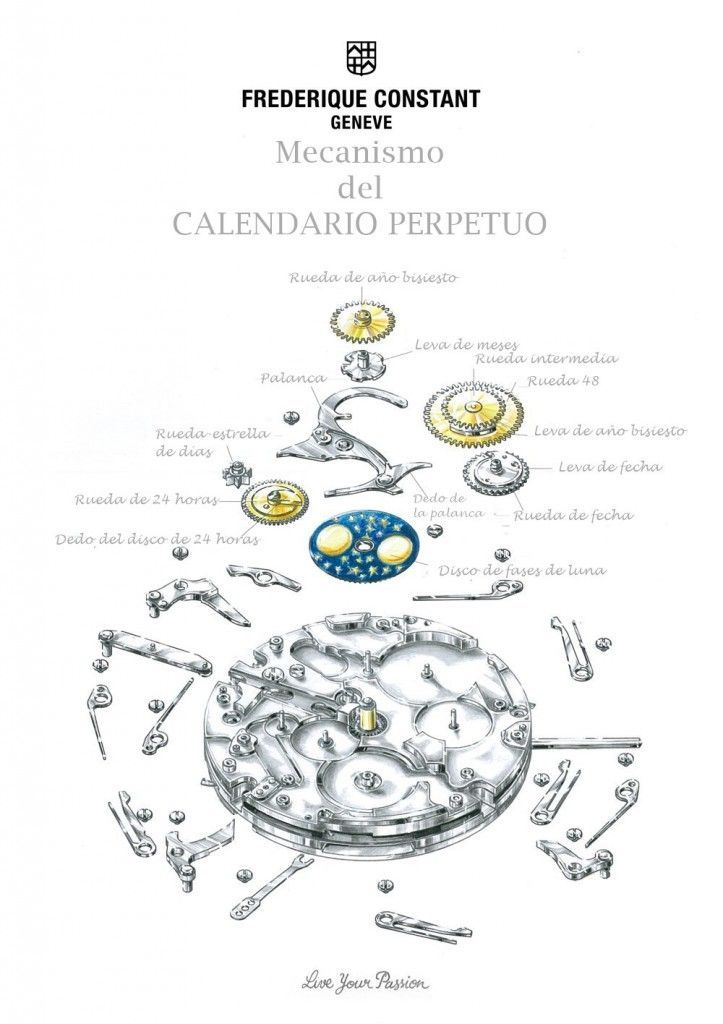
El calendario perpetuo está considerado como el rey de las complicaciones: no sólo “sabe” qué meses tienen 30 o 31 días sino que está programado para distinguir los febreros de 29 ó 28 días según sean años bisiestos o no. Esto es así porque el año solar tiene 365 días, 5 horas, 48 minutos y 45 segundos… suena complicado ¿verdad? Pues la cosa no termina aquí, porque ese lapso de 24 horas produce una sobrecompensación y se hace necesario omitir el día 29 de los años múltiplos de 100.
With your newFrederique Constant Manufacture Perpetual Calendaronce again enforces the slogan that has made the Geneva brand famous: “affordable luxury”. Because a perpetual calendar is a watchmaking luxury (and pleasure), but the fact that it also has a price below 9,000 euros puts it much closer to a legion of fans who would never have thought of owning such a complication due to its high prices. I still remember the admiring comments from journalists inBaselworld 2015talking about the “great price” of a steel perpetual that would cost… 28,000 euros.
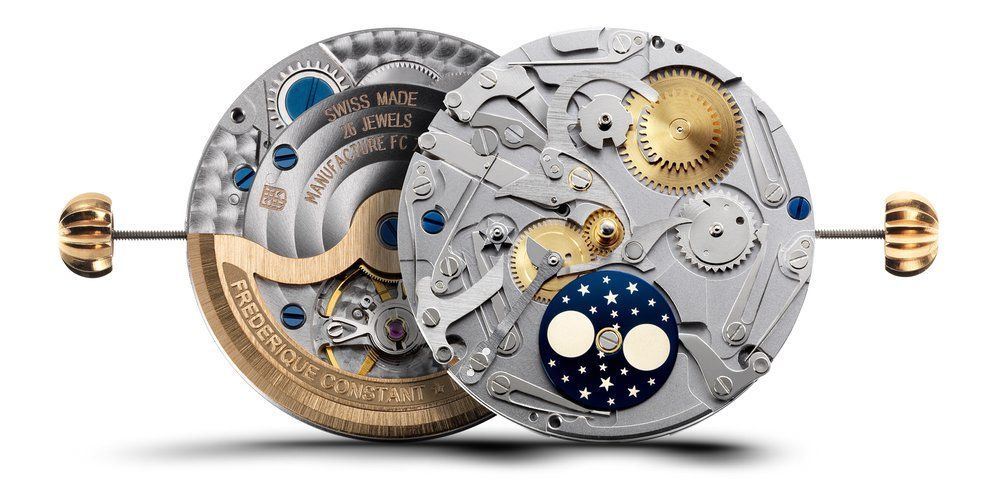
Designed according to the canons of classic watchmaking, the automatic caliber FC-775 has been conceived and developed over two years by Manuel da Silva Matos, R&D director, and Pim Koeslag, technical director of Frederique Constant. A total of 191 parts that together beat at a frequency of 28,800 a/h (4 Hz) and have 36 hours of power reserve. It mounts 26 rubies, its bridges are decorated withcôtes from Genevaand the pearlescent plate while the oscillating weight is gold plated. All this in a thickness of 6.7mm. The settings of the different indications other than the time (day of the week, day of the month, month, moon phase and leap year) are adjusted using pushbuttons located on the case and next to the lugs, while the time setting is still done through the traditional crown.
Well, this is the watch that I have had the opportunity to test thanks to Ibelujo, its distributor in Spain. And it is no small thing, because until now only “dummies” had been seen, that is, watches with the final appearance, but empty, without the caliber. As a curiosity, it came with a temporary strap because his crocodile strap needed a CITES permit, which was not available at the time the watch was shipped from Switzerland.
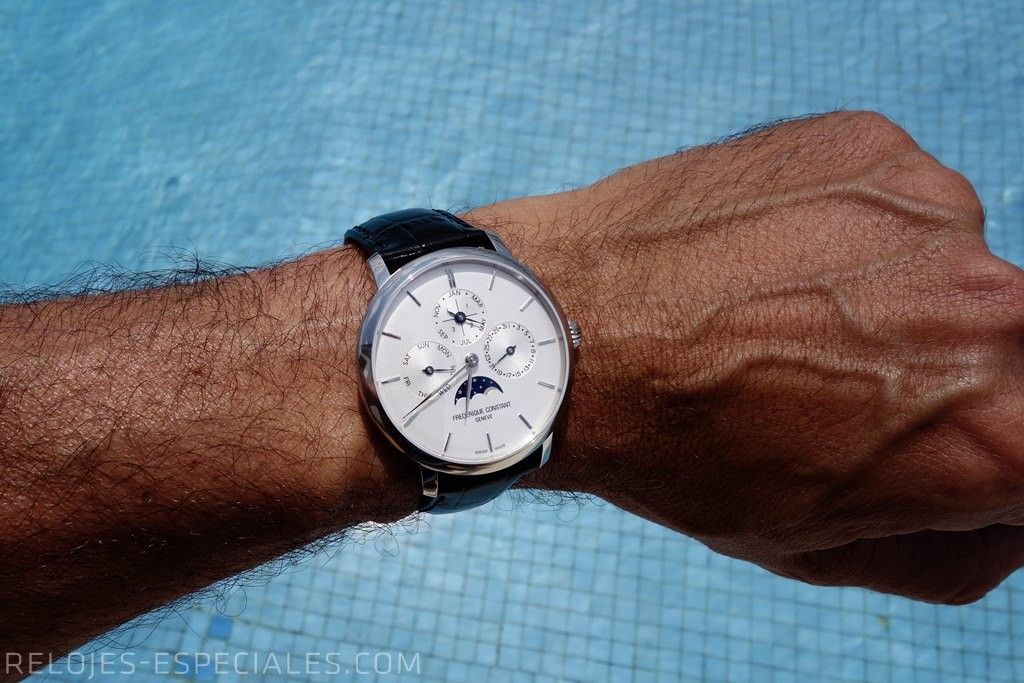
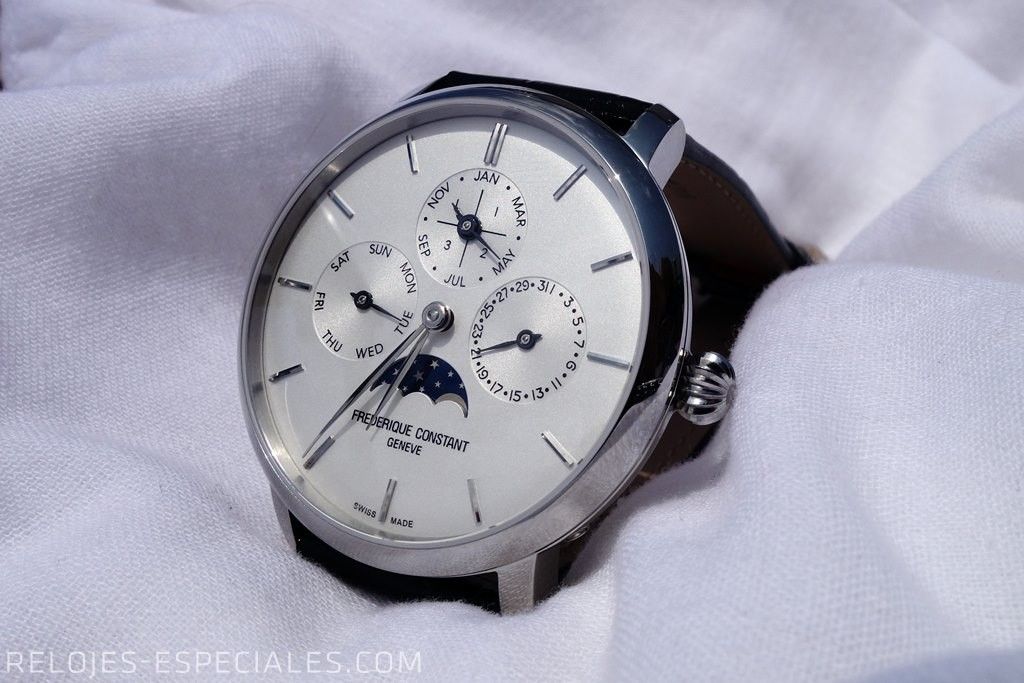
Aesthetically, it is a component of the Slimline family that has given the brand so much satisfaction. With an ingenious truncated-conical configuration that “leaks” the case towards its own center, it manages to appear less thick than its real size, thinner, more “slim”. The crown, of the bulb or “onion” type, reinforces that classic appearance that Frederique Constant has made the flag. 42mm steel case that – subjective opinion – fits well on a wrist of 18cm in circumference, without millimeters too much or too little, even for a dress watch, as is the case. The adjustment pushers are discreet and are practically not visible with the watch on. Domed sapphire crystal with good anti-reflective treatment, I refer to the photographs.
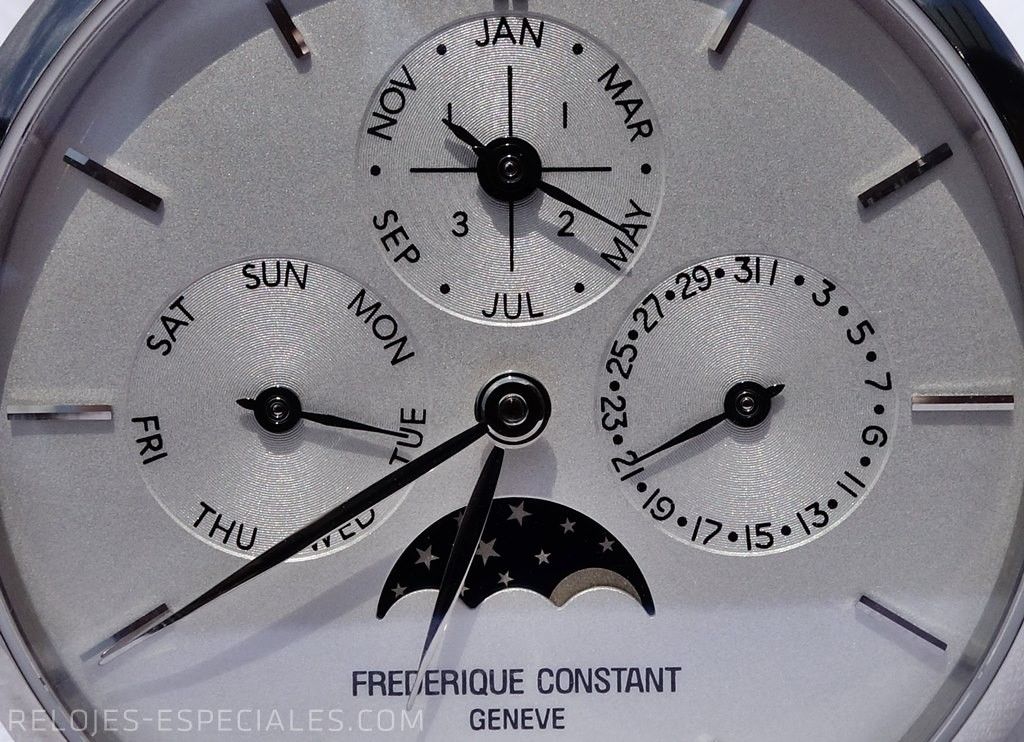
The dial, silver in this case, has four subdials for the different indications arranged cardinally (north, south, etc.). The “southern” one, with the lunar phases, breaks the symmetry somewhat as it is only half, and has been used to give the name of the House. From my point of view they should have separated them more, going towards the edge of the sphere, filling it. I think that concentrating the subdials in the center takes away from the whole category. And it is curious, because looking at the back – now we will talk about it – it is clear that the caliber does fill the entire case. Technical impositions? Being that it is a caliber created from scratch, it could have been taken into account. In any case, a classic dial for a classic watch.
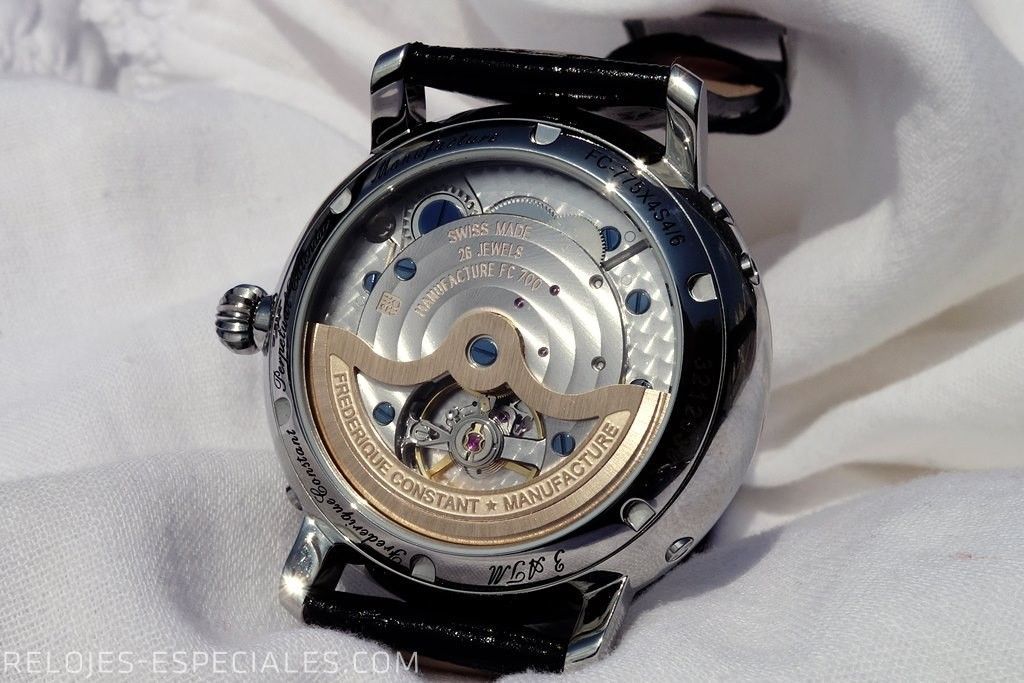
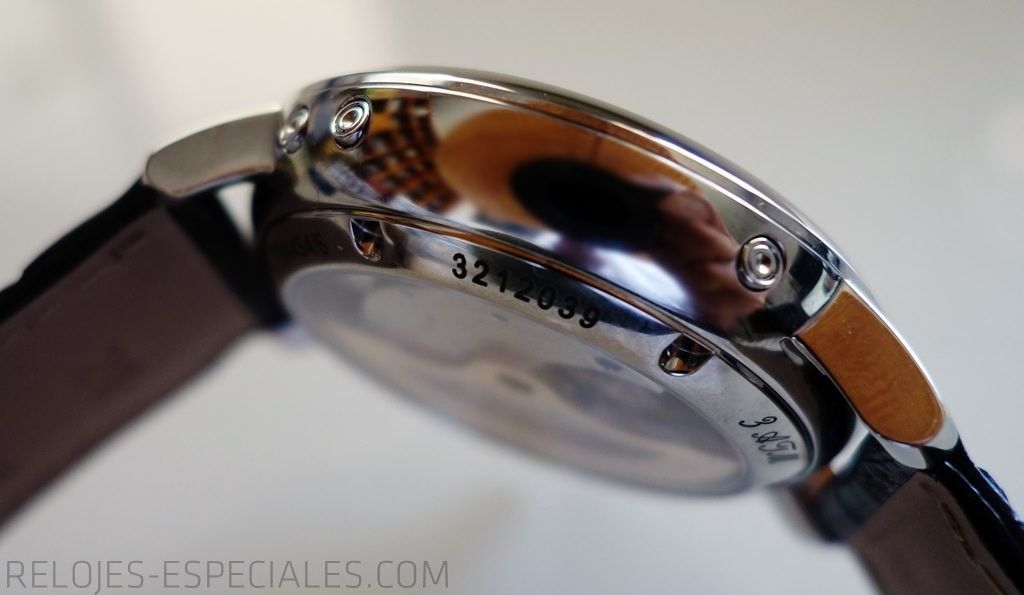
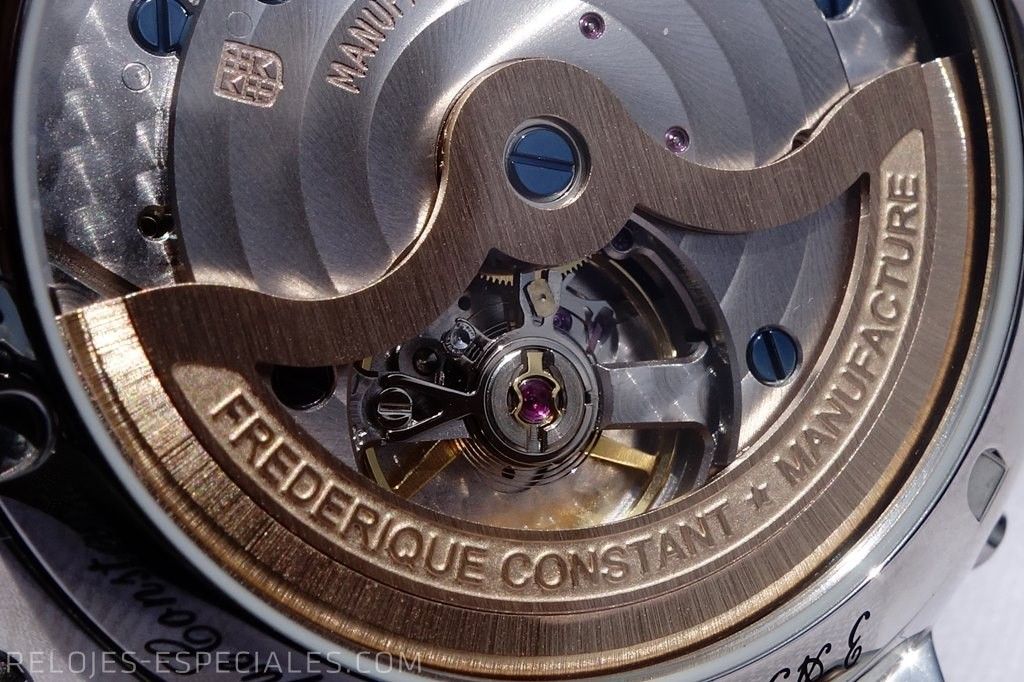
The caseback, with a flat sapphire crystal, allows you to see the mechanism already described before, with itscôtes de Geneveand the perlage in addition to the gold-plated oscillating mass with a skeleton that allows the balance to be seen even when said mass is right above it. Here it would seem that there is a kind of nod to the origins, when the brand gave its first knock, precisely showing the steering wheel from the dial side, how much it has already rained. The ring containing the crystal is engraved with the model and caliber numerical references as well as the brand name and again the model. With very good sense, a limited series of a model called to “democratize” high complications has not been made.
It occurs to me that thePerpetual Calendar Manufacture of Frederique ConstantIt could inaugurate a new category of “engagement watch”: after all, an amount like this (8,350 euros in steel, 8,650 euros in the gold-plated version) is in the range of the Rolex, IWC or Audemars Piguet so common in these ceremonies. And a perpetual calendar is like diamonds: forever.
Best watch strap | Best annual calendar watch | Best watch winder | Best Black Luxury watch | Best Luxury Watches Men | Best Swiss Luxury Watches Women | Best Men Diamond Watches under 1000 | Best Diamond Watches Women | Best Luxury Dive Watch










