

Some things don't exist for the simple reason that they are impossible... until someone like Rolex starts looking into it. Contrary to what Rolex's detractors (and they have them) argue, the Swiss brand has been developing and patenting processes and materials since its birth and today has more than 400 patents in its name. One of them is Cerachrom®, and the most recent is Cerachrom® bicolor.
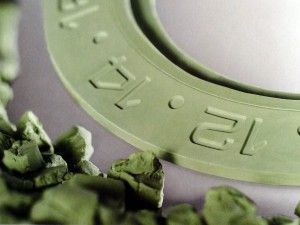 In 2005, after several years of research, Rolex developed and patented a new high-performance material to mount on the rotating bezels of its watches and thus replace the anodized aluminum inserts it had been using since the 1950s: Cerachrom® (ceramic and Χρώμα, color). The polished surface of this extraordinarily resistant material ensures perfect legibility of the figures engraved on it and covered with a thin layer of gold or platinum. Ceramic is a material of exceptional robustness and durability: it resists corrosion, is not affected by ultraviolet rays and is virtually scratch-resistant.

In accordance with its own quality standards and control of all the key components of its watches, Rolex internally developed the research, processes and equipment to maintain its independence also in the production of the ceramic components. The workshops are impressive facilities inPlan les Ouates(by the way, adjacent to Patek Philippe) on the outskirts of Geneva. There Rolex produces the elements that make up its cases and bracelets, melts its own alloys such as Rolesor® and provides other raw materials to assemble and polish them. The production of the ceramic is controlled from the base material to the finished Cerachrom® insert itself.
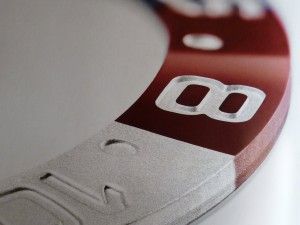 The Cerachrom® insert was introduced in 2005 on the Rolex Oyster GMT Master II 116710 with a monochrome black insert. Later, in 2007, the Rolex Oyster Submariner 116610LV appeared with a green bezel (and dial). It was not until 2013 that the first bicolor in blue and black presented in the same model arrived, and it was a world first. In one piece, the demarcation between the two halves was perfectly executed. In 2014 Rolex has taken this skill one step further and has presented the Rolex Oyster GMT Master II 116719 with the desired and long-awaited insert in blue and red, thus paying tribute to the first bezel in that color combination made in Plexiglas in 1955. The feat has two parts: first, the red color is extremely difficult to obtain in ceramic and therefore very rare. The second, having managed to create an insert in red, discovered a method that modifies the chemical structure of each grain to turn the red into blue in one of the halves while maintaining that perfect delimitation between both colors. It is certainly not the first manufacturer to present red-colored ceramics, since it already didHublot in 2013, but yes, who makes it in two colors.
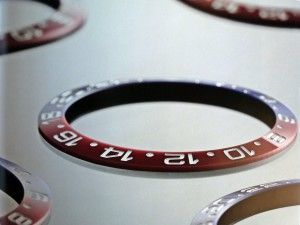 In most coloring processes, colors are achieved by adding pigment to the base material. In the case of ceramics, these are mineral pigments that can withstand the high temperatures to which they are subjected to achieve the hardness that characterizes them. Red is particularly difficult to achieve because there is no mineral pigment stable enough to produce Cerachrom®. After years of research Rolex has achieved it thanks to a procedure that for obvious reasons it wanted to keep secret. But this was only half of the success: the challenge went further since the goal was to be able to do it in two colors. The solution was to introduce an intermediate step in the preparation of the insert in which the red to “blue” part is impregnated with a chemical solution whose composition is equally secret. This is done just before sintering the assembly at 1600ºC, when the ceramic densifies and the added components react to turn blue.
Chronology:
– 2005: Rolex patents Cerachrom® and presents it in a single color (black) in the GMT Master II 116710LN
– 2007: Rolex presents the Submariner 116610LV with green Cerachrom® bezel
– 2010: Rolex goes one step further and introduces an all-black Cerachrom® bezel on the Daytona Cosmograph
– 2013: First bicolor blue and black Cerachrom® bezel on the GMT Master II 116710BLNR. Second brown monobloc bezel on Daytona 50th Anniversary Platinum 116506
– 2014: Rolex finally presents the long-awaited two-tone insert in red and blue: The GMT Master II 116710BLRO
Read next: Best watch strap | Best annual calendar watch | Best watch winder | Best black luxury watch | Best Luxury Watches Men










