

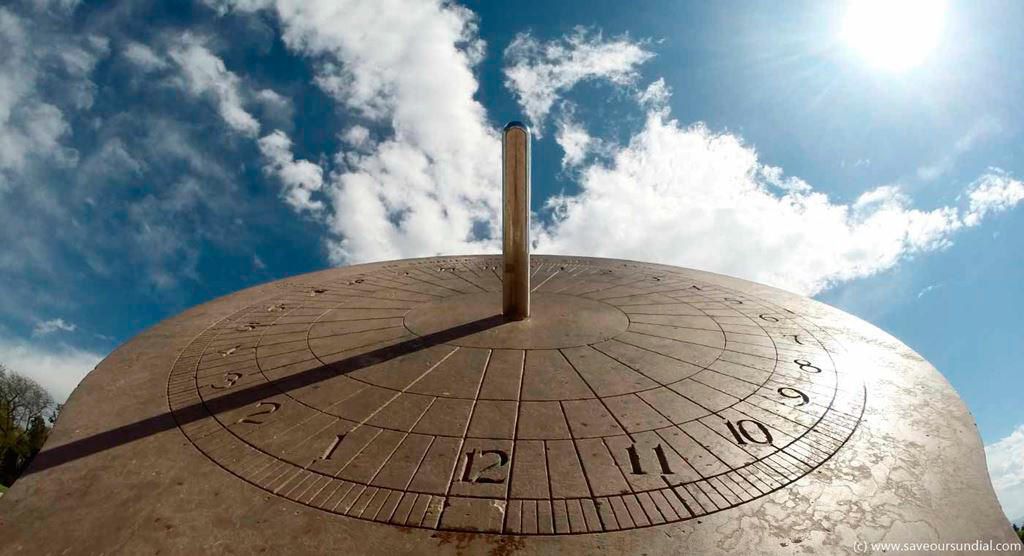
Today we bring you an article about one of the most romantic watch complications: the Equation of Time. Probably, the easiest description to understand the magnitude of the complication of the Equation of Time is the one that refers us to the difference between the time given by a sundial and that given by another traditional one. You just have to stop to ask yourself one question: what are the real differences between the two?
A question of Astronomy
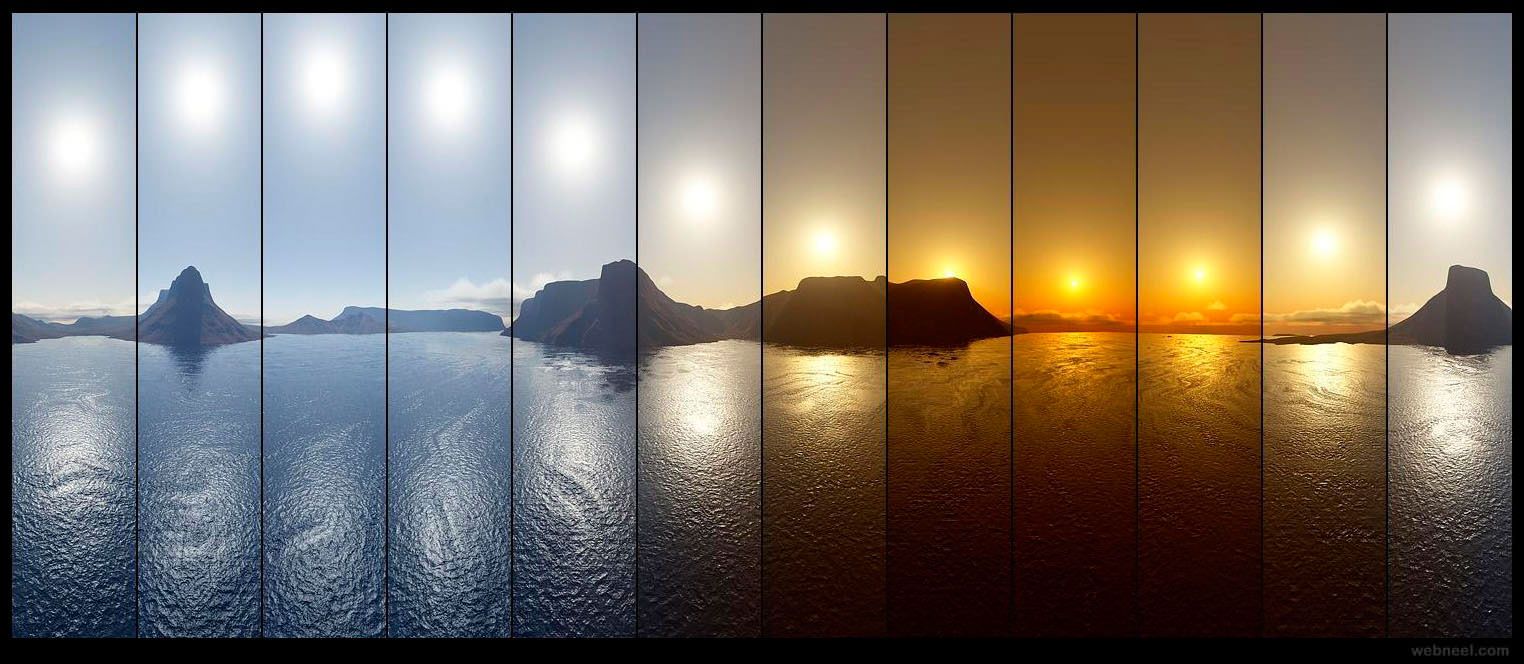
To answer it, it is necessary to go back in time and enter a time in which Man lived looking at the sky, without artificial light, observing the stars, especially the king star, which governed time in accordance with its cycle, day and night. In this context, scientists strove to explain what the Babylonians first observed: that the sun's movement was irregular, sometimes higher in the sky at noon than others, and that the length of the days varied considerably over the course of a year.
Get Lifetime Access to Top AI Tools
Find Bleeding Edge Business Software at Scandalous Prices on Appsumo.

There were many astronomers who tried to find the explanation for this phenomenon, since Ptolemy, who in the 2nd century AD. C. developed his theory based on the geocentric conception of the universe according to which the stars moved around the Earth in a circular motion, until Copernicus who, a few centuries later (towards the end of the 15th century), revolutionized astronomy with a new theory, heliocentrism, which established that the Sun is the center of the Solar System.
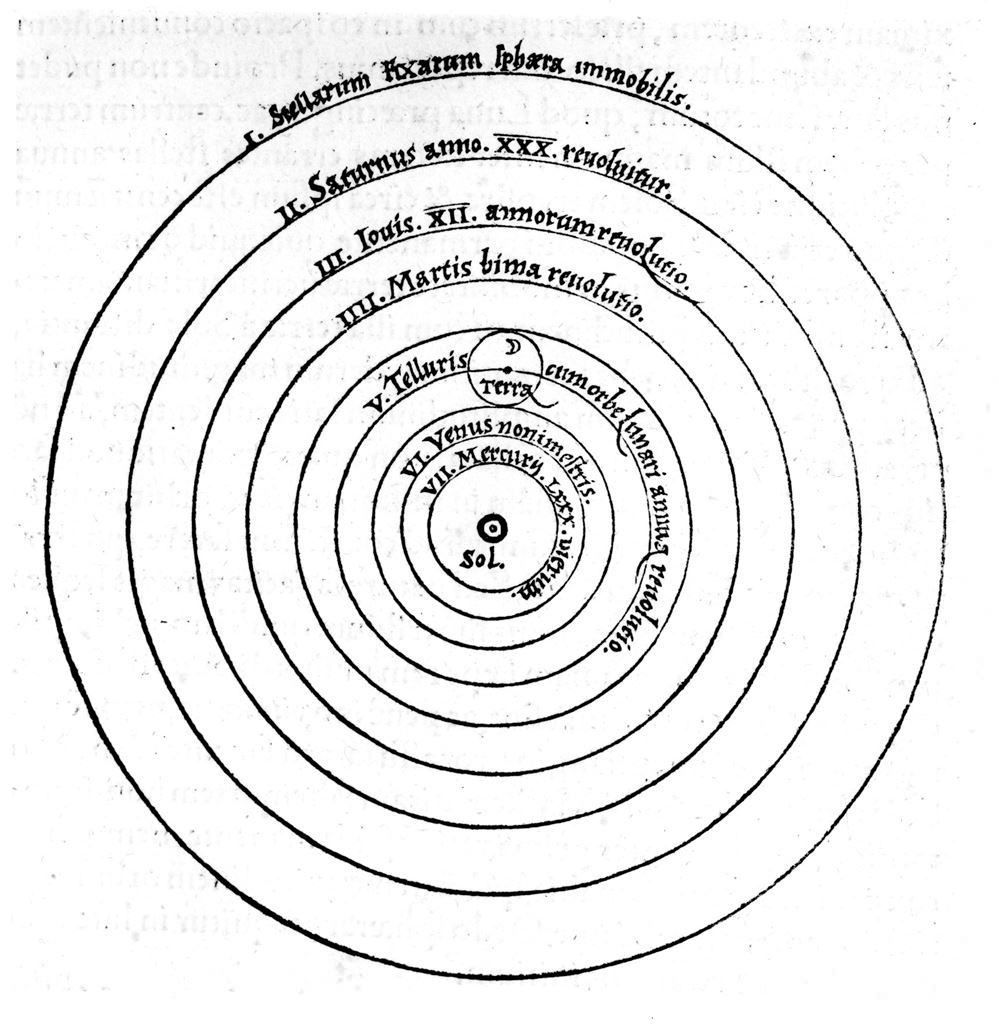
However, the definitive support for Copernicus' postulations, which in fact had not been widely disseminated, came from two contemporary astronomers, born at the end of the 16th century although with opposite lives, Tycho Brahe and Johannes Kepler. The first, born into a rich family in Copenhagen, was an eccentric lover of Astrology who had great resources for its study, which allowed him to provide very valuable and highly accurate astronomical data to Science. This allowed Kepler, a staunch Copernican born into a humble family in Prague, to calculate the orbits of the planets with extraordinary precision. And it was his findings that put us in the position of beginning to clear up the mystery of the Equation of Time, since he established that planetary orbits did not describe perfect circles, but rather experienced a rather elliptical movement.
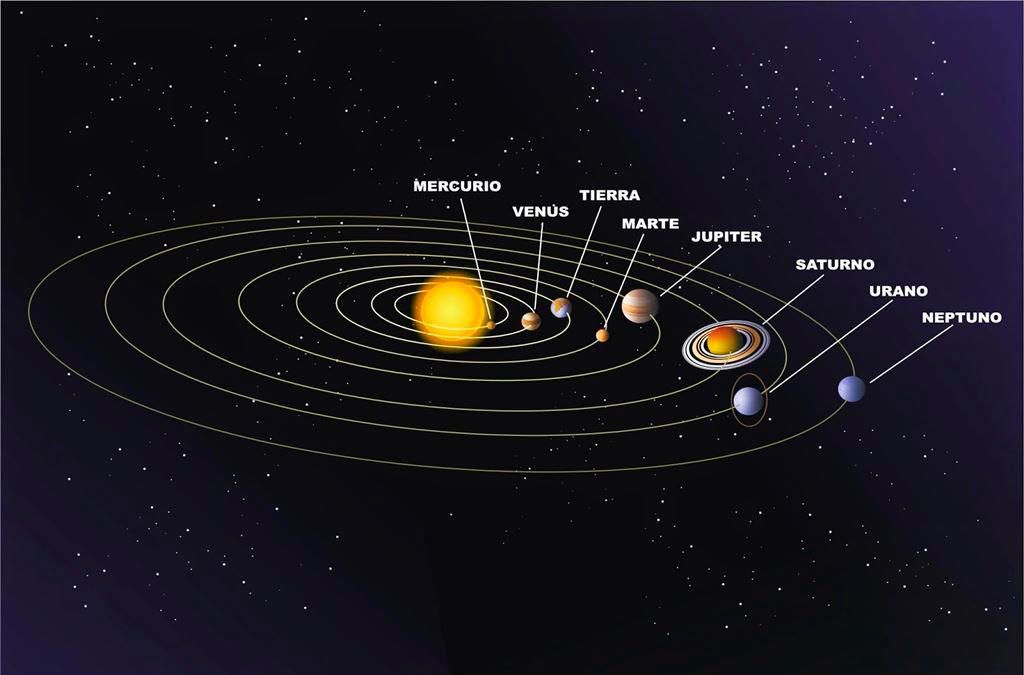
Galileo and Newton later entered the fray to finish finishing off the traditional Ptolemaic model, thanks to the detailed study of the orbits of Jupiter's moons by one and the formulation of the Laws of Gravity by the other.
The truth is that we arrived at the end of the 17th century with two very clear concepts: that the Earth describes an orbit around the Sun that is not a perfect circle, but rather an ellipse, and that the Earth's axis is not completely vertical, since a fairly pronounced inclination was recorded (23 degrees and 7 minutes of arc).
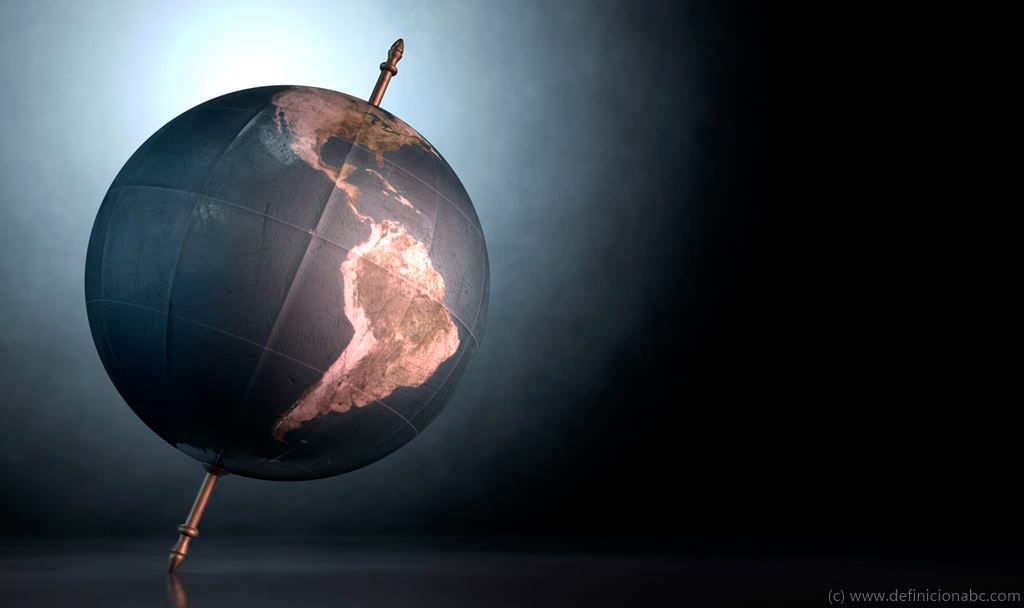
These two certainties explain various phenomena, including the seasons of the year, with their variations in temperature and the different lengths of days and nights: in the Northern Hemisphere, for example, when the pole is tilted towards where the Sun is, the days are longer and the Sun occupies a higher position in the sky. On the contrary, when the inclination moves away from the King Star, the days are short and its position in the sky is much lower.
If we measured the height of the Sun above the Horizon every day at exactly 12 noon on a clock, we would see how this height changes until it reaches the highest position on the Summer Solstice and the lowest on the Winter Solstice. If we carefully observe the path of the Sun in the sky, we discover that it follows a path that draws a strange figure in the shape of an 8.
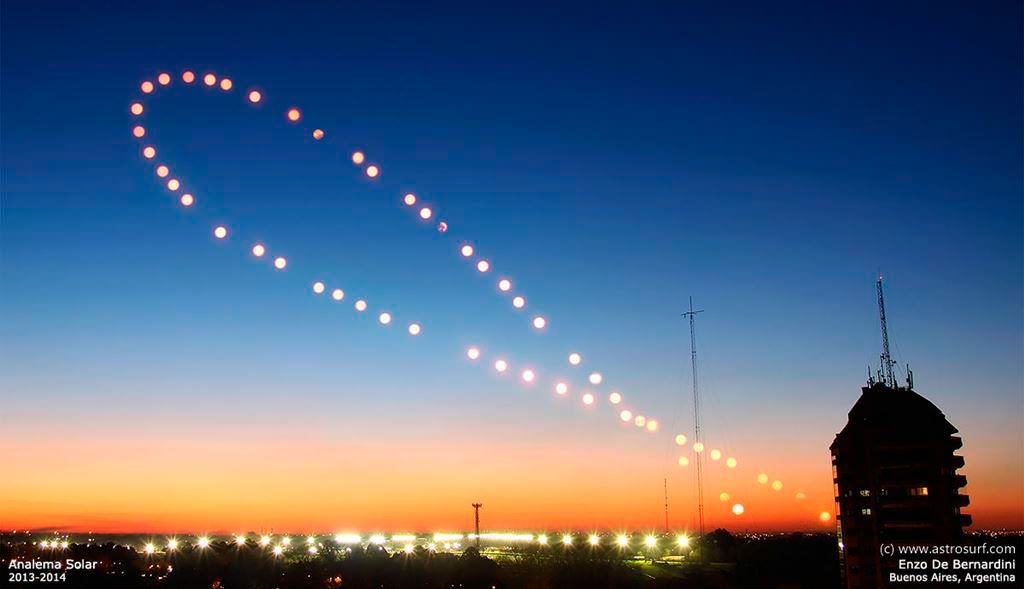
That trembling eight in the sky is called the analemma, and the fact that the Sun sometimes moves forward to the position it should occupy at noon, and other times falls behind, is what the hand of the Equation of Time of a clock is intended to illustrate.
The Equation of Time or capturing the path of the Sun on a clock
As we have seen, many of the Complications that have traditionally enriched Fine Watchmaking have been nourished by Man's innate need to try to explain something as indefinable as the magnitude of time.
Such is the case of the Equation of Time, a horological Complication that attempts to reflect the discrepancy between the time indicated by a clock and the position of the Sun in the sky, the one that an ancient sundial would show, and which is due, as we have said, to the inclination of the Earth's axis.
Since the Sun's orbit is elliptical, it appears to accelerate and slow down throughout the year. This cycle of acceleration and slowdown that occurs introduces a variation of solar time into the Equation of Time with an annual periodicity. The tilt of the Earth, on the other hand, not only makes the Sun appear higher or lower in the sky, but this also occurs on a biannual basis.
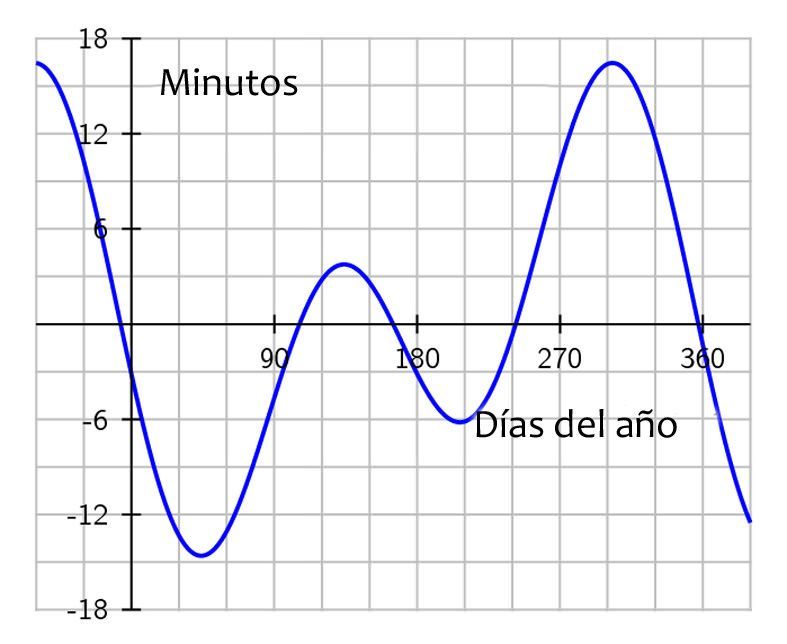
Indeed, the sum of both cycles gives us the Equation of Time: as the position of the Sun varies cyclically throughout the year, solar time moves ahead or behind with respect to the time indicated by the clock. Thus, the Equation of Time in any watch, whether it is a wristwatch or not, can be indicated in several ways: the most common is that there is a sector of the dial in which a needle shows how much must be added or subtracted from the mean solar time to obtain the apparent solar time, that is, what a sundial would mark.
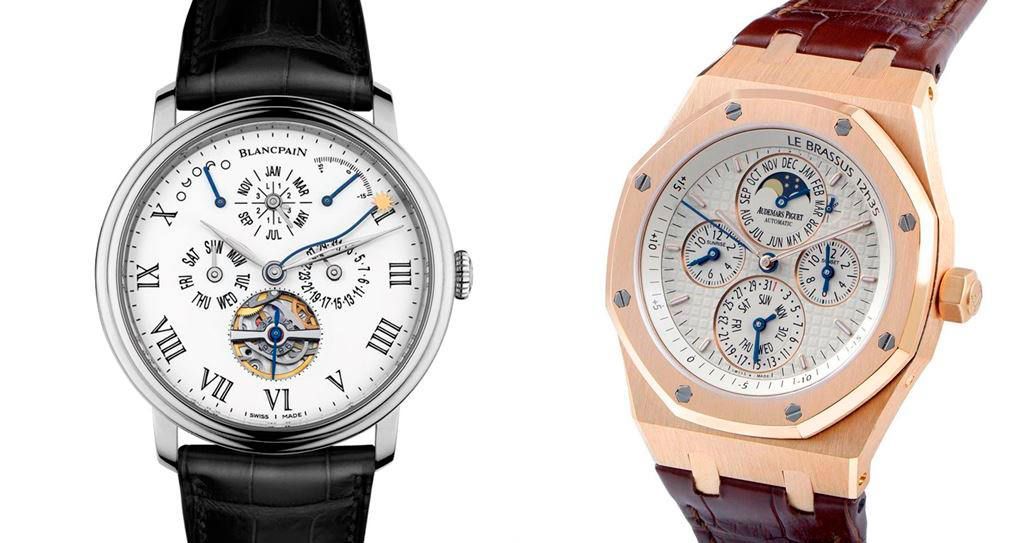
The hand oscillates forward or backward, moved by gears hooked to a “metallic finger” that outlines the contour of a cam that rotates once a year, with a shape that vaguely reminds us of that of a kidney, whose silhouette corresponds to the analemma (that strange eight that the Sun seems to draw in the sky).
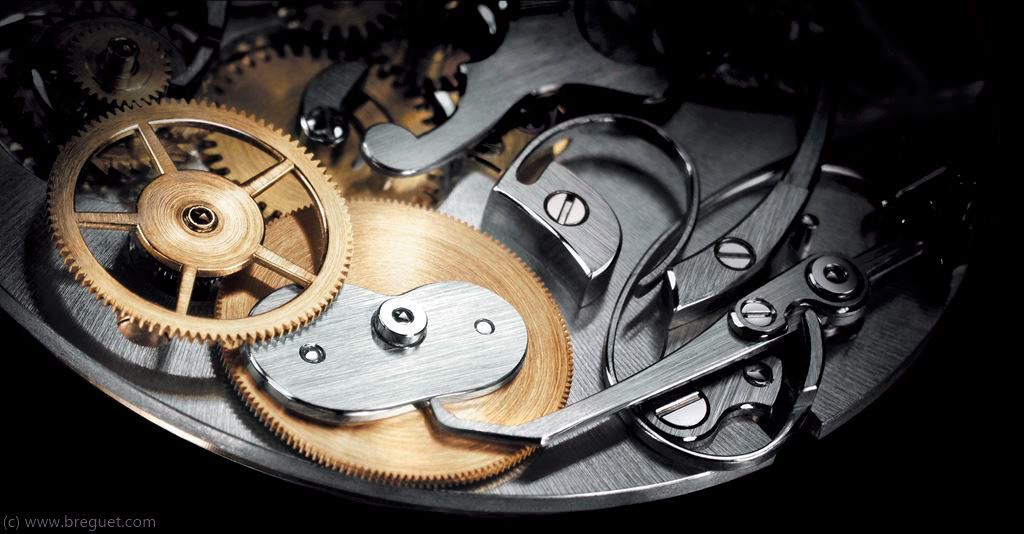
The Equation of Time is a rather unusual Complication in itself, even in its simplest version, but it has evolved to give even more complex and less frequent variants, such as the Marching Equation of Time.
In this one, there are two minute hands on the dial, one for the mean time and another for the apparent solar time. Over the course of the 365 or 366 days of a year, the “EOT” hand, that is, the one that obeys the Equation of Time, slowly closes distances with the minute hand until it advances it, and then falls behind it, just as the Sun in the sky gradually approaches the clock time and then falls behind.
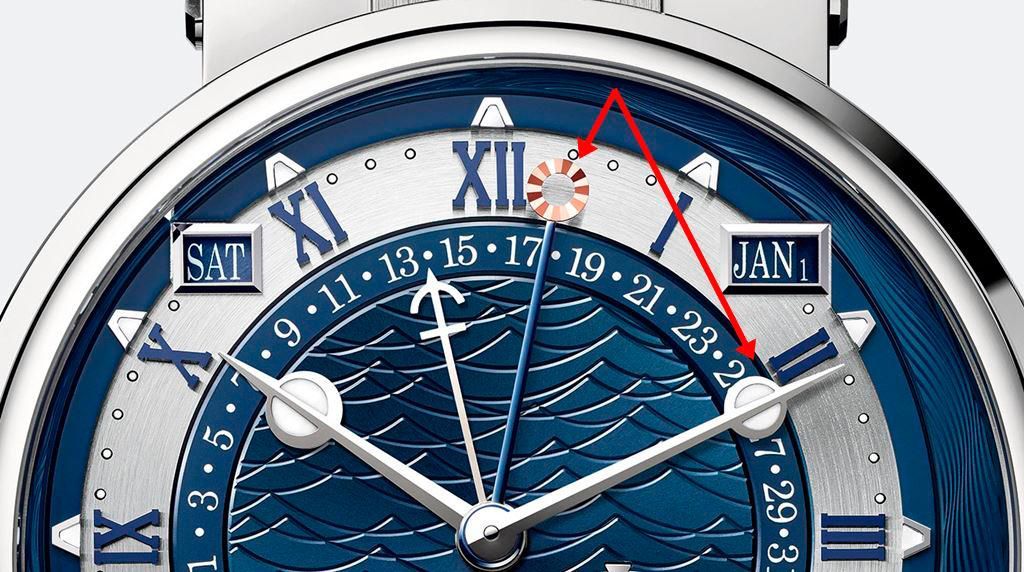
The Equation of Time: story of an unusual Complication
Historically, the Equation of Time, one of the most beautiful and fascinating Complications of Fine Watchmaking, was (and remains) a rarity.
It is usually found on large watches. It can rarely be seen on pocket watches, since for much of the History of Watchmaking, carrying a watch with this Complication in a vest pocket was reserved for princes of commerce or members of a royal family.
The list of manufacturers of pocket watches with Equation of Time includes the cream of Fine Watchmaking: Thomas Mudge in the 18th century and creators of the stature of Leroy, Breguet and Berthoud in the 19th century manufactured pocket watches with Equation of Time only at the request of their most illustrious clients. Of course, the most famous, extreme example, is Breguet's 'Maria Antoinette', which disappeared in 1983 and was recovered in 2007, and of which Breguet herself made an exact reproduction that, after four years of work, was presented in 2008:
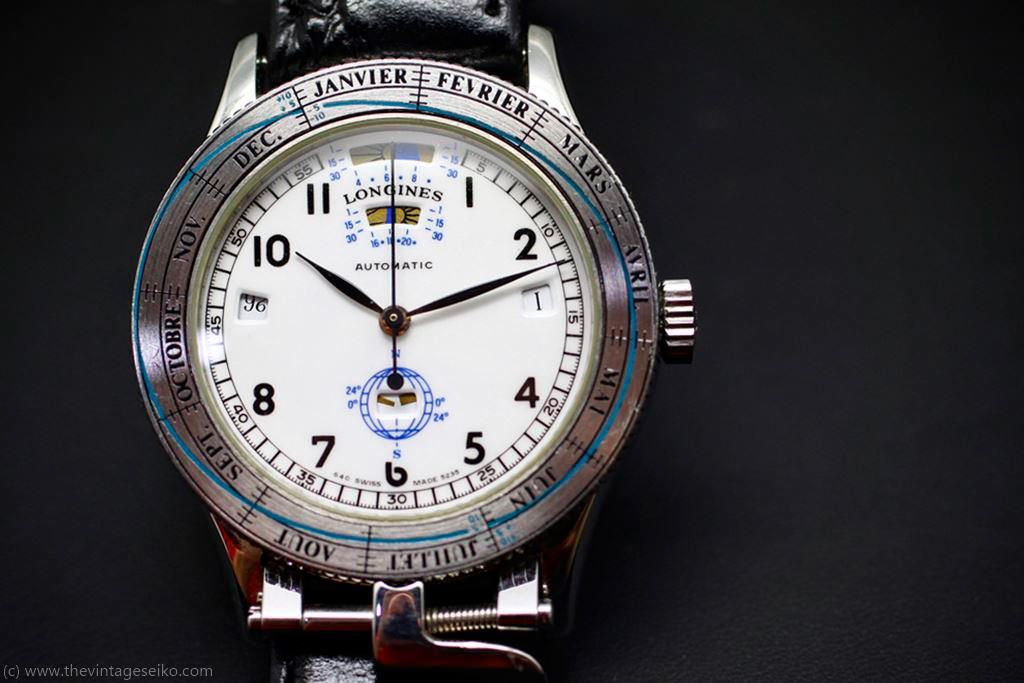
The first wristwatch with this Equation of Time belongs to a house that is not usually associated with the introduction of high-end complications. In 1989, Longines produced the 'Ephémérides Solaires', a complex piece with several astronomical indications that displays the Equation of Time, although not as a mechanical indication: the EOT appears on a rotating bezel that runs around the circumference of the bezel, with a scale for each month displaying the Equation.
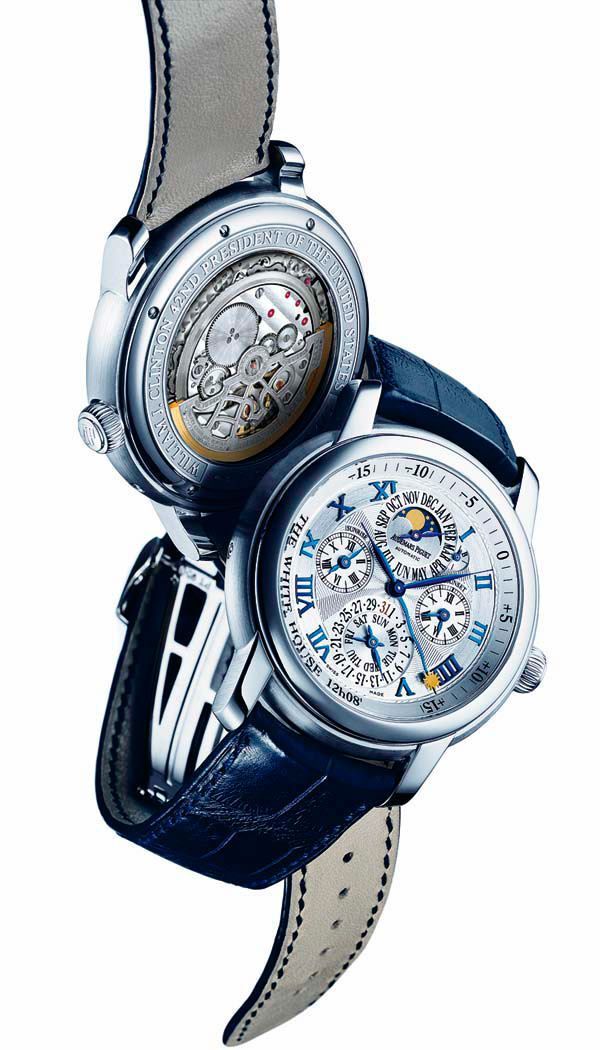
The 'Jules Audemars Equation of Time', the work of Audemars Piguet, is one of the most important watches that include this complication. It is undoubtedly one of the most interesting and most technically precise that exists. Manufactured in 2000, it not only shows the EOT indication, but also offers the correct time of Sunrise and Sunset, in addition to displaying a Perpetual Calendar and Moon Phases. The 'Boreas', by Martín Brawn, his contemporary, competes with him in distinction and rarity.
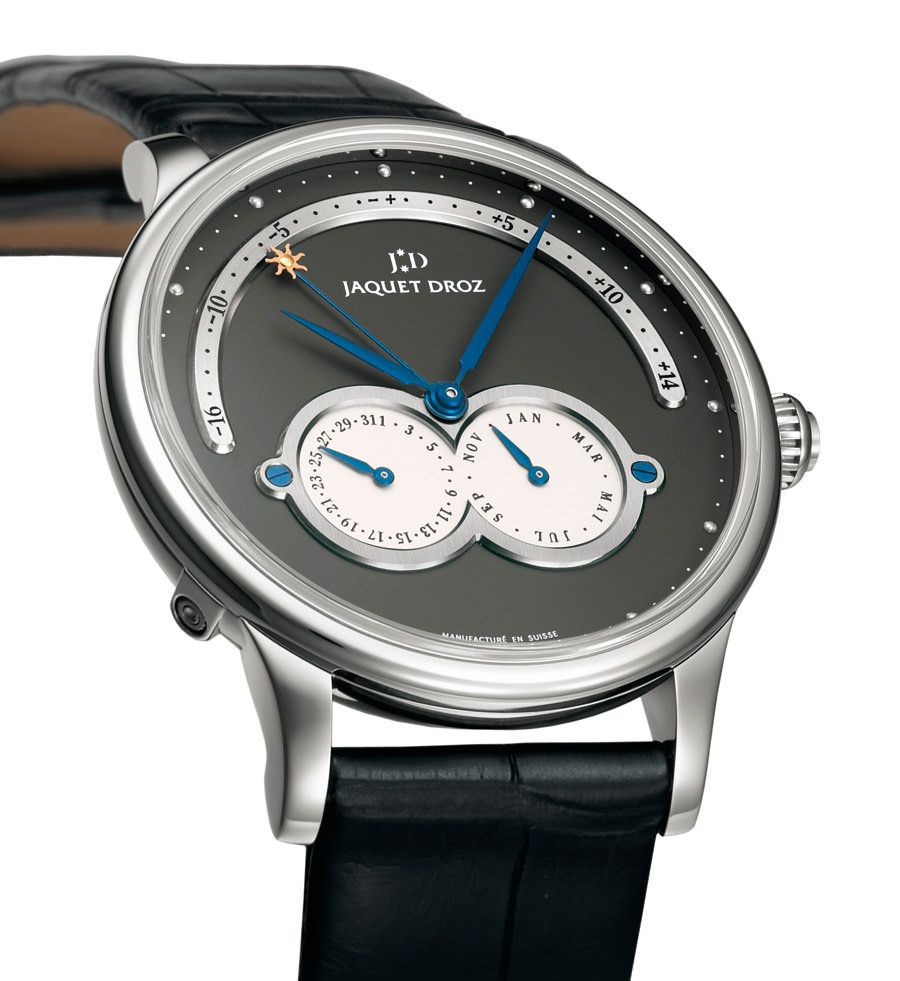
If we talk in terms of beauty, one of the greatest exponents is the 'Equation of Time' by Jaquet Droz, made in a limited series of 28 units, in which the Equation of Time indication takes the form of a sector of the dial that shows the adjustment that must be made with respect to the middle dial, although in the case of this watch that sector has a generous margin of 180 degrees of space.
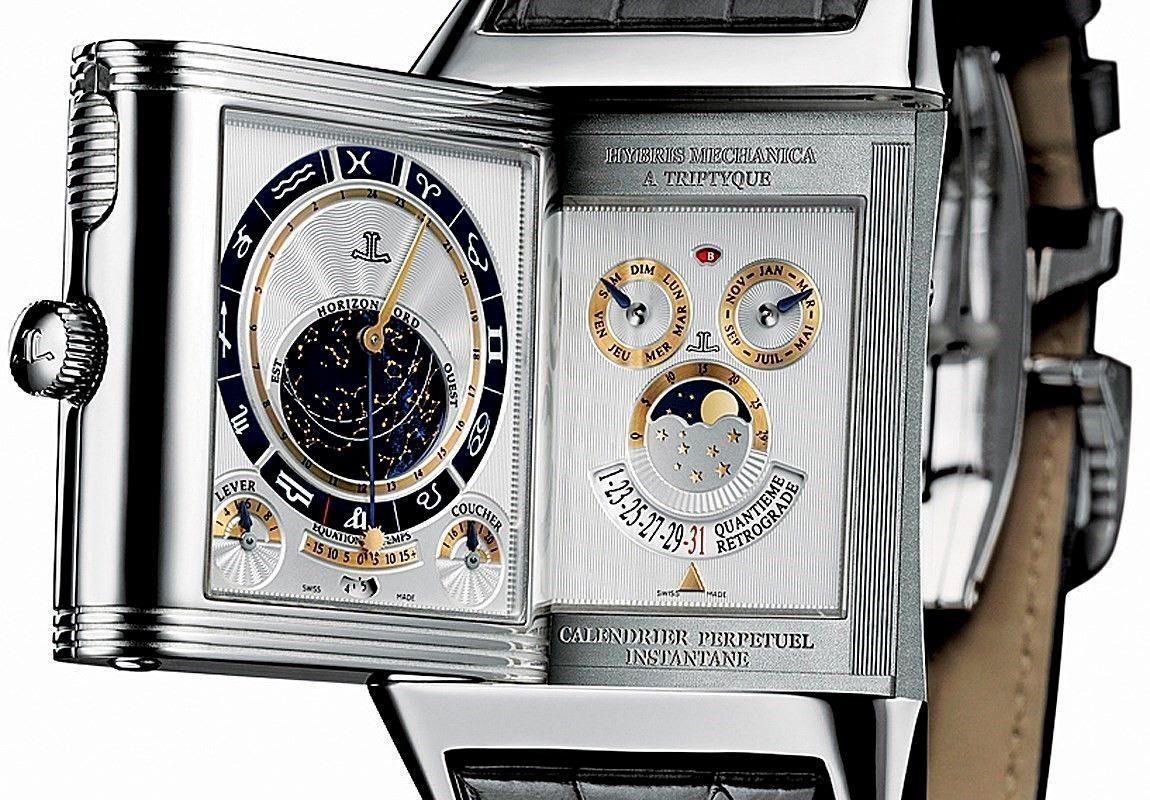
On the other hand, one of the exponents whose excellence surpasses interplanetary confines is the 'Triptyque' by Jaeger-LeCoultre. A true catalog of astronomy with indications of the Equation of Time, Sidereal Time, Perpetual Calendar, Lunar Phases, hours of sunrise and sunset, accompanied by a planispheric representation of the night sky. A true delight of Fine Watchmaking.
The Equation of Time is a mechanical development as beautiful as it is complex, which occupies a special place in the milestones of Fine Watchmaking, a Complication that crosses space, reminding us that our civil time is nothing more than a newcomer, also evoking the effort that Man has made over thousands of years to unravel the mystery of celestial mechanics.
If you have been interested in this topic, and as a summary, we leave you a very illustrative Blancpain video:
Best watch strap | Best annual calendar watch | Best watch winder | Best Black Luxury watch | Best Luxury Watches Men | Best Swiss Luxury Watches Women | Best Men Diamond Watches under 1000 | Best Diamond Watches Women | Best Luxury Dive Watch
Home Decor Shop
 Acacia frida deluxe solid wood bed frame |
Bedroom bench |
Bed chest drawers |
Lingerie dresser |
Frame base |
Mirror with jewelry storage |
30 Bathroom Vanity |
Memory foam queen mattress |
Mattresses for back pain |
Nightstand set of 2 |
Grand Goldman Shop |
Civil Lawyer
Deutschland Trikot WM 2026
Acacia frida deluxe solid wood bed frame |
Bedroom bench |
Bed chest drawers |
Lingerie dresser |
Frame base |
Mirror with jewelry storage |
30 Bathroom Vanity |
Memory foam queen mattress |
Mattresses for back pain |
Nightstand set of 2 |
Grand Goldman Shop |
Civil Lawyer
Deutschland Trikot WM 2026










