

The rulesDIN 8310 or ISO 2281describe the different levels of water resistance of watches and the testing procedure by which this resistance is calculated. To begin with, watches that do not have the inscription “Water Resist” (or WR) on their back or back cover are not considered water resistant. Although in practice there are no watches that can be called such without this inscription, if there are they should not come into contact with water under any circumstances.
But water resistance according to these DIN 8310 or ISO 2281 standards is not a characteristic with a permanent guarantee since it depends on the good maintenance of the watch's joints, which are subject to natural aging and wear caused by use. Extremely high or low temperatures or contact with solvents or cosmetics can accelerate this process and cause the joints to become brittle and porous, which will compromise the water resistance of the watch. Except for models specifically designed for this, watches should not be used in temperatures below 5º C or above 50 °C, although it must be taken into account that normally the wrist that wears it transmits part of the body heat.

Very important: the number of meters indicated on the watch does not mean that they can be used directly at that depth, since the water resistance data only represents the -static- pressure to which the watch has been subjected during the tests. During movement in water, such as swimming or waving your arms underwater, the dynamic pressure created can greatly exceed the static pressure indicated on the back or back of the watch. Furthermore, a watch can be damaged when it is submerged in water after prolonged exposure to the sun, because then negative pressure due to cooling is added to the pressure of the impact.
It is important to follow the maintenance recommendations of each manufacturer, although as a general rule it could be said that we must have seals checked and replaced at least once every four years (less, if the watch is used intensively), but above all, do not forget what depends directly on us, such as screwing the crown properly after a time or date change. Otherwise it will be of little use that our watch is nominally waterproof to 200 meters.
The following table gives us a graphic idea of the water activities that we can do with our watch according to the Water Resist legend it displays:
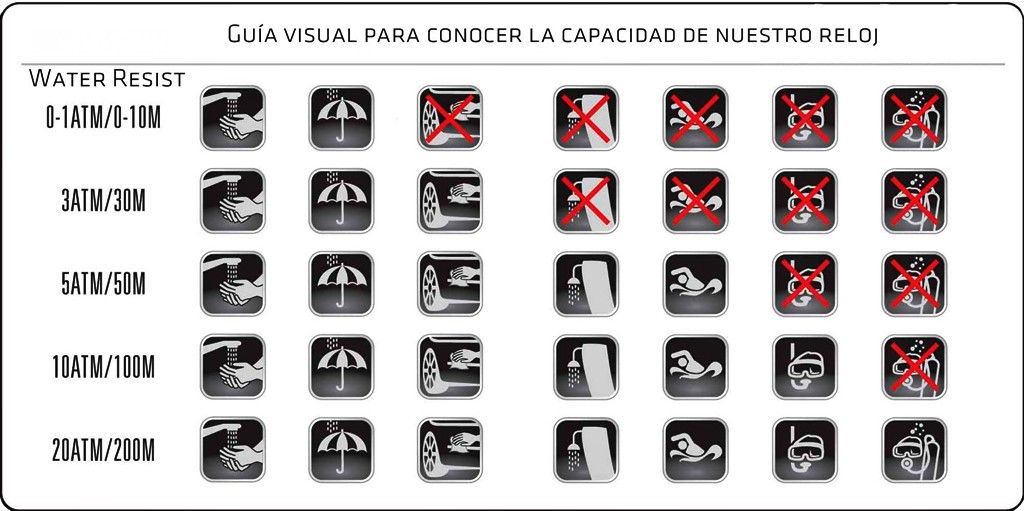
By the way, to certify resistances greater than 200 meters the standard is used ISO 6425 divers’ watches standard.
Read next: Best watch strap | Best annual calendar watch | Best watch winder | Best black luxury watch | Best Luxury Watches Men










