

2. Juni 2025, 10:58 Uhr | Lesezeit: 23 Minuten
How does traveling with a disability work? How barrier-free are the travel destinations? And what challenges do you encounter when traveling with a wheelchair? Sunnytrips author Anna Wengel (Chiodo) asked the founder of “Wheel Around the World”, Shane Hryhorec, these and other questions during an interview in Melbourne.
Find Bleeding Edge Supplements at Scandalous Prices on iHerb.

Accessibility only plays a marginal role in the travel industry. A lot has happened in many places in recent years, and a lot still has to change. One person who has dedicated his life to this change is Shane Hryhorec.
Who is Shane Hryhorec?
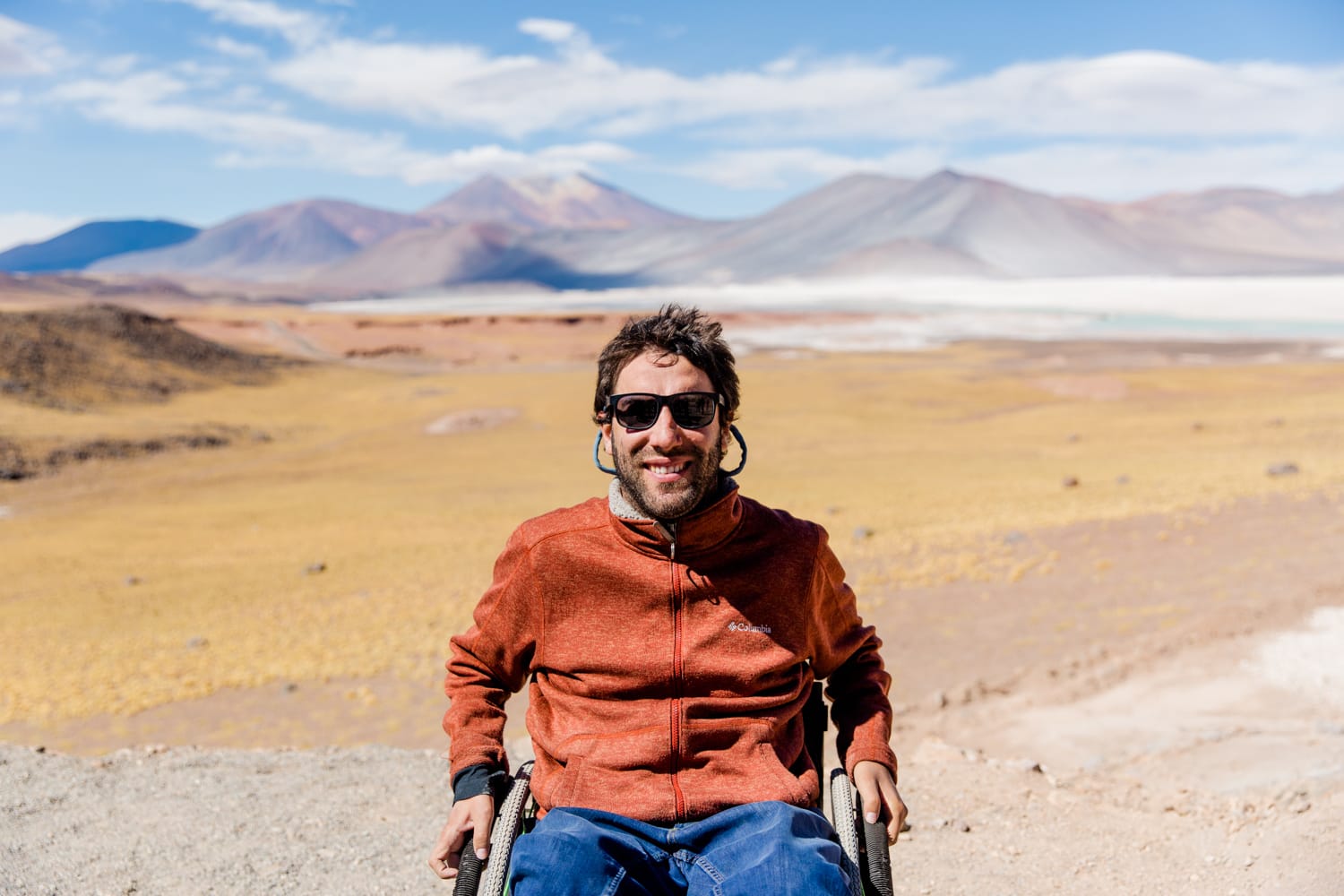
The Australian native has been in a wheelchair due to a spinal cord injury since a swimming accident in 2007. He doesn't let that get him down. He travels the world in a wheelchair and documents his experiences, both good and bad. Shane's YouTube channel "Wheel Around the World" and its networked channels reach millions of viewers. With the “Accessible Beaches” initiative, the son of a Ukrainian father ensured that (so far) 160 Australian beaches became barrier-free. He recently created Co-able, an accessible wellness and health destination in Port Adelaide. And last but not least, Shane was nominated for the Australian of the Year Award as “Local Hero” this year.

Shane Hryhorec in an interview with Sunnytrips
I was able to meet Shane for an interview in Melbourne, Australia, where he lives about half the time. The other half he lives in his hometown of Adelaide or travels around the world with a wheelchair and camera. And if I can add a personal note in advance: I am honestly thrilled and touched by the energy, wit and ease with which Shane talks about his work and his not always necessarily positive experiences of his life traveling in a wheelchair. This is what he told me:
Sunnytrips: How much time do you spend traveling?
Shane Hryhorec:I travel abroad at least once a year, every other year to Europe, usually also to Germany. However, I only started Wheel Around the World twelve months ago. Before that I was usually on the road between one and three months. Last year I traveled for five of the twelve months.
Where in Germany do you like to go?
Every other year, a company for the disabled that I am part of organizes a large trade fair in Düsseldorf, in which I take part. In Munich I usually come to Oktoberfest, although I stopped drinking alcohol three years ago - I try to work at a high level, i.e. run my companies and charities, and alcohol and especially the hangover afterwards don't fit in. The only time I drank alcohol at all in three years was at the Oktoberfest in Munich. And only because I couldn't find the tent with the non-alcoholic beer and so I made an exception. In the end, the experience reinforced to me that the decision to completely banish alcohol from my life was one of the best of my life.
BILD Reisen: Discover the best hotels in Munich now!
What is the best travel decision you have made in your life?
The decision to travel and document it. That was in Bali in March last year. It was the first time I took a trip to capture it and share my experiences. It was great because I learned a lot about the power of storytelling. I learned that by creating content and sharing my story, I can help many people and improve tourism.
How was the experience in Bali?
Bali is a challenge for people with disabilities. The footpaths are not particularly accessible, restaurants are not accessible, tourist attractions are not accessible. I like challenges and challenging those around me, but after a while it gets tiring. After a week in Bali, you're looking forward to returning to Australia where things are a little more accessible.

What is it like for people with disabilities in Australia?
Australia is pretty good, but it's not where it needs to be yet. I rate Australia a 7 out of 10 for overall accessibility. Many businesses in Australia are still not barrier-free, and the same applies to many homes. We still have a long way to go.
How do you rate Germany?
Probably an 8 out of 10. Germany is pretty good when it comes to accessibility. But one of the problems is the houses. There are a lot of older houses, so even those of many of my friends are not easily accessible. There are also some other challenges, such as shops that you only need to enter through one level, but in general I think Germany is pretty good. In Berlin, for example, there are many shops that still have one level, but this is very common in Europe as a whole. Going to galleries is now mostly easy, there seems to be a uniformity. But it becomes more difficult, especially in rural areas. The larger and more developed the city, the better the accessibility.
You said you travel to Europe every other year - where do you go the other years?
I have been to Taiwan, Japan, South Korea, Turkey, Bali, Thailand, Fiji, New Zealand and America. I have traveled to America three or four times. In Europe and America I usually go to the same places. In America I usually fly to Los Angeles and then drive to Las Vegas and San Francisco and back to L.A.
Which of the places you visited was particularly good in terms of accessibility?
Grenoble in France. I had just returned from an eight-day disaster cruise on my trip to Europe. Accessibility on the MSC ship was a nightmare. When the cruise was over, I thought I needed to get away from the beach and people, so I got in the car and drove north. I actually only wanted to stay in Grenoble for one night. But when I got there it was empty, everyone had left Grenoble to go to the beach. And I had left the beach to go to Grenoble – and I loved it.
I stayed six days. The public transportation, the walking, pretty much everything I did was so easy to get to and it was just so beautiful. This is probably one of the most inclusive cities I've been to in my life. Grenoble was definitely the best of all the places I've been so far. It's not perfect, but it's definitely the best.
Which places disappointed you the most?
South Korea was one of the biggest challenges for me. When I flew from Japan to South Korea, I had the worst flying experience of my life. At check-in they had problems with my batteries. I waited three hours and thought I wouldn't fly at all. I even checked to see if I could take a ferry. I was finally allowed to go through security 15 minutes before departure. That was so stressful. I filmed it and the video got a lot of views, but the experience itself was just exhausting for me.
When I arrived in South Korea, I was exhausted - and ended up in a hotel that wasn't barrier-free. I wanted to go to the pool, but the driveway was so steep that I needed help getting down and back up. When I finally got to the swimming pool, they told me that I wasn't allowed in with my wheelchair. I practically begged them and in the end they let me in.
It was really nice to swim there. But in some places like Bali, Japan and South Korea, to name a few examples, you hardly see people with disabilities. They are hidden by society, so to speak. Many people with disabilities stay at home, so there are adults in their 20s who have never left home. Therefore, people in the community do not know how to deal with disabilities. The people there don't fight for equality and better quality, so they don't see any improvements.
And then I come along and ask why the hell I'm not allowed in there and challenge it. And I'm already there. This is just one example from South Korea that shows that every interaction changes perception. The second time I was at the pool they were much more relaxed. They realized I was okay and everyone was okay, they just needed to get over it. And they did, it was a great learning experience for everyone.

Do you remember your first wheelchair trip? How was the experience?
Yes, my first trip after the accident was to Cairns, Australia. That was almost 20 years ago now. I went there with a good friend from Adelaide and it was quite a shock. I could no longer do many of the things I enjoyed doing in the same way, such as going to a nightclub that was upstairs or in the basement. Additionally, some people felt uncomfortable meeting someone with a disability in a bar. There I learned about my disability, but also how people are affected by a disability. I also learned how to travel with a disability and it was a pretty good first experience, also because I learned a little about my limitations.
One of the biggest challenges back then was fatigue. Moving a wheelchair over long distances is very, very strenuous and tiring. I have one with a motor at the moment, but they've only been on the market for about 13 years. Before that you had to push yourself, which was very tiring. In addition, one was often dependent on the help of others. I think that was the biggest turning point for travel. Now we have assistive engines that help people like me explore much more without using energy. If it goes uphill, I can drive up the mountain. This has completely changed the way I travel.
Nevertheless, my first trip was a really great experience. It was just different. There I also experienced for the first time some of the things that make people feel disabled - and that is the environment. Hills or tourist activities that are not fully accessible. So many things you can't do. There are always things you can do, but also a lot you can't do. Many places claim they are accessible, but when you get there you realize they are not.
What obstacles do you encounter the most along the way?
Hotels. The most convenient way to book is through platforms like Booking.com. The hotels there label themselves as barrier-free, you book it - and then you get there and often it's not what was promised. Or the hotel has given its barrier-free room to a person without disabilities. This is one of the biggest challenges. In half of all my bookings I get a room that is not barrier-free. Since I stay in so many places, I don't have time to always call and ask. So I go there and sort out problems on site. By filming and publishing these experiences, I want to show what reality is really like.
If hotels have promised an accessible room but then already given it to someone without a disability, are they usually willing to ask the other person to change rooms?
They usually don't tell you there's a problem. They usually just try to solve the problems without you knowing what's going on. They never say, "I'm really sorry we gave the room to people who don't need it" - but I'm good at getting the reasons out of them. And then I keep asking why. At some point they admit that there are people living in the rooms who don't need accessible rooms. This is one of the biggest problems. Someone without a disability can use an accessible room, but someone with a disability who needs an accessible bathroom cannot use an accessible room. If more barrier-free rooms were simply built, the problem would be solved.
How often do you have to change hotels – or do hotels usually find a solution?
Not that often. When I was in Vienna recently, I booked a room for four nights. The first night was a disaster, so I only stayed one night and then moved to another hotel. Sometimes it's easier to stay there for the moment. If you get a room that is DDA (Anm. d. Red.: australischer Disability Discrimination Act) oder ADA- (Anm. d. Red.: Americans with Disabilities Act) compliant, a good experience is all but guaranteed. But sometimes you can do it without it. It's more difficult and not as pleasant, but you can do it easily. For example, I love swimming in the morning, so sometimes I stay in a hotel where I don't even use the bathroom. I wake up early in the morning, swim two kilometers and then shower there.
How do you deal with situations like this where you have to move?
That's part of traveling. You have to be able to deal with it, otherwise you can't travel.
Do you sometimes get angry? Or have you gotten used to it?
I definitely get angry, but I just expect it by now; I think it's a question of attitude. I just go with it and expect something to be problematic every time - and if it isn't, I celebrate it. My perspective has changed, but it also wears you down.
A good example is my experience with a hotel in Nice:

However, the story began earlier: I came from Lake Como to a country house in Italy where I was supposed to stay for three days, but which I couldn't even get into. So I moved on to a hotel I booked online that had given its last accessible room to someone without a disability. And then I arrived in Nice, where the last accessible room was also given to someone who didn't have a disability. That was exhausting. From there we went on to Marseille for the aforementioned disaster cruise. Then I came to Grenoble. I plan to go there every August and spend a week there when most people are not there and at the beach instead.
What role does planning play for you and how much spontaneity is possible?
I don't plan much. I'm a spontaneous traveler and that's how I like it. People without disabilities often travel this way. Why shouldn't people with disabilities do the same? I just like to travel wherever I want, whenever I want. I prefer to book my appointments for the trip there and back and the rest falls into place along the way. I usually book a few days in advance. When I was in Taiwan recently, I just got back from a two week stay and booked it literally a day or two in advance. This is typically how I travel. Because if I like a place, I can stay longer, and if I don't, I can just leave again.
Find out more about Shane's trip through Taiwan here:
But do you always check whether a hotel, sights, cafés, etc. are barrier-free? Or are you just going there spontaneously?
I always do my research beforehand. I always book hotels that say they are accessible. Every store I go to I check beforehand. If you go to a modern gallery or museum, you are almost certain that it is barrier-free. But every other activity I research beforehand.
Is the accessibility of shops, restaurants, etc. the second biggest challenge on the road?
Yes, the accessibility of shops, such as cafés and restaurants, but also the general search for barrier-free places. Recently, Google introduced a blue icon for stores that, in my experience, is about 40 percent accurate. It often happens that you drive to a place that has a blue symbol - and then there is a big step that you have to overcome. Accurate information is probably the hardest part. But I believe that a lot has already happened; Now there is corresponding technology. Platforms like Google could make so much possible so quickly and easily. But only if they want to - and they obviously don't. I've already asked Google if they would be interested in adding more accessibility categories so that companies can provide more information to the general public. Google then stated that this was not a priority at the moment.
Are there any specific websites or apps you recommend?
No. Honestly, not a single app should be required. Google could simply provide more information. The reason there are so many apps is because people want to know what is and isn't accessible in the community. If there was a business directory on Google and Google was committed to inclusion and included this information, the problem would be solved.
Auch interessant: Reisen mit Behinderung – diese speziellen Anbieter gibt es
You are committed to barrier-free travel in your work. What exactly does your commitment look like? What are you doing to make the world more accessible?
I tell stories and share my experiences. It's about awareness. I noticed that after my experience in Nice, the video had 15 million views on various platforms. Shortly afterwards I used Booking.com and noticed that the search functions had been improved. Of course they don't call and say, "Hey Shane, we saw the video of you shaming us as a company and that's why we've improved." They will never do that. But it's interesting because you're paving the way for change. Telling stories is a tool for change and it's great when you see it having an impact.
In another video, I was at Disneyland in Tokyo and couldn't ride a single ride, not one. This video also hit like a bomb, with someone writing in the comments: “I wish Disney execs would see this.” And then someone wrote back: “I work at Disney and I guarantee all the key Disney executives saw this.” The point is that it is a very powerful tool. After my MSC cruise, I met with the bosses at MSC Cruises and they told me what they had changed. Long story short: The platform for exchanging experiences, good, bad and ugly, questions organizations and tourism as a whole. And it's up to them whether they want to continue getting stories like this or whether they improve their offering by making it more accessible.
What needs to change most in the travel industry?
The accommodation, because if you don't have accommodation you can't travel. There is so much that needs to change, but first and foremost is more accessible housing and more information about accessible housing. There are so many activities you can do, but you can't do them if you don't have accommodation close to the activity.
What about means of transport such as flights, trains, etc.?
Flying with a disability is a big concern for many people for a variety of reasons. Will the equipment be damaged? Will there be problems with my batteries? Will they be traumatized by customer service, by people who don't know how to deal with disabled people? There are many fears that people associate with traveling and a big part of it is related to training.

There is definitely a lot of room for improvement. For example, I took the train from Vienna to Germany and it looked like I wouldn't get an elevator to get on the train. At the last minute someone showed up to solve the problem and that was good, but it is always a certain stress factor. A non-disabled person simply walks up the stairs. There are many modes of transportation that are accessible, but they are only as accessible as the service that surrounds them. There is still a lot to do in terms of processes and settings.
By the way, that's the great thing about transportation in Japan. For example, you don't need much help there, whereas here in Melbourne you can't get on the tram at all. The steps are so high that others must think we are in the 1920s. In places like Taiwan or Tokyo, access is simply flat. If you invest in new public transport, just make it inclusive.
Also interesting: So many train stations in Germany are not barrier-free
What do you think you have already achieved, for example through collaboration with providers or political engagement?
I think I had success with Booking.com. By sharing my experiences, it gets these organizations thinking and asking themselves how they can do better. Organizations are typically unaware of the impact they have on people with disabilities. So it's about becoming aware of it. And then they can say, okay, we want to do better - how can we do better? To be honest, my videos are instructions on how to solve the problem.
Most of the time I just talk about the problem, like with the Disney cruise. There was a step to go down, but it didn't have to be there. I made a video about it that got 1 million views. And all of a sudden, I don't know, maybe Disney saw it, they just put in a ramp. Most of the time it hardly costs anything. So large organizations can make small changes that make a big difference.
I saw that thanks to your efforts, 160 beaches in Australia are already barrier-free - what does an accessible beach look like?
I founded a charity called Accessible Beaches in 2016 to make beaches across the country more accessible. There are approximately 12,000 beaches in Australia, 160 are accessible. Making a beach accessible requires accessible parking, walkways, beach mats for wheelchairs, shade and water access. These are the most important requirements for people with disabilities to be able to visit and enjoy the beach.
Also interesting: Greece is making hundreds of beaches barrier-free
What do you think about being nominated for Australian of the Year and has it changed anything for you or your work?
Not really. I don't think it's changed much, but it's hard to say. I was very surprised that I was nominated and made it to the final round of the election. But it was nice because I work a lot and try to make things more accessible and inclusive in Australia and around the world. When you are recognized, it is a good feeling.
What is your next travel destination? And what are you most looking forward to?
We are currently in discussions with producers who want to bring “Wheel Around the World” to television. This is very exciting. And it looks like the first season will be a trip around Australia, so that will probably be my next big trip, which I think is really great. But otherwise I'll take a little break from traveling in the near future and wait to see how the first season goes.
What else would you like to tell Sunnytrips readers about yourself, your work, accessibility in the travel world or traveling with disabilities in general?
I think it's good to address how travel content can influence people. A good example of this is: A woman reached out to me and said: "I live an hour away from London, but with my disability I have never been able to drive into London in the last ten years. Your content has inspired me to take a trip to London with my children."
What I like most about Wheel Around the World is how it can inspire people, not just people with disabilities but people in general, to explore and give them the confidence to see the world. I am so brutally honest about the travel experience and report everything in its rawest form. People then have an expectation, they know it's not going to be perfect, but they think: Okay, I might have the same experiences as Shane, but you know what, he can handle it, I can too.
Another point I would like to make is that there is no travel show in the world that features people with disabilities. This also inspired me to start doing this. No matter what travel series you watch, there is no information about accessibility. And when you consider that 20 percent of the world's population is disabled and how many people are affected by it, for example through the disability of a family member or friend, I don't understand it. If you have a family of five and want to vacation with the extended family of 20 and one person is in a wheelchair, the entire family will need to plan their trip based on what that one person can and cannot do.
So wouldn't you think that the tour operators would say, "You know what, why don't we just include some information about accessibility?" That just doesn't happen, and that's the real reason Wheel Around the World works: it finally gives people a glimpse into what it's like to travel with a disability.
Thank you for this inspiring conversation, Shane.
Essential Travel Planning Tips, Destinations, Shopping, and Lifestyle ResourcesWhether you're planning your next vacation, researching destinations, comparing travel costs, or looking for unique online stores, having reliable resources can make every decision easier. This guide highlights useful travel insights, money-saving tips, dining recommendations, and specialty websites worth exploring.
Smart Travel Planning and Budget Strategies
Successful trips start with proper preparation. Before booking, review these practical href="https://grandgoldman.com/blogs/travel/planning-tips">travel planning tips to avoid common mistakes and maximize your budget.
Travelers interested in resort vacations should learn the cheapest time for all-inclusive resorts and discover the most affordable countries for all-inclusive resorts.
If you're comparing options, explore whether all-inclusive vacations are cheaper than booking separately, understand how all-inclusive resorts generate revenue, and determine the ideal length of an all-inclusive stay.
Understanding All-Inclusive Resorts
Many travelers wonder about resort experiences. Learn about the various types of all-inclusive resorts, discover the advantages and drawbacks of all-inclusive resorts in Mexico, and see whether all-inclusive resorts are really boring.
You may also want to know whether resorts water down alcohol, what happens at adult-only all-inclusive resorts, and whether kids-free">Sandals Resorts are kid-free.
Dining Recommendations Around Europe
Food is often the highlight of travel. Discover the best restaurants in Córdoba, find a cheap restaurant in Madrid, enjoy local cuisine at a budget-friendly restaurant in Cudillero, explore the best restaurants in Budapest, and save money with recommendations for the best cheap restaurants in Iceland.
Unique Destinations and Cultural Insights
Travelers heading to Mexico may enjoy these clothing-optional beaches in Cancun. For those interested in history and social studies, this guide to South African apartheid history offers valuable context.
Travel Finance and Essential Resources
Reducing banking fees while abroad can significantly lower travel costs. Compare options for the best credit cards without foreign transaction fees.
Online Shopping, Business, and Lifestyle Websites
Beyond travel, several specialty websites provide useful products and services. Explore educational toys at Building Blocks Toy, Spanish business resources at Empresa España, and French business information through Entreprises France.
anime-toy.com" target="_blank" rel="noopener">Anime fans can browse merchandise at jujutsu-kaisen-merch.com" target="_blank" rel="noopener">jujutsu-kaisen-merch.com/">Jujutsu Kaisen Merch, while leather enthusiasts may appreciate Leder Kaufen.
Creative services are available through Matrix Studios, while premium fashion shoppers can visit Pretium Victoriae. Gaming enthusiasts can discover retro-games.co" target="_blank" rel="noopener">retro entertainment at Retro Games.
Motorcycle riders may enjoy resources from RideRace, and kitchen product shoppers can explore innovative accessories at Walfos, with cutting edge compact computers at Mini PC.
Final Thoughts
From all-inclusive resort planning and European dining guides to financial travel tools and niche online stores, these resources provide valuable information for travelers, shoppers, entrepreneurs, and hobbyists looking to make informed decisions and enjoy better experiences.
Browse the Shop
 Acacia frida deluxe solid wood bed frame |
Bedroom bench |
Bed chest drawers |
Lingerie dresser |
Frame base |
Mirror with jewelry storage |
30 Bathroom Vanity |
Memory foam queen mattress |
Mattresses for back pain |
Nightstand set of 2 |
Grand Goldman Shop |
Civil Lawyer
Deutschland Trikot WM 2026
Acacia frida deluxe solid wood bed frame |
Bedroom bench |
Bed chest drawers |
Lingerie dresser |
Frame base |
Mirror with jewelry storage |
30 Bathroom Vanity |
Memory foam queen mattress |
Mattresses for back pain |
Nightstand set of 2 |
Grand Goldman Shop |
Civil Lawyer
Deutschland Trikot WM 2026










