


Don't know what type of brick to use to avoid risks in your home? If so, stay with us and learn which brick is best to start the construction of your house. Bricks are an essential part of the most traditional construction systems in the world. Although they are available in a variety of materials, ceramics are the most commonly used. To do this, clay and water are mixed, shaped, dried and fired at high temperatures. All thanks to the red/orange ceramic tiles that we all know.


«Ceramic brick eliminates outside noise by up to 70% and resists high temperatures. Take into account the following recommendations to have a safe home. »
Advantages of using ceramic brick for construction:
Ceramic brick is one of the most used materials in construction due to its advantages such as better thermal behavior, so it can keep the house cooler or warmer depending on the month of the year. It is also resistant to high temperatures: after being baked at a high temperature of 960 degrees, it can withstand high temperatures of up to 1200 degrees Celsius. These bricks offer a high level of safety as they are non-combustible and do not emit gases or smoke when exposed to fire, thus acting as a protective barrier in the event of a fire. In addition to maintaining humidity, another advantage is that it provides better acoustic performance, since it reduces noise from one environment to another more than other construction materials.

On the other hand, construction materials, especially ceramics, is the sector that consumes the least energy and is the most respectful of the environment. Example: A 36 m² house emits 12 tons of carbon dioxide (CO2) into the atmosphere if it is built with concrete walls and 6 tons of CO2 if it is built with concrete blocks. But if it were made of adobe, it would emit only 2 tons of CO2. Partitions (partitions) can be removed during additions or rezoning without fear of the house collapsing, and unlike concrete, masonry means the house can be rebuilt without much inconvenience. This is always done under the supervision of trained professionals.
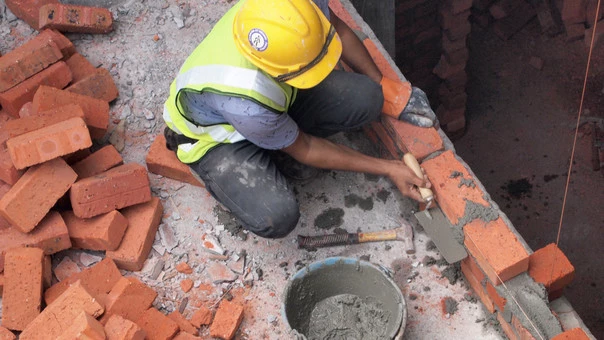
How to distinguish a good ceramic brick from a poor quality one?
- It is important to check that they have the seal of the company that manufactured them.
- Make sure there are no cracks.
- Orange should be both inside and out (for example, breaking bricks), but not excessively.
- The clay is responsible for the strength of the brick and the earth is responsible for giving it its color. So more red means more ground and therefore less resistance.
- Sound is very important. The sound when you hit the brick with the coin should be metallic.
- The surface of the brick should not have white spots, such as external elements called calcification, which form nitrates and destroy the integrity, and foreign bodies.
What type of ceramic brick?
There are various types of brick depending on the housing sector that is built.
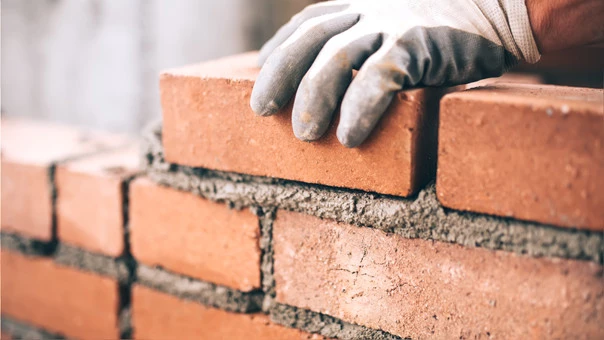
1) For load-bearing walls: main walls
The load-bearing walls are the main walls that support the entire weight of the building, the load of the roofs and the force of earthquakes. According to the Technical Standard E-030 for Earthquake Resistant Design and the Technical Standard for Masonry E-070, for seismic zones 2 (coast) and 3 (mountains), bricks with a maximum of 30% air or vacuum must be used, that is, the area of the holes does not exceed 30% of the area of the brick.
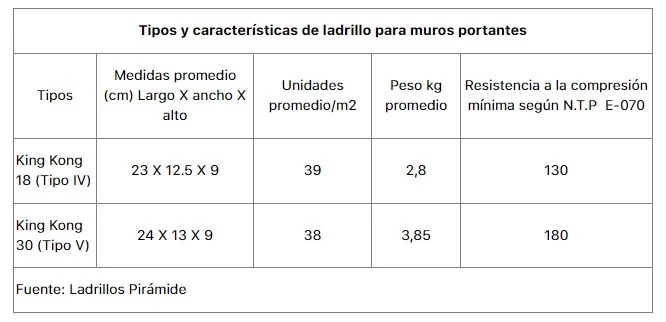
Therefore, type IV or type V King Kong brick is suitable for main walls (called “30” because it has 30% void).
Smooth ceramic bricks have an aesthetic function and serve to make non-plastered walls look uniform. While bricks with stripes make the job easier because they offer faster adhesion.
A load-bearing wall is the main wall that supports the entire weight of a building, roof loads, and seismic forces. According to the Technical Standard E-030 for Earthquake and Resistant Design and the Technical Standard for Masonry E-070, they must use up to 30% air or hollow brick. That is, the area of the hole should not exceed 30% of the area of the brick. Therefore, King Kong Type IV or V bricks (referred to as “30” for their 30% porosity) are suitable for main walls.
Smooth ceramic tiles have an aesthetic function and are used to smoothen patterned walls. The stripes make work easier as they provide a faster grip.
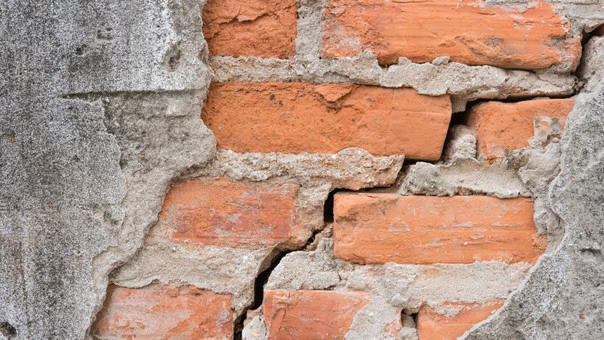
2) For partition walls: dividing walls
Walls that do not support the main load and only serve to separate rooms in the house are called “partitions” and can be removed safely.
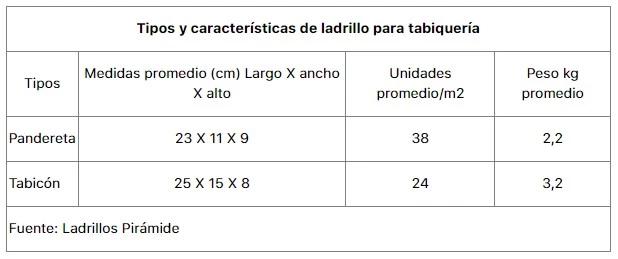
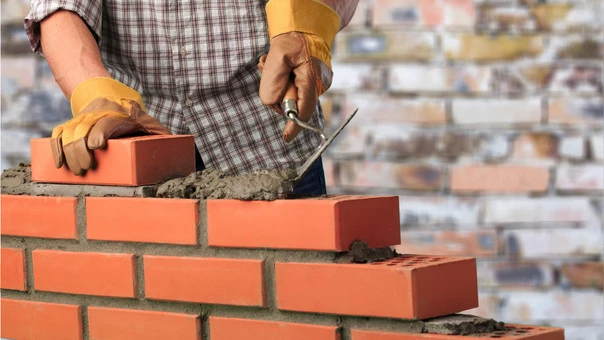
Tambourine bricks are most often used for this type of wall. This can be smooth or striped. A less common type that is also suitable for partitions is bulkhead brick. This, due to its design, provides a better gluing surface for Tarageo.
3) For roofs
The conventional holes are 15, but the holes are different depending on the surface of the roof. They are all the same size, they only differ in height. The one with hole 8 is 8 cm high, the one with hole 12 is 12 cm high, and so on.
Remember, the taller my building is, the more loads it will support; that's why the ceiling light at the top (first floor) has to be bigger.

4) For decorative finishes
For interior and exterior walls for architectural finishes, smooth tiles without plastering can be used. As for finishing the roof, pastry bricks are used as protection and coating. In addition, they absorb and dissipate the sun's temperature and insulate humidity.
Recommendations for building with ceramic brick
- Decide the type of soil to build. Based on this, select materials and construction systems. Please note that soft soil is more susceptible to ground movement than hard soil.
- Good material. Make sure they are of high quality and meet safety requirements.
- Have plans made by architects or engineers. It is important that the design of the space be carried out by experts in the field.
- Have professional and qualified personnel. Advice and supervision should be provided by a professional. Engineers are responsible for their work and foremen direct them in accordance with the planning and application of Peru's national building codes.

On bricks:
- Wet the bricks 24 hours before using. This way, the mixture will be able to hold the bricks better, making the structure more durable.
- The size of the joint should not exceed1.5cm. A joint is a joint between bricks where the cement mixture enters. According to the technical standards, the thickness of the horizontal and vertical joints should be between 1 and 1.5 cm.
Remember that if you don't know what type of brick to use to avoid risks in your home, use our tips about bricks as many times as necessary.
You can follow us on oursocial networksto see more interesting content.
Popular Content
How to make a rocket stove for outdoors
Cardboard Drawers Lined with Jeans
Ideas and Advantages of Window Grilles for the Home!
Latest Articles
How to make a refrigerator out of insulating material: Practical step-by-step guide
How to make a Kilim for the Home: Complete Step by Step Guide
How to protect ourselves from accidents in our workplace: Complete prevention and safety guide
Related Content
Build a coffee table with pallets!
How to make a light table to trace
How to remove scratches from all types of surfaces
10 original ideas with forks
Creative Home Decor Ideas to Transform Every Space
Refreshing your home starts with smart design choices that combine comfort, personality, and functionality. Whether you want to modernize a small apartment, upgrade outdoor areas, or create cozy rustic interiors, these trending ideas can completely change the atmosphere of your space.
Outdoor Spaces That Increase Style and Functionality
Outdoor living continues to dominate modern home trends. Homeowners are increasingly investing in practical entertainment zones inspired by these BBQ shed ideas, which create the perfect setup for gatherings and weekend cooking sessions.
First impressions also matter when designing exteriors. Elegant farm entrance gates design ideas help properties stand out while improving privacy and curb appeal.
Compact living solutions are also gaining popularity. These inspiring 16x40 shed house interior design ideas show how smaller spaces can still feel luxurious and functional.
To enhance patios and entryways, homeowners are adding stylish protection with these creative porch awning exterior DIY ideas that blend aesthetics with practicality.
Rustic and Cozy Interior Design Trends
Warm and natural interiors remain timeless. These charming rustic decor ideas combine wood textures, vintage accents, and earthy tones to create welcoming spaces.
Bedrooms are becoming more personalized with curated wall arrangements. Many homeowners use these stylish picture wall ideas for bedroom spaces to display memories and artwork creatively.
Textured wall treatments are another major trend. Installing a board and batten wall adds architectural character while keeping interiors elegant and modern.
Similarly, bold accent wall ideas can instantly transform plain rooms into eye-catching focal points without requiring a full renovation.
Smart Kitchen and Organization Inspiration
Functional kitchens are essential for modern homes. These practical kitchen wall cabinet ideas maximize storage while maintaining a clean and stylish appearance.
Organization also starts at the entrance. Well-designed mud room ideas help families keep shoes, coats, and daily essentials neatly arranged.
Colorful and Personalized Home Styling
Vibrant interiors are becoming increasingly popular thanks to playful dopamine decor ideas that use bright colors and joyful accessories to improve mood and energy.
Gallery walls also continue to evolve as a major decorative feature. These trendy gallery wall inspiration ideas offer creative ways to combine prints, photos, and statement art.
Young renters and new homeowners are especially embracing these stylish first apartment aesthetic ideas to create sophisticated interiors on a budget.
Finally, selecting the right shades can dramatically influence any room’s atmosphere. These modern trendy color ideas help homeowners choose palettes that feel fresh, elegant, and timeless.
Final Thoughts
From rustic charm and colorful interiors to outdoor entertaining areas and functional storage solutions, today’s home decor trends focus on creating spaces that feel both beautiful and livable. By combining smart layouts, modern textures, and personalized decorative elements, any home can become more stylish, comfortable, and inspiring.










